How to Remove Soap Scum Without Damaging Your Shower Surface
Soap scum is annoying. Surface damage is worse.
Before you reach for vinegar, baking soda, a scrub pad or a strong bathroom spray, confirm what the shower or tub surface actually is. A method that is reasonable for one material can be a poor choice for another. Acrylic can scratch. Natural stone can react badly to acidic cleaners. Treated shower glass may have care rules that differ from ordinary glass.
The practical order is simple: surface first, cleaner second.
If you know the material and any special treatment, use the matching section below. If you do not, do not guess from appearance alone. Start by finding the product or manufacturer information, and keep any interim cleaning very gentle.
On this page
- Before you clean: confirm the surface or treatment
- Quick surface-safe starting points
- How to clean soap scum from ordinary shower glass
- If the glass has a coating or treatment
- Acrylic tubs and shower surrounds: keep the cleaner and the tool non-abrasive
- Fiberglass, gelcoat and composite units: do not assume the finish
- Ceramic or porcelain tile and grout: treat the system, not just the tile face
- Natural stone: this is the no-acid branch
- If you do not know what the surface is
- How to slow the buildup from coming back
- The next cleaning step is sometimes identification
Before you clean: confirm the surface or treatment
A white tub surround may be acrylic, fiberglass, another composite material or a proprietary finish. A stone-look wall may be natural stone or a manufactured surface. A glass shower door may have a factory-applied treatment that changes its care instructions.
That is why visual appearance is not enough for a confident material diagnosis.
Look for the highest-quality information you already have: the product manual, model number, order confirmation, installer paperwork, manufacturer label or an authoritative product page. If the shower door has a named coating or treatment, treat that as part of the surface—not as a detail you can ignore.
When the manufacturer is known, its care instructions should control. Product-specific finishes can differ even within broad categories such as composite shower walls.
If you are trying a manufacturer-approved cleaner for the first time, follow the product and surface instructions, including any direction to test on an inconspicuous area. Do not leave cleaner sitting on a surface longer than the instructions allow.
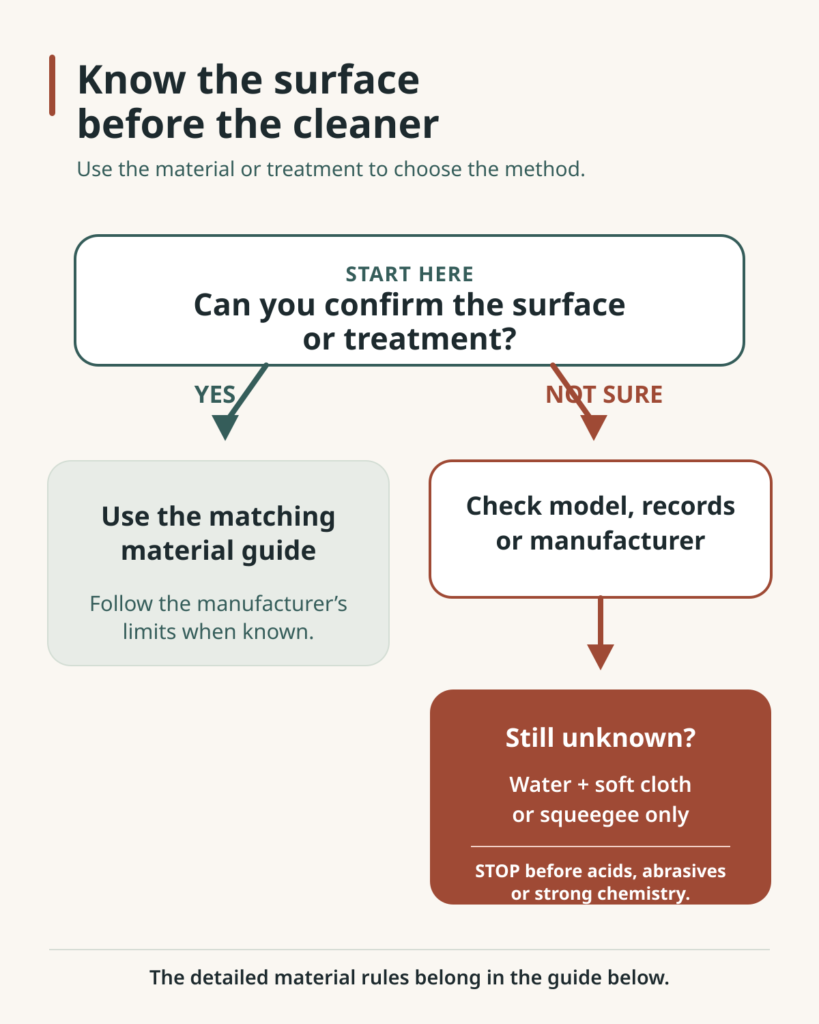
Surface Check
– Surface or treatment confirmed? Use the matching material guidance below and stay within the manufacturer’s limits.
– Not sure? Check the model, order records, product documentation or manufacturer information before escalating the cleaning method.
– Still unknown? Use water with a soft cloth or squeegee as a low-risk holding step, dry the surface, and stop before strong acids, abrasive powders or pads, sharp scraping or aggressive leave-on chemistry.
Quick surface-safe starting points
| Surface | Safer starting direction | Main caution |
|---|---|---|
| Ordinary shower glass | Mild detergent diluted in water; soft cloth or squeegee | Avoid abrasive brushes, sponges, cleaners and sharp tools |
| Coated or treated glass | Follow the coating maker; soft cloth + water or squeegee is a common regular-care direction for KOHLER/Sterling CleanCoat | Do not assume ordinary-glass methods apply; avoid abrasive cleaners |
| Acrylic | Soft cloth or sponge with a non-abrasive cleaner compatible with acrylic/plastic | Avoid scouring pads, steel wool, abrasive tools and incompatible chemicals |
| Fiberglass / gelcoat / composite | Warm water + non-abrasive liquid cleaner + soft cloth as a conservative starting point | Finish rules vary; do not assume abrasive tolerance |
| Ceramic / porcelain tile + grout | Use a cleaner suited to the tile-and-grout system; rinse thoroughly | Do not assume one cleaner fits every glaze, grout or adjoining material |
| Natural stone | Mild or neutral stone-safe care; use a non-acidic soap-scum remover appropriate for stone | Avoid vinegar, lemon and other acidic cleaners on acid-sensitive stone; abrasives may scratch |
| Unknown surface | Identify the product/material first; water + soft cloth or squeegee only as a holding step | Do not guess from appearance or jump to stronger chemistry |
The table is a starting map, not a substitute for product instructions. If your exact shower, tub, coating or cleaner has more restrictive guidance, follow it.
How to clean soap scum from ordinary shower glass
For ordinary shower glass with no special treatment known, KOHLER’s shower-door care guidance supports a mild, non-abrasive approach. For occasional cleaning, it recommends a mild detergent diluted in water. A soft cloth or squeegee keeps the tool side of the job gentle.
Avoid turning the glass into a scrubbing project. KOHLER advises against bristle brushes, abrasive sponges or cleaners, and sharp instruments on shower-door glass and anodized aluminum components. Cleaners also should not be left to soak on the surface; rinse or wipe them away after cleaning according to the product directions.
For routine maintenance, wiping or squeegeeing the glass dry after use can help reduce the water spots, soap deposits and lime buildup that make the next cleaning harder.
The useful distinction here is not “natural versus chemical.” It is compatible versus incompatible. A popular household recipe is not automatically a better choice than a mild product that the surface maker allows.
If the glass has a coating or treatment
Do not automatically treat coated shower glass like plain glass.
KOHLER’s CleanCoat, for example, is a factory-applied glass treatment designed to change how water and dirt interact with the surface. KOHLER and Sterling both advise against abrasive cleaners on CleanCoat-treated glass. Sterling’s regular-care guidance points to a soft cloth with water or a squeegee.
If you know the name of the coating, use that coating or shower-door manufacturer’s instructions. This is one of the places where a generic “best glass cleaner” answer can be too broad.
If you do not know whether the door has a treatment, check the original product information before using a more aggressive method. Do not escalate the cleaner or tool until you know what the treatment allows.
Acrylic tubs and shower surrounds: keep the cleaner and the tool non-abrasive
Acrylic care should stay non-abrasive.
Sterling/Kohler care guidance for acrylic baths calls for soft cleaning tools and non-abrasive methods. Delta similarly warns that some chemicals and cleaners can deteriorate acrylic and advises against products that are not suitable for acrylic or plastic.
A sensible starting point is a soft cloth or sponge with a non-abrasive cleaner that is compatible with acrylic. The cleaner label matters here. “Bathroom cleaner” is not the same thing as “approved for acrylic.”
Skip scouring pads, steel wool, abrasive brushes and scratch-causing tools. If the buildup does not release easily, the next step is not automatically a rougher pad. Check the tub or surround maker’s care instructions before escalating.
This is also why abrasive pastes should not be treated as universal shower advice. If a cleaner or method is not compatible with acrylic, do not use it as the default simply because the buildup is stubborn.
Fiberglass, gelcoat and composite units: do not assume the finish
Fiberglass and composite shower units deserve their own branch instead of being folded into acrylic.
Bestbath’s fiberglass shower and tub guidance uses liquid detergent, warm water and a soft clean cloth, and it warns against abrasive cleansers and metal tools. That supports a conservative starting method: warm water, a non-abrasive liquid cleaner and a soft cloth.
But the broader composite category is not uniform. Swan’s maintenance instructions show why product-level guidance matters: its Swanstone and Veritek lines have different care directions, and the Veritek guidance specifically warns against abrasive cleaners and scouring pads. A method allowed for one proprietary finish should not be generalized to another.
The practical conclusion is not that one of these instructions is “better.” It is that the finish controls the method.
If you know the exact fiberglass, gelcoat or composite product, use its care guide. If you do not, stay with the non-abrasive starting point and do not assume a rougher scrub is safe merely because another composite product allows it.
Ceramic or porcelain tile and grout: treat the system, not just the tile face
Glazed ceramic and porcelain tile can look durable enough to invite aggressive cleaning, but the tile-and-grout system still needs compatible care.
Daltile’s care guidance supports using an appropriate cleaner for the tile-and-grout system and thoroughly rinsing with fresh water so cleaning residue does not remain behind. Heavier soap-scum removal may call for a tile/grout cleaner suited to the installation.
The important limit is that tile guidance should not be stretched into stone guidance. A cleaner that is acceptable for one ceramic or porcelain installation is not automatically appropriate for natural stone or for every grout and finish combination.
If you know the tile manufacturer or grout system, check its care instructions before moving to a stronger cleaner. If you do not, choose a cleaner specifically compatible with the installed materials rather than relying on a one-recipe-fits-all bathroom formula.
Natural stone: this is the no-acid branch
Natural stone is where common household acid recipes can create a much bigger problem than soap scum.
The Natural Stone Institute recommends understanding the stone type before choosing care products. For soap scum, its guidance points to a non-acidic soap-scum remover appropriate for stone. Acidic products such as vinegar and lemon can dull or etch calcareous stone, and abrasive powders or creams may scratch some stones.
So if your shower contains marble, limestone, travertine or another natural stone that may be acid-sensitive, skip the vinegar shortcut. Use a stone-safe, non-acidic direction and follow the stone or product guidance.
In wet areas, the Institute also recommends using a squeegee to reduce soap-scum accumulation.
One separate chemistry rule is worth keeping clear: never mix ammonia and bleach. The Natural Stone Institute includes that warning in its stone-care guidance, and it is a good reason not to improvise cleaner combinations when one compatible product and a controlled method will do.
If you do not know what the surface is
If you cannot identify the surface confidently, treat unknown as the answer for now.
If you inherited the bathroom, lost the paperwork or cannot tell whether a surround is acrylic, fiberglass, stone-look composite or something else, do not make a material diagnosis from a photo or visual impression alone.
First, look for a model number, manufacturer name, invoice, installer record, order history or product documentation. If a shower door may have a coating, look for that information too.
While the surface is still unknown, keep the cleaning method deliberately limited. Water with a soft cloth or squeegee, followed by drying, is a reasonable holding step. Avoid escalating to strong acids, abrasive powders or pads, sharp scraping or aggressive leave-on chemistry until you know what the surface can tolerate.
For an expensive, unusual or potentially sensitive surface, stopping is a legitimate cleaning decision. The next useful step may be identifying the material, not buying a stronger cleaner.
How to slow the buildup from coming back
Several of the care guides support a simple maintenance step: remove water and residue from the surface after use where the material guidance calls for it.
For shower glass, KOHLER and Sterling recommend wiping or squeegeeing after use as part of regular care. The Natural Stone Institute also recommends a squeegee in wet stone areas to help minimize soap-scum accumulation.
That does not mean every surface needs the same homemade daily spray. Keep routine care material-specific. Rinse or wipe away cleaner as directed, dry surfaces where the manufacturer recommends it, and avoid creating a second maintenance problem with a product the finish was never meant to tolerate.
The goal is not a showroom-perfect shower after every use. It is to reduce the buildup you have to deal with later.
The next cleaning step is sometimes identification
If you know the surface, use that branch and stop at its limits. If the surface has a known coating or proprietary finish, let those instructions override generic advice.
If you do not know the surface, finding the product or material information is the next cleaning step—not reaching for a stronger cleaner.
That one decision helps avoid a bad tradeoff: removing the soap scum while creating a scratch, dull spot, etched patch or damaged finish that is much harder to undo.
Sources used for this guide
– KOHLER — shower glass care: https://www.kohler.com/en/support/how-to-use-kohler-cleaning-products/how-to-clean-glass-shower-doors
– KOHLER — CleanCoat glass treatment: https://assist.kohler.com/en/shower-doors/Shower-Door-CleanCoat-Glass-Treatment
– STERLING — bath and shower door care: https://sterling.kohler.com/en/support/care-and-cleaning/how-to-clean-and-care-bath-and-shower-doors
– STERLING/Kohler — acrylic bath care: https://sterling.kohler.com/en/support/care-and-cleaning/how-to-clean-and-care-acrylic-baths
– Delta — acrylic compatibility/care guidance: https://www.deltafaucet.com/node/267
– Daltile — ceramic and porcelain tile care: https://www.daltile.com/how-to/how-to-care-for-and-maintain-tile/how-to-care-for-and-maintain-ceramic-and-porcelain-tile
– Natural Stone Institute — natural stone care: https://www.naturalstoneinstitute.org/consumers/care/
– Bestbath — cleaning and maintenance: https://www.bestbath.com/cleaning-maintenance
– Swan — product maintenance: https://swanstone.com/services/product-maintenance