Clothes Storage Without a Dresser: Make a Small Bedroom Work Before You Buy More Furniture
A dresser can technically fit in a small bedroom and still make the room worse.
The body may fit against the wall, but the drawers open into the walking route. The bed becomes harder to reach. The closet door loses room to operate. Or the dresser solves one clothing problem while creating three everyday room problems.
So do not start by asking what can replace the dresser.
Start by asking what storage jobs the dresser was supposed to perform.
If you know which clothes need hanging, which need folded storage, which small items need a contained home and which seasonal items can move out of prime space, you can test the room you already have before adding more furniture.
On this page
- The quick answer: replace the dresser’s jobs, not its shape
- Sort the clothes by the storage job they actually need
- Measure what a dresser really costs the room
- Inventory the storage capacity already in the room
- Use closet space only where the clothing job fits
- Test under-bed storage by the real clearance, not the label
- Treat a freestanding clothes rack like furniture
- Use tall or wall storage only after the safety and installation test
- Let existing bedroom furniture do two jobs only when it truly can
- Six dresser-free layouts to test—not six universal recommendations
- Use this clothing-capacity-and-fit worksheet
- Worked example: the narrow dresser fits until the drawer opens
- Common mistakes when a small bedroom has no room for a dresser
- Before you buy any dresser alternative
- A useful clothes-storage setup solves the jobs without stealing the bedroom
The quick answer: replace the dresser’s jobs, not its shape
Treat the dresser as a bundle of storage jobs, not as a required bedroom object.
For this decision, separate clothing into four practical groups:
- Hang: items your household already chooses to keep on hangers.
- Fold: everyday folded clothing that needs usable shelf, drawer or contained storage.
- Small items: socks, underwear, accessories or other small categories that need containment.
- Seasonal / low frequency: clothing that does not need prime daily access.
Then use this sequence:
CLOTHING JOB → EXISTING CAPACITY → USABLE ROOM ZONE → DAILY ACCESS → PRODUCT BODY + OPERATION → SAFETY / INSTALLATION → KEEP / REPURPOSE / MOVE / BUY / SKIP
The goal is not to replace one dresser with five smaller organizers.
The goal is to give the clothes workable homes while keeping the bedroom easier to walk through, reach, open, clean and reset.
Sort the clothes by the storage job they actually need
Before measuring furniture, measure the problem.
A bedroom that seems short on dresser space may really have one overloaded category. Everyday folded clothes may be the issue while hanging clothes already fit comfortably. Or seasonal items may be occupying the easiest shelf and pushing daily clothing into piles.
Make a simple inventory:
- What clothing does the household currently hang?
- What clothing is folded and used often?
- What small items need drawers, bins or another contained home?
- What seasonal or low-frequency clothing can move out of prime daily storage?
This is an organization framework, not a universal fabric-care rule. Different households make different hanging and folding choices, and this article is not assigning care instructions to specific fabrics.
The useful question is whether each clothing job has enough practical capacity.
If all four categories are treated as one undifferentiated pile, almost any new organizer can look useful. Once the jobs are separated, it becomes easier to see whether the room actually needs a new storage product at all.
Measure what a dresser really costs the room
Furniture fit is not only width.
A dresser occupies its body footprint, but it also needs space to operate. Drawers move. People stand in front of them. Nearby doors still need to open. The bed still needs a usable route.
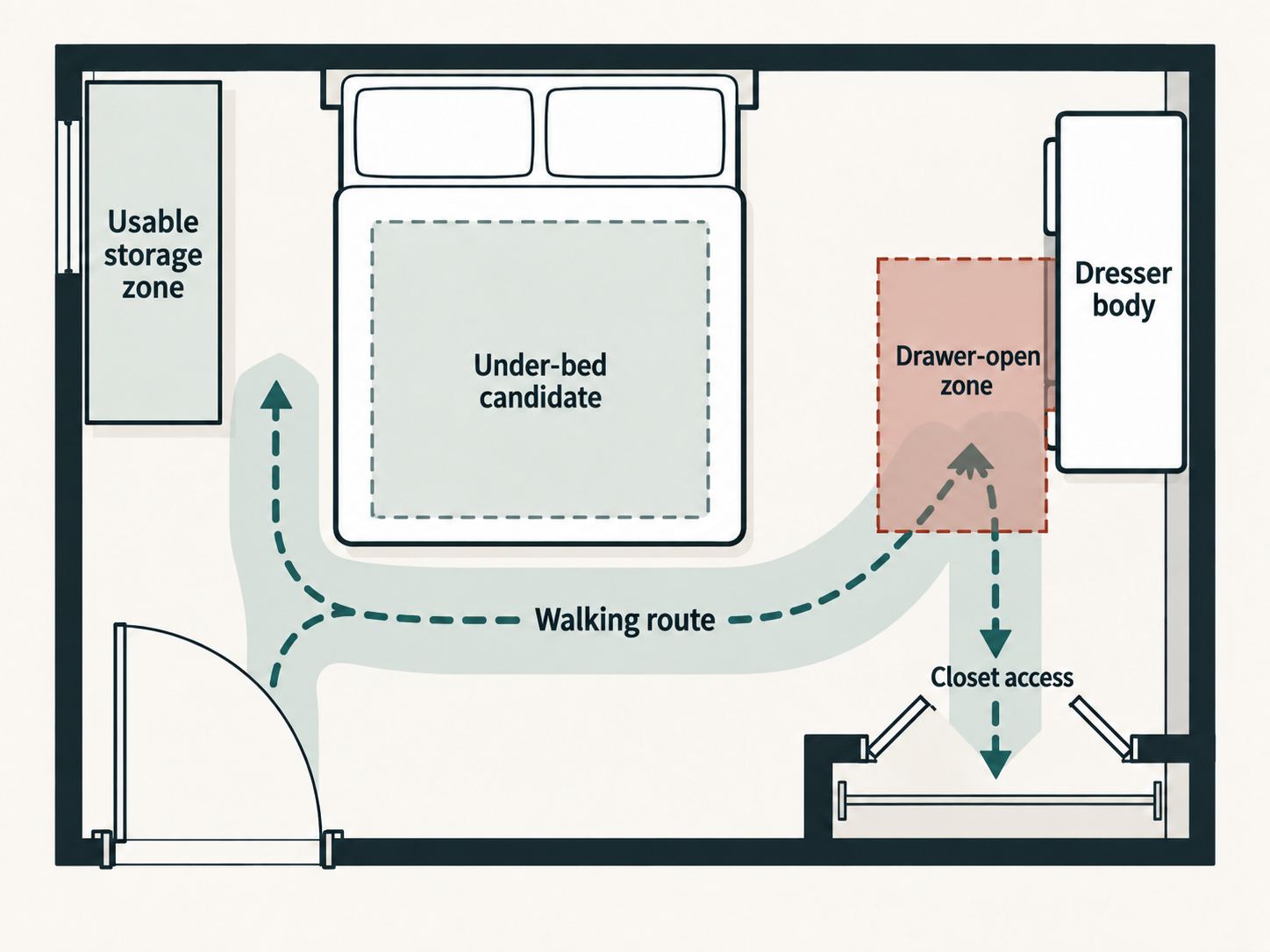
For any dresser or drawer unit, record:
- exterior width;
- exterior depth;
- full height;
- drawer pull-out or opening envelope;
- the walking route in front of it;
- bed access;
- bedroom-door swing;
- closet-door or closet-track conflict;
- any exact anchoring requirement.
A current IKEA STORKLINTA five-drawer dresser, model 205.592.85, is a useful example of why width alone is incomplete. IKEA currently lists it at 15 3/4 inches wide, 18 7/8 inches deep and 47 1/4 inches high, with a 10 7/8-inch drawer pull-out. IKEA also includes a wall-anchoring kit and says this model is designed to meet the U.S. Federal Stability Standard: https://www.ikea.com/us/en/p/storklinta-5-drawer-dresser-white-anchor-unlock-function-20559285/
Those measurements do not make the dresser a recommendation.
They show the test.
A 15 3/4-inch body may fit a narrow wall segment while the drawer-opening zone still conflicts with the bed or walking path. A product described as narrow can still be too deep, too tall, hard to operate or wrong for the available wall.
Measure the furniture while it is doing its job, not only while it is closed.
Inventory the storage capacity already in the room
Before adding another storage object, map the capacity the bedroom already owns.
Look at:
- closet hanging space;
- closet shelves or drawers;
- the shelf above a closet rod;
- usable under-bed clearance;
- existing nightstand or bedside drawers;
- an existing storage bench or bed drawer, if one is already part of the room;
- a genuinely usable wall or floor zone.
Then judge each area by use, not by theoretical volume.
A high shelf that is awkward to reach may be fine for low-frequency clothing but poor for everyday socks. A deep under-bed zone may exist physically but be difficult to pull from one side of the bed. A closet shelf may have open inches but still be needed for another repeated job.
Ask three questions about every candidate:
- Can the intended clothing category physically fit?
- Can the household reach it at the frequency required?
- Does using that capacity make another important bedroom job worse?
If existing capacity can absorb the clothing jobs without creating new friction, the bedroom may not need a dresser replacement at all.
This function-first approach is also consistent with our broader bedroom-refresh rule: identify the room problem before buying the product. See our guide to refreshing a bedroom without replacing usable furniture: https://reasonedhome.com/refresh-bedroom-without-replacing-furniture/
Use closet space only where the clothing job fits
A closet can take over some dresser work, but that trade is not free.
Adding hanging shelves, drawers or bins may consume the same closet envelope currently used for hanging garments. The right question is not whether an organizer fits inside the closet. It is whether the household can give up that hanging space.
IKEA’s SKUBB organizer with six compartments, model 403.000.49, is one concrete example. IKEA currently lists it at 13 3/4 inches wide, 17 3/4 inches deep and 49 1/4 inches high and describes it as an organizer that can hang in a wardrobe or on a freestanding rack for folded clothes: https://www.ikea.com/us/en/p/skubb-organizer-with-6-compartments-white-40300049/
That does not “create extra closet space.”
It changes the job of a real section of the closet from hanging storage to shelf-like folded storage.
Before using that type of solution, ask:
- Which hanging garments currently occupy that width?
- Can they move elsewhere without creating a new problem?
- Is the organizer easy enough to use every day?
- Does its depth work with the closet opening and doors?
- Are the items placed at practical access heights for the household?
If the bedroom already has too little hanging capacity, converting more hanging space may be the wrong solution even if the organizer itself fits.
Test under-bed storage by the real clearance, not the label
Under-bed space can be valuable in a small bedroom because it uses an area already occupied by the bed.
But “under-bed storage” is still a fit problem.
Measure:
- floor-to-frame clearance at the actual access point;
- bed legs, center supports or other obstructions;
- usable width and depth;
- how far the container must pull out;
- the route beside the bed;
- whether the item will be accessed daily or only occasionally.
IKEA’s SKUBB storage case, model 905.910.55, is currently listed at 17 inches wide, 20 3/4 inches deep and 7 1/2 inches high. IKEA describes it as suitable for a wardrobe or under the bed and says it protects clothes from dust and dirt while using mesh for ventilation: https://www.ikea.com/us/en/p/skubb-storage-case-white-90591055/
The important number here is not a universal under-bed clearance. It is the exact product height compared with the exact bed clearance.
If the bed has only 7 inches of usable clearance, a 7 1/2-inch case does not earn the space.
Also match access to frequency. Seasonal clothing may tolerate a less convenient under-bed location. Everyday clothing may not, especially if a container must be pulled into a narrow route every morning.
Do not count under-bed square footage unless the storage can actually enter, exit and be used.
Treat a freestanding clothes rack like furniture
A clothes rack can add hanging capacity without a built-in closet system, but it is not invisible storage.
It occupies floor area.
IKEA’s RIGGA clothes rack, model 502.316.30, is currently listed at 43 3/4 inches wide and 20 1/8 inches deep, with an adjustable height from 49 5/8 to 68 7/8 inches. IKEA lists a maximum load of 77 pounds: https://www.ikea.com/us/en/p/rigga-clothes-rack-white-50231630/
Again, those specifications are evidence, not a recommendation.
The rack has to pass the same room test as a dresser:
- Does the body fit?
- Does the bedroom route stay usable?
- Does the door still open?
- Can the household reach the clothes normally?
- Does the exact load stay within the manufacturer’s limit?
- Does the rack solve the actual clothing shortage?
That last question matters.
If the bedroom already has enough hanging capacity but lacks a good home for socks, underwear and folded shirts, a large clothes rack may add the wrong kind of storage.
A product can fit the room and still fail the job.
Use tall or wall storage only after the safety and installation test
A tall narrow drawer unit may look attractive because it uses less floor width.
That does not make it automatically safer or more suitable.
The U.S. Consumer Product Safety Commission has a mandatory federal rule for covered clothing storage units, codified at 16 CFR part 1261, and its current business guidance explains that covered units must meet stability and labeling requirements: https://www.cpsc.gov/Business–Manufacturing/Business-Education/Business-Guidance/Clothing-Storage-Units
For a household article, the practical takeaway is narrower:
Treat stability and anchoring instructions as part of the fit decision.
If the exact furniture says it must be anchored, the candidate wall and installation method have to support that requirement. Do not buy a tall unit for a wall where the required installation cannot be completed correctly.
Likewise, a wall-mounted storage product needs its exact installation instructions, wall requirements and load limits checked before it becomes a candidate.
Do not assume:
- narrow means stable;
- tall means space-efficient enough to ignore safety;
- wall-mounted means renter-safe;
- adhesive or no-drill means damage-free.
Those are product- and surface-specific claims.
Let existing bedroom furniture do two jobs only when it truly can
The easiest storage gain may come from furniture already taking up floor space.
A nightstand with unused drawers may be able to hold a small clothing category. A bed frame with existing drawers may handle low-frequency items. An existing bench with genuine enclosed storage may absorb seasonal accessories.
The rule is not “make every furniture piece multifunctional.”
The rule is:
Before buying another footprint, ask whether an existing footprint has unused, workable capacity.
A nightstand drawer that already serves medication, charging, glasses and reading items may not have spare capacity just because it is a drawer. A storage bench filled with bedding is not available for clothing unless those items have another sensible home.
Use real capacity, not imagined capacity.
If an existing piece can absorb one small clothing job without weakening its primary purpose, that is a useful gain. If not, leave it alone.
Six dresser-free layouts to test—not six universal recommendations
These are patterns to test against the same job, capacity and fit questions. They are not ranked.
1. Closet absorbs folded clothes; no new floor furniture
This can work when the closet has genuine spare shelf, drawer or convertible hanging capacity.
Test:
- hanging needs;
- shelf access;
- door/track clearance;
- daily reset.
Failure mode:
the closet becomes packed and the household loses needed hanging capacity.
2. Under-bed reserve + closet for daily clothes
This can work when low-frequency or seasonal items move under the bed while everyday clothing stays in easier storage.
Test:
- exact under-bed clearance;
- pull-out route;
- container dimensions;
- access frequency.
Failure mode:
the containers technically fit but are too awkward to retrieve.
3. Existing bedside drawers take small items
This can work when nightstand drawers are already present and genuinely underused.
Test:
- current bedside job;
- drawer dimensions;
- daily clothing category.
Failure mode:
the nightstand becomes an overflow drawer that stops working for bedside needs.
4. Hanging organizer converts some closet space to folded shelves
This can work when the household has enough hanging capacity to trade a real section for folded storage.
Test:
- organizer dimensions;
- displaced garments;
- closet depth/opening;
- reach.
Failure mode:
folded storage improves while hanging clothing loses a workable home.
5. Freestanding rack + contained folded storage
This can work when the bedroom needs hanging capacity and has a real floor zone for a rack.
Test:
- rack footprint;
- route;
- load;
- folded-storage plan.
Failure mode:
a large rack appears, but the original folded-clothing problem remains.
6. Verified-fit narrow drawer unit
This can work when the household truly needs drawer storage and the whole operating envelope passes.
Test:
- body dimensions;
- drawer pull-out;
- anchoring;
- bed/door/closet conflicts.
Failure mode:
the “narrow” unit fits when closed and blocks the route when opened.
The useful pattern is the one that solves the missing clothing jobs with the fewest new room conflicts.
Use this clothing-capacity-and-fit worksheet
Use one row for each clothing job or candidate storage zone.
| Clothing job | What must fit | Current home | Candidate zone | Usable width | Usable depth / clearance | Usable height | Daily access test | Product model | Exact product dimensions | Operation / pull-out | Anchoring / installation | Decision |
|---|---|---|---|---|---|---|---|---|---|---|---|---|
| Hanging | KEEP / REPURPOSE / BUY VERIFIED-FIT / SKIP | |||||||||||
| Folded everyday | KEEP / REPURPOSE / BUY VERIFIED-FIT / SKIP | |||||||||||
| Small items | KEEP / REPURPOSE / BUY VERIFIED-FIT / SKIP | |||||||||||
| Seasonal / low frequency | KEEP / MOVE SEASONAL / BUY VERIFIED-FIT / SKIP |
A product earns the room only after the clothing job and candidate zone are clear.
Worked example: the narrow dresser fits until the drawer opens
EXAMPLE — NOT A UNIVERSAL STANDARD AND NOT A TESTED HOUSEHOLD.
Imagine a small bedroom with a narrow wall segment beside the closet.
The available wall width is 18 inches. A hypothetical layout check makes IKEA’s current STORKLINTA 205.592.85 look promising because its listed width is 15 3/4 inches.
On width alone, it fits.
Now use the rest of the manufacturer dimensions.
The dresser is 18 7/8 inches deep, and IKEA lists a 10 7/8-inch drawer pull-out.
In this hypothetical room, the dresser body can sit against the wall, but an open drawer extends into the easiest route between the bed and closet. The wall can support the required anchoring, so installation itself is not the failure. The operating route is.
Now inventory the clothing jobs.
Suppose:
- hanging clothing already fits the closet;
- everyday folded clothing can use one deliberately converted closet section;
- socks and underwear fit unused bedside drawers;
- seasonal clothing fits verified under-bed containers.
The second plan does not “create” more room.
It assigns the clothing jobs across existing capacity so the bedroom can skip a new floor object.
In a different bedroom, that same dresser might pass every test and be the better choice.
The example is about the method, not the product verdict.
Common mistakes when a small bedroom has no room for a dresser
Replacing one bulky object before defining the storage jobs
A smaller cabinet is not automatically the answer. First decide whether the shortage is hanging, folded, small-item or seasonal storage.
Counting inaccessible space as storage capacity
A high shelf, deep bed zone or blocked closet corner only counts if the intended item can be retrieved at the required frequency.
Buying “small-space” furniture by width alone
Depth, drawer pull-out, door operation, height and anchoring still matter.
Using under-bed storage without measuring the bed
The product label does not know your frame clearance, support legs or pull-out route.
Adding a clothes rack when folded storage is the real shortage
Match storage type to the job.
Converting closet hanging space without accounting for displaced garments
A hanging organizer uses a real part of the closet envelope.
Assuming narrow or tall furniture is automatically safer
Use the exact manufacturer’s safety and anchoring requirements.
Letting seasonal clothes occupy prime daily storage
Low-frequency items may be able to move to a less convenient but still suitable zone.
Buying several “small” organizers without adding their footprints together
Three little products can create more route friction than one carefully chosen piece of furniture.
Treating the bedroom like a storage puzzle instead of a room
The bed, doors, routes and normal use remain primary jobs. Storage has to fit around them.
Before you buy any dresser alternative
Verify the exact product rather than the category name.
Check:
- model or variant;
- exterior width, depth and height;
- drawer, door or pull-out operation;
- exact usable interior capacity if you plan to rely on it;
- manufacturer load limit where relevant;
- wall anchoring or installation requirement;
- under-bed clearance if applicable;
- closet depth and hanging envelope if applicable;
- current availability;
- whether the product solves the assigned clothing job.
If a product is marketed as “narrow,” “small-space,” “under-bed,” “vertical” or “space-saving,” treat that as a prompt to measure, not proof of fit.
If a drawer unit fits the wall but blocks the bed route when open, it fails.
If an under-bed case fits the clearance but cannot be pulled out without moving furniture, it fails the access test.
If a rack fits but the household needed folded storage, it fails the job test.
And if the existing room already has enough usable capacity once seasonal and daily clothing are separated, buying nothing may be the correct outcome.
A useful clothes-storage setup solves the jobs without stealing the bedroom
A small bedroom does not need a dresser simply because bedrooms traditionally have dressers.
It needs practical homes for the clothing the household actually keeps there.
Start with the clothing jobs.
Then inventory the capacity already in the room.
Then measure the dresser or alternative while it is operating, not just while it is closed.
Protect the bed, the doors, the closet and the route.
If existing closet, under-bed and small-item storage can handle the jobs, skipping the dresser can be the complete solution.
If a verified-fit drawer unit genuinely solves an unmet need and passes its full operating and safety envelope, a dresser-type solution may still be right.
The room decides after the jobs and measurements are clear—not before.