How to Share a Coat Closet With Cleaning Supplies Without Making Either Job Worse
One small closet can end up doing the work of three rooms. Coats hang from the rod, a vacuum leans into the corner, a mop and broom share the floor, and a cleaning caddy lands wherever there is space left. When the closet is half empty, all of that can look workable. Once the coats are loaded and the tools have to come out in real life, the conflicts appear.
The useful question is not, “How many organizers can I fit in here?” It is, “Can these two storage jobs still work when the closet is loaded?”
For this planning method, treat a shared coat-and-cleaning closet as workable only when four things remain true at the same time: coats still hang normally, cleaning tools can be removed without unloading the closet, cleaning products are stored according to their labels and household safety needs, and the door and retrieval path stay usable.
That means the order matters. Measure and assign the jobs first. Buy organizers last.
On this page
- Quick answer: decide whether the closet can do both jobs before you buy organizers
- First, make sure this is a household storage closet
- Map the two jobs while they are loaded
- Protect the door and retrieval path
- Decide what deserves prime access
- Use the mixed-use closet worksheet before shopping
- Choose organizers only after the two jobs fit
- Example: one small closet, two jobs
- Reload the closet and test the system
- When the closet should stop doing both jobs
- Make the closet do fewer jobs, better
Quick answer: decide whether the closet can do both jobs before you buy organizers
Start by treating the closet as two overlapping storage systems.
The first system is the coat job: hanging garments, bags, hats, shoes or other entry items that need quick access.
The second is the cleaning job: a vacuum, mop, broom, duster, caddy, refill supplies or other household-cleaning items.
These jobs compete for different parts of the same closet. Coats occupy more than the width of a hanger. Bulky jackets project forward and downward. A vacuum needs floor area, but it also needs a clean path out of the closet. A broom or mop may fit vertically against a wall, but only if the handles do not interfere with the hanging clothes or the door.
So before you buy an over-door rack, shelf, hook system or vacuum mount, answer this:
Can both jobs still be used normally after the closet is fully loaded?
If the answer is no, the right fix is often to move one category elsewhere rather than add more hardware.
First, make sure this is a household storage closet
This article is about a normal household storage closet. If the closet contains a furnace, water heater, electrical equipment or other mechanical/service equipment, stop treating it as ordinary storage space.
Mechanical equipment can have manufacturer, service-access, ventilation and local-code requirements that generic organizing advice should not override. In that situation, follow the exact equipment instructions and applicable local requirements rather than using the closet plan below.
For a regular household storage closet, the next safety boundary is cleaning products.
The U.S. Consumer Product Safety Commission advises keeping household chemicals and cleaning supplies safely stored, keeping household chemicals in their original child-resistant containers, and using locked/out-of-reach storage where children can access them. CPSC also advises keeping laundry packets in their original containers and out of children’s sight and reach. CPSC poison-prevention guidance.
EPA guidance likewise emphasizes following the product label, keeping products in their original containers and storing them out of children’s reach. EPA label and child-safety guidance.
Those sources do not give one universal shelf height for every cleaner, and this article will not invent one. The product label and your household’s access needs come before convenience.
Map the two jobs while they are loaded
Empty-closet measurements are useful, but they are not enough. The shared system has to be measured with both jobs in mind.
The hanging-coat envelope
Start with the hanging area.
Measure the clear width of the rod or hanging zone. Then look at what actually hangs there during the busiest season, not just what happens to be there today.
A winter coat can project much farther into the closet than a light jacket. A shoulder bag hanging from the same rod can consume side space. Long coats can reach into the floor area you thought was available for a vacuum or caddy.
The key measurement is the loaded envelope: the space the garments occupy when they are hanging naturally.
You do not need to compress every coat into one narrow strip just to make a storage diagram work. If the clothes have to be crushed, pushed aside or lifted every time you remove the vacuum, the two jobs are already fighting each other.
The cleaning-tool envelope
Now map the cleaning tools.
Do not measure only the vacuum’s parked footprint. Measure the path you need to remove and return it.
The same applies to a mop, broom or long-handled duster. A tool may fit vertically against the wall but still fail if it has to swing through the hanging garments to come out.
Record:
- the floor footprint of the vacuum or cleaning caddy;
- the full height of long-handled tools;
- the direction each tool has to move for removal;
- any hose, handle or attachment that projects into another zone;
- whether a tool can be returned without moving coats, bags or shoes first.
A good cleaning-tool zone should be usable with one normal motion. If a tool needs three other things moved out of the way, the closet is storing it but not serving it.
The product-storage zone
Cleaning products need a zone of their own.
This is not mainly about making bottles look tidy. It is about keeping the products in their proper containers, following label instructions and placing them where the household can store them appropriately.
If children can access the closet, use the current CPSC guidance as a real constraint, not an afterthought.
Also keep leaking, wet or dirty cleaning equipment from pressing against coats. The practical issue is simple: garments should not become the surface that a damp mop head, dusty tool or cleaning bottle rubs against every time the closet opens.
That does not require a decorative bin system. It requires separation by job.
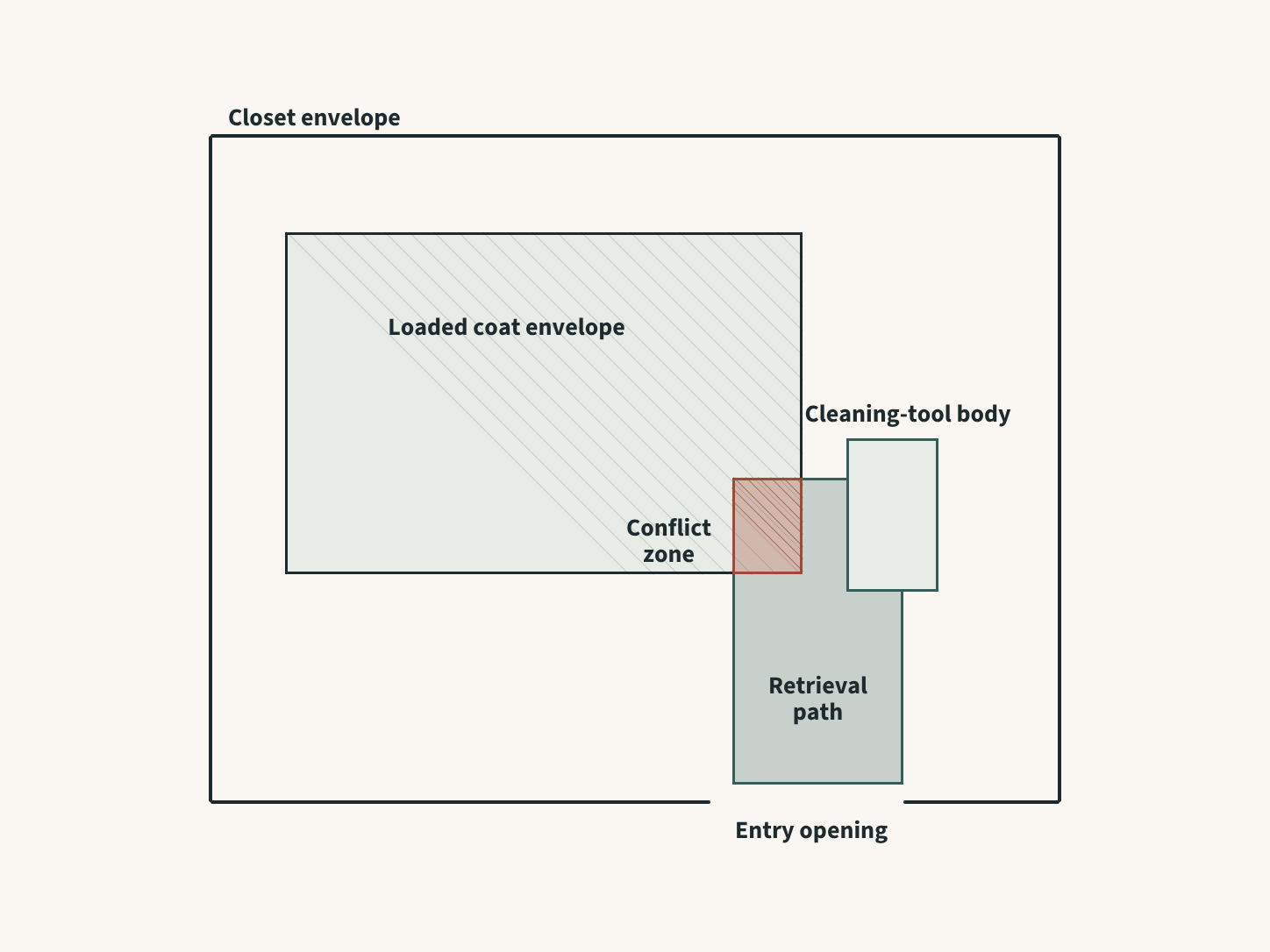
Protect the door and retrieval path
A closet is not functional if the door opens but the contents cannot be removed.
Check the door through its full normal motion. Then load the closet and test the route for the largest or most awkward item.
Watch for four common conflicts:
- coats or bags hanging into the doorway;
- a vacuum parked directly behind the door;
- an over-door organizer projecting into the hanging clothes;
- cleaning tools that have to sweep through the coat zone to come out.
The best test is physical and simple: open the closet, remove the item you use most often, return it, and close the door again.
If that motion requires unloading another zone, the plan is not finished.
Decide what deserves prime access
The most accessible space should go to the items that move most often.
That usually means daily coats near the easiest part of the rod and the most-used cleaning tool in a floor or wall zone that can be reached without disturbing the coat job.
Low-frequency items should not occupy prime real estate merely because they technically fit.
For example, a rarely used seasonal cleaning attachment may belong on a higher shelf or somewhere else entirely. A bulky spare tote may be better outside this closet if it blocks the vacuum every week. Extra paper goods may belong in reserve storage if they consume the only clear floor area.
The goal is not to make every item live in one place. The goal is to make the closet’s two important jobs easy to perform. For general coat-and-entry-item storage, see small coat closet organization.
Use the mixed-use closet worksheet before shopping
Use this worksheet before you buy anything.
| Zone | Clear width | Clear depth | Clear height | Current job | Loaded item projection | Access frequency | Safety / label constraint | Organizer candidate | Decision |
|---|---|---|---|---|---|---|---|---|---|
| Zone 1 | |||||||||
| Zone 2 | |||||||||
| Zone 3 | |||||||||
| Zone 4 |
Do the worksheet with the closet loaded as realistically as possible. If you measure only an empty shelf or an empty rod, you will miss the conflicts created by coats, bags, tool handles and the products themselves.
The last column matters most: the decision may be KEEP, MOVE, RELOCATE ITEM, ADD ORGANIZER, or DO NOT USE THIS ZONE.
Not every empty-looking zone deserves storage.
Choose organizers only after the two jobs fit
Once the two jobs fit, choose the smallest organizer that solves the remaining problem.
Over-door storage
Best for: small, light categories that can use the back of the door without interfering with the door swing or the hanging clothes.
Measure first: door thickness, trim, hinge movement, organizer depth and the loaded contents.
Skip if: the organizer hits the coats, stops the door from closing normally or puts cleaning products where your household cannot store them appropriately.
Wall-mounted long-tool holders
Best for: brooms, mops, dusters or other long tools that need a predictable return spot.
Measure first: handle diameter, tool height, wall area, mounting surface and the space needed to pull the tool free.
Skip if: the tool has to swing through the coat zone, the mount’s load or fastening requirements are not verified, or the location interferes with the door.
Shallow shelves
Best for: backup supplies or contained items that can live above or beside the hanging zone without making daily access worse.
Measure first: clear shelf width, depth and height; the real size of the items; and the room needed to lift them in and out.
Skip if: the shelf becomes a dumping zone, pushes products into an unsafe location or forces frequently used items above comfortable access.
A contained cleaning caddy
Best for: a small set of products that are used together and can be carried to the room being cleaned.
Measure first: the loaded caddy footprint and the shelf or floor zone where it will live.
Skip if: the caddy blocks the vacuum, sits under long garments, contains products that need a different storage condition or becomes so heavy that it is awkward to move.
A vacuum mount
A wall-mounted vacuum setup can free floor area, but it is not a generic recommendation.
Use one only after the exact vacuum and mount instructions are verified, including the mounting surface and any charging requirements. If those details are not verified, keep the article at the planning level and do not make a load, installation or charging claim.
Example: one small closet, two jobs
Example only — not a real household result.
Imagine a small hall closet with a full rod of coats and one open floor corner. Empty, that floor corner looks large enough for a vacuum and cleaning caddy.
Once the coats are loaded, several jackets hang into that corner. The vacuum still fits, but removing it means pushing the coats aside and lifting the caddy first.
The first instinct might be to add more hooks.
A better sequence is to remove the lowest-frequency item from the floor zone, give the vacuum a direct exit path, move the caddy to a contained shelf or door zone that passes the safety check, and leave the hanging garments enough space to hang normally.
Nothing about that example depends on a universal closet width. The lesson is the relationship among the loaded jobs.
The same closet could produce a different answer with shorter coats, a cordless stick vacuum, a different door swing or a household that cannot safely store cleaning products on the door.
Reload the closet and test the system
Before you call the closet finished, reload it and test the system as it will actually be used.
Check that:
- the door opens and closes normally;
- coats hang without being trapped behind tools;
- the vacuum, mop or broom can be removed without unloading the closet;
- cleaning products remain in their proper containers and follow their label/storage requirements;
- child-access controls are in place where relevant;
- daily items remain the easiest to reach;
- an organizer does not create a new collision with the door, rod or hanging garments;
- no product load, mount or charging assumption is being made without exact manufacturer proof.
If the closet only works when it is half empty, the system is not complete.
When the closet should stop doing both jobs
A shared closet should stop doing both jobs when one job prevents the other from working normally.
Move a category elsewhere when:
- safe cleaning-product storage cannot be maintained;
- the closet contains mechanical/service equipment that makes generic storage advice inappropriate;
- long-handled tools cannot be removed without disturbing coats;
- the vacuum blocks the door or the coat zone;
- hanging garments constantly contact damp or dirty cleaning equipment;
- the only way to fit everything is to overload shelves, hooks or door organizers;
- the closet becomes harder to reset after every use.
That is not wasted space. It is a better assignment of space.
Make the closet do fewer jobs, better
A calm closet is not the closet with the highest item count. It is the closet where the jobs still work.
Start with the loaded coats. Map the cleaning tools. Apply the cleaning-product storage rules. Protect the door and the retrieval path. Then add only the organizer that solves a specific remaining problem.
If two storage jobs can share the closet without making either one worse, keep them together.
If they cannot, give the closet fewer jobs—and make the jobs it keeps easier to use.