How to Keep Family Laundry From Piling Up in Different Rooms: A Shared-Household System
Family laundry can look like a washing problem when the bigger problem is often everything that happens before and after the machine.
Dirty clothes start in bedrooms, bathrooms and other places where people change. Towels may come from another room. A basket gets filled upstairs but the washer is downstairs. Someone means to bring it over later. Clean clothes make the trip back in another basket, then stop on a bed, chair or floor because the return step was never really assigned.
That is why adding more hampers or copying someone else’s laundry schedule does not automatically fix the mess. A household can own plenty of baskets and still have unclear handoffs.
A better starting point is to map the route: where laundry enters the system, who or what moves it forward, where exceptions are handled, and how clean items return to the right room. Once that route makes sense, the schedule becomes much easier to choose.
The goal is not to make every family do laundry the same way. It is to give the household a system that more than one person can understand and repeat.
On this page
- Start with where laundry actually lands
- Decide whether each room really needs its own collection point
- Give every hamper or basket a transfer rule
- Keep special-care items out of the ordinary flow when their instructions require it
- Sort where it creates the least repeated handling
- Build the clean-return route before you buy more baskets
- Share the work without making one person the permanent collector
- Fix the step people keep skipping
- Quick decision table: where should this laundry step live?
- A seven-step setup for the household
- A family laundry system is a route, not a pile of baskets
Start with where laundry actually lands
Before buying a sorter or assigning wash days, walk through the home and look at where washable items repeatedly appear.
That may include:
– a bedroom floor near the closet;
– a bathroom hamper;
– a chair where work clothes come off;
– a child’s room;
– a utility or entry area after sports or outdoor activities;
– a kitchen or laundry area for household linens.
You are not trying to prove that every one of those places deserves its own hamper. You are identifying the real entry points into the laundry system.
A repeated pile is useful information. If clothes keep landing beside the same chair or outside the same bathroom, ask what the person is doing at that moment and where the nearest practical collection point is. The answer may be a hamper in that room. It may be a shared basket just outside it. It may be moving an existing container closer to the behavior that already happens.
The important part is to work from the household you actually have instead of the household layout a routine article assumes you have.
Decide whether each room really needs its own collection point
There are three simple ways to organize dirty-laundry collection, and none is automatically better than the others.
Room-level collection
Each repeated drop point has its own hamper or basket.
This can make sense when people change in separate rooms, when bedrooms are far from the laundry area, or when keeping each person’s clothes together makes the return trip easier.
The tradeoff is that every extra collection point creates another handoff. Someone still has to notice it, move it and return the empty container.
Shared-zone collection
Two or more nearby rooms use one collection point.
This can reduce the number of baskets to manage when a hallway, bathroom or other shared area is genuinely convenient for the people using it.
The tradeoff is distance. A shared hamper that looks tidy but is several steps away from where clothes actually come off may never become the household’s real habit.
Hybrid collection
Some rooms keep their own hamper while other low-volume areas feed a shared point.
This is often the most realistic model when the home has different floors, different changing habits or different amounts of laundry coming from each room.
Do not choose by basket count. Choose by repeated drop point and reliable transfer.
A collection point earns its place when it catches a real stream of laundry and has a clear way to move forward.
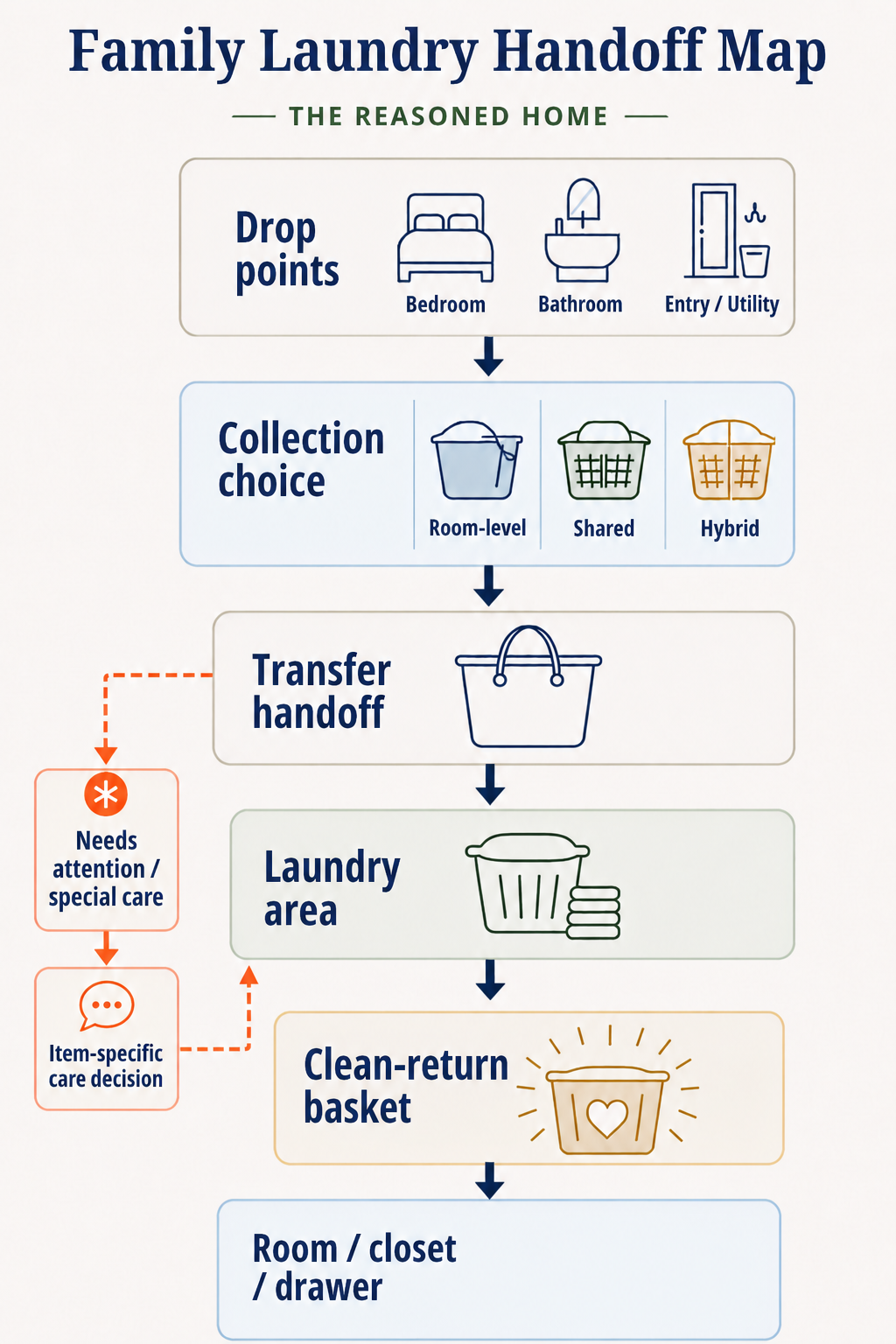
Give every hamper or basket a transfer rule
“Someone will bring it to the laundry room” is not a transfer rule.
If no one knows when a basket moves or who notices that it needs to move, the collection point can become another place where laundry waits indefinitely.
For each active hamper, answer one question:
What moves this basket to the next step?
That could be:
– the person or room owner moves it at an agreed point;
– one household member makes a collection round during the normal laundry window;
– the basket moves when it reaches a practical full point for that household;
– a shared bathroom or linen basket moves on the day that category is normally washed.
The trigger does not need to be complicated. It just needs to be visible enough that two people would give the same answer if you asked what happens next.
Do not treat the container itself as a measurement. One full hamper does not automatically equal one washer load. Basket sizes, appliance capacities, item types and care instructions differ. The container is a collection tool, not a universal load gauge.
If a basket repeatedly becomes too awkward to carry before anyone moves it, the answer may be an earlier transfer trigger, a smaller container or a different collection location. If it stays nearly empty while clothes pile elsewhere, the problem may be placement rather than capacity.
Keep special-care items out of the ordinary flow when their instructions require it
A family system should simplify ordinary laundry without making it easier to wash the wrong item the wrong way.
The Federal Trade Commission’s Care Labeling Rule requires covered garments to carry regular care instructions and warnings. In practical household terms, that means the actual garment label should control when an item needs different washing, drying or other care from the ordinary load.
You do not need a complicated special-care station in every bedroom. A small “needs attention” place near the laundry decision point may be enough for items that need to be checked before they enter a normal load.
That might include an item whose label calls for different care, something that needs stain treatment, or another piece that the household already knows should not be dropped into the next ordinary load without a check.
Keep the exception path simple. If five labeled bins create more confusion than one small needs-attention spot, the bins have become the problem.
The household workflow can decide where an item waits. The garment label and the exact product or appliance instructions still decide how that item is actually cleaned.
Sort where it creates the least repeated handling
Some families sort laundry at the bedroom hamper. Others carry mixed laundry to the laundry area and sort there. Some keep only one recurring category separate, such as towels or a special-care group.
All three approaches can be reasonable.
The American Cleaning Institute’s current Laundry Basics guidance treats sorting, fabric-care instructions, washing, drying, folding and putting away as parts of the ordinary laundry process. That does not mean every household needs the same number of sorting bins or the same sorting location.
Ask where sorting will actually be done correctly and consistently.
If everyone already understands a simple two- or three-way collection system and uses it, presorting may reduce handling later. If family members regularly ignore the labels on a multi-bin sorter, one ordinary collection point with sorting near the machine may be simpler.
Do not create complexity just because a sorter has more compartments.
The household system should make the right action easier, but it should not override the care instructions on the actual item.
If the washing machine sits inside a tight closet, keep the household handoff system separate from the physical storage-fit problem. Our laundry closet storage guide helps you check appliance doors, hoses, vents and reachable space before adding shelves, hampers or carts around the machines.
Build the clean-return route before you buy more baskets
Many laundry systems are designed only in one direction: bedroom to hamper, hamper to washer, washer to dryer.
Then the clean clothes stop.
A complete system needs a return route too.
Decide:
– how clean items will be grouped for return;
– whether grouping by person or room makes putting away easier;
– which basket or container carries clean items back;
– where that basket lands;
– who empties it into the actual closet, drawer, shelf or other chosen storage place.
A separate clean-return basket can be useful when one container otherwise keeps switching jobs and no one knows whether its contents are dirty, clean or waiting to be put away. But you do not need a separate basket for every theoretical step.
The test is whether the route is clear.
If clean laundry always lands on the same bed and has to be moved again at bedtime, that is a handoff worth redesigning. If a return basket sits in a hallway for days, decide whether the landing point is wrong or whether the put-away responsibility is unclear.
The washer finishing is not the end of the system. The item is finished when it has reached the place where the household intends to keep it.
Share the work without making one person the permanent collector
A shared-household system should make responsibility visible enough that laundry does not depend on one person noticing every full hamper in the home.
That does not require a complicated chore chart.
Depending on the household, one person may move their own hamper, another may carry the shared bathroom basket, someone else may return clean clothes to bedrooms, and another person may put away their own items.
If children participate, keep the tasks appropriate to the child and the household rather than relying on a universal age rule. Carrying a small basket, pairing clean socks or putting away familiar items may be different decisions from handling detergent or operating an appliance.
The U.S. Consumer Product Safety Commission specifically advises that children should not handle laundry detergent packets and that those packets should be kept in their original containers out of children’s sight and reach.
So “everyone helps” does not mean everyone handles every part of the process.
The useful question is: which safe, realistic handoff can this person own?
That keeps responsibility distributed without turning the system into a safety shortcut.
Fix the step people keep skipping
A household routine is allowed to reveal that your first setup was not the right fit.
If clothes keep landing beside the hamper, move or simplify the collection point.
If no one uses a three-section sorter correctly, reduce the number of decisions or move sorting closer to the machine.
If a full basket sits upstairs for days, change the transfer trigger or assign the handoff more clearly.
If clean clothes return to the bedroom but never reach the closet, the return route needs another look.
Do not respond to every failure by buying another organizer.
The repeated bypass is the information you need. A system that requires constant rescue from one person is not yet a shared system.
Quick decision table: where should this laundry step live?
| Decision | Keep it near the room if… | Move it toward the laundry area if… | Simplify / change it if… |
|---|---|---|---|
| Dirty-clothes collection | Laundry repeatedly starts there and the container gets moved reliably | A nearby shared point is genuinely easier for several rooms | Clothes consistently land somewhere else |
| Towels / household linens | The category is generated in one clear room and collection is easy | Several rooms feed the same wash category | Multiple small bins create extra transfer work |
| Special-care / needs-attention | The household reliably remembers a small local exception spot | The care decision is usually made near the washer | Items disappear into a complicated exception system |
| Sorting | People use the sorting choices correctly at the drop point | Sorting is easier once laundry reaches the machine area | Compartments are ignored or create repeated re-sorting |
| Transfer to laundry area | The room owner can move the container at a clear trigger | One collection round works better for the household | Baskets wait because no one owns the handoff |
| Clean return | Grouping by room/person makes return simple | A central fold/return point is actually used | Clean baskets become long-term storage |
| Put-away | The person/room can finish the last step reliably | A shared put-away routine works better | Clean items repeatedly stop before reaching storage |
A seven-step setup for the household
1. Walk the real drop points
Notice where dirty clothing and household laundry actually appear during normal life.
2. Choose room-level, shared or hybrid collection
Give a basket only to the locations that have a repeated job.
3. Give every collection point a transfer owner or trigger
Decide who moves it or what event moves it forward.
4. Create one simple exception path
Keep items that need different care visible enough to be checked before they enter an ordinary load.
5. Decide where sorting happens
Use the location that reduces repeated handling and still respects the actual care instructions.
6. Define the clean-return route
Choose how clean items get grouped, transported, landed and put away.
7. Watch one normal laundry cycle and simplify what gets bypassed
This is not a test that proves the system will work forever. It is a practical observation: where did laundry stall, where did people ignore the setup, and which step created unnecessary handling?
Change that step before adding more containers.
A family laundry system is a route, not a pile of baskets
The most useful laundry setup is not the one with the most labeled bins or the most impressive schedule.
It is the one where the household can answer a few simple questions: Where does dirty laundry go? What moves it to the machine? Which items need a different path? How do clean clothes get back? Who owns each handoff?
Once those answers are clear, the home can use room-level hampers, a shared collection point, a hybrid system or a schedule that fits the actual household.
If a step keeps failing, simplify it. If a basket has no clear job, remove it. If clean laundry keeps stalling on the return trip, fix that route before buying another sorter.
The goal is not to make laundry disappear. It is to stop the system from depending on one person remembering every unfinished handoff in the house.