Artificial Christmas Tree Storage: Measure the Tree, Route and Space Before You Buy a Bag
A storage bag can be large enough for your artificial Christmas tree and still be wrong for your home.
Tree-storage products are often described by the height of the tree they can hold. That is useful, but it does not answer the three questions that matter once the season is over: how large the tree becomes when packed, whether that package can travel to your storage area, and whether the final storage space can actually accept it.
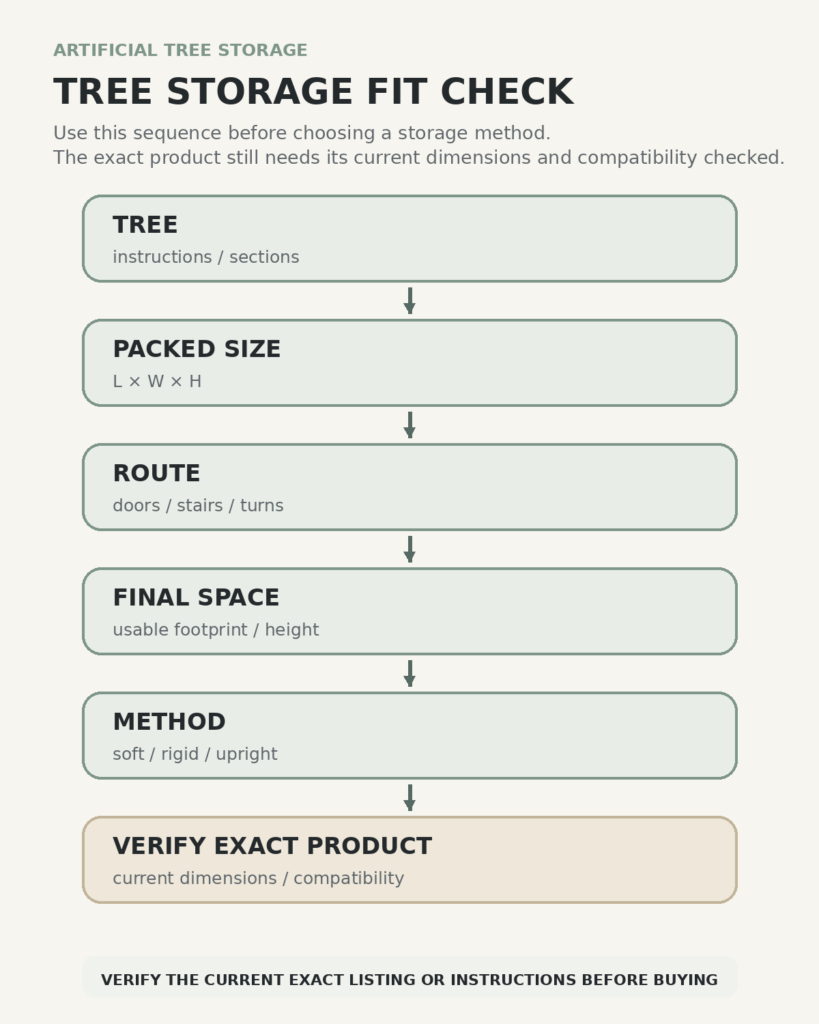
Before you buy a bag, box or rolling system, work through this sequence:
TREE → PACKED SIZE → ROUTE → FINAL SPACE → METHOD → VERIFY THE EXACT PRODUCT
That turns tree storage from a vague “will this fit a 7-foot tree?” question into a practical fit decision.
On this page
- Start with the tree’s own storage instructions
- Measure what the tree becomes when it is packed
- Measure the route before the storage space
- Measure the usable storage footprint
- Compare the three main storage directions
- Run a simple fit check before you buy
- Which storage method should you investigate first?
- Store the tree according to the instructions you actually have
- What to verify on the product page before checkout
- The short version
Start with the tree’s own storage instructions
Before measuring storage containers, check how your tree is meant to come apart.
Artificial trees do not all store the same way. Some conventional trees separate into several trunk sections. Some systems have their own stands, bags or rolling storage method. Balsam Hill, for example, tells owners of traditional trees to remove decorations, unplug lighting, compress foliage carefully and disassemble the tree by section before storage. Its Flip Tree system uses a different process in which the base flips on a wheeled stand and the sections are stored according to that model’s instructions.
The practical rule is simple: do not let a generic storage article override the instructions for the tree you actually own.
Write down:
- the tree height and model, if known;
- how many sections it has;
- whether the manufacturer requires disassembly;
- the longest section once the tree is taken apart; and
- whether the tree came with a storage bag, box or model-specific storage system.
If you do not know the model, the instruction manual, order history or manufacturer site is a better starting point than assuming every hinged artificial tree compresses the same way.
Measure what the tree becomes when it is packed
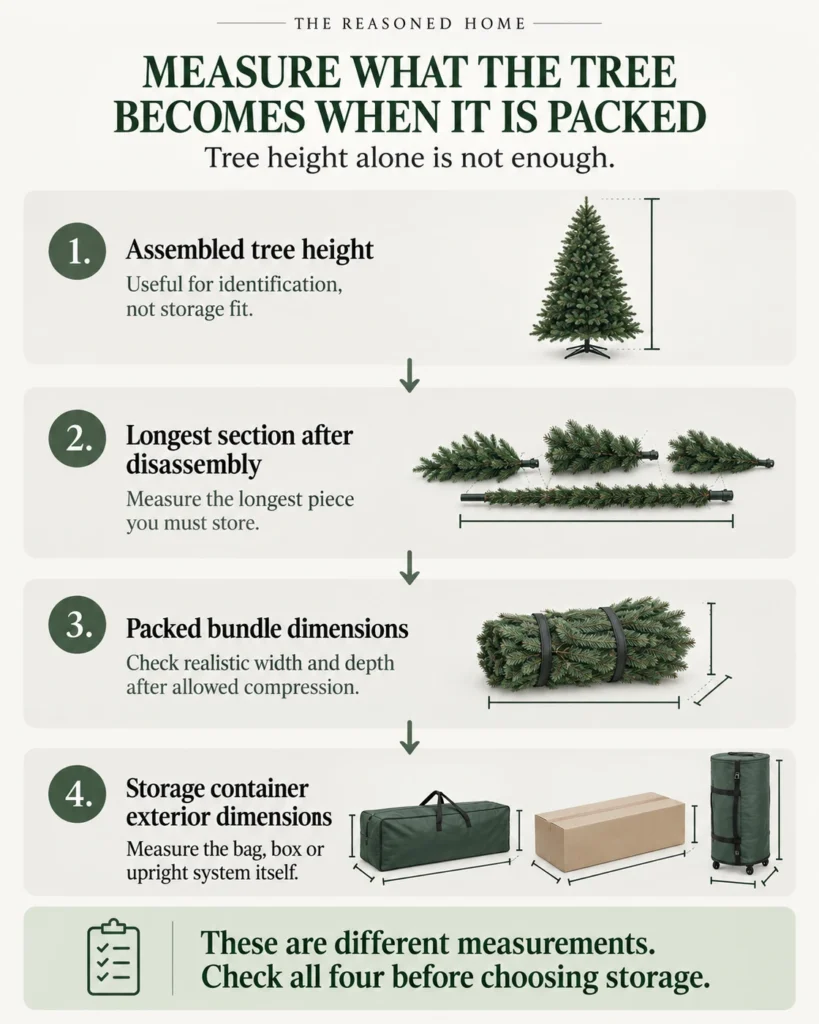
A 7-foot tree is not a 7-foot package.
Once the tree is disassembled, the longest trunk section may be much shorter than the assembled height. At the same time, compressed branches can make the packed bundle wider or deeper than you expect.
Use manufacturer-provided packed dimensions when they exist. If they do not, measure the actual sections you have. Record the longest section and the realistic width and depth of the bundle after folding or compressing the branches only as the manufacturer allows.
Do not invent a compression percentage. A full tree, slim tree and heavily hinged tree can behave very differently when packed.
For shopping, the dimensions that matter are the exterior dimensions of the storage container, not only the tree-height label in the product description.
That distinction matters because current products use very different shapes. One Balsam Hill Rolling Multipurpose bag is listed at 60 × 25 × 31 inches, while its Standard Upright Rolling bag is listed at 60 × 23.5 × 22 inches. Those are manufacturer-published dimensions for two specific products, not universal standards.
Measure the route before the storage space
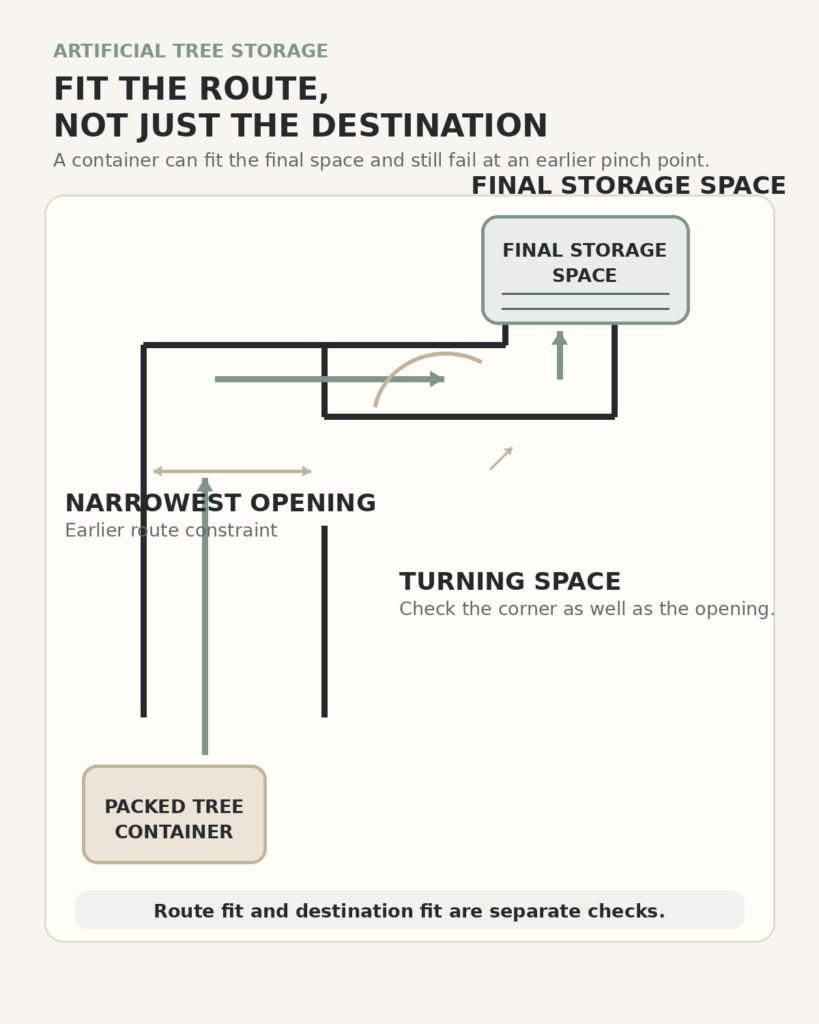
A container can fit perfectly in a basement, closet or garage bay and still be a poor choice because it cannot get there comfortably.
Walk the full route you will use after the tree is packed. Measure the narrowest or most awkward points:
- doorway openings;
- hallway width;
- stair width;
- stair landings and turns;
- low ceilings or sloped sections;
- thresholds;
- closet openings; and
- the space needed to rotate a long or rigid container.
Also think about how the container will move. Wheels can be useful on a level route, but the important question is whether those wheels help on your actual path. Stairs, tall thresholds and tight turns can change the job completely.
Do not rely on a simple diagonal calculation for a difficult stair turn. Real routes are three-dimensional, and handles, wheels and your own grip position take space too. If the fit looks close, a cardboard rectangle, taped floor outline or another simple mock-up can tell you more than guessing from a product photo.
Destination fit and route fit are two separate tests. You need both.
Measure the usable storage footprint
Now measure the place where the tree will live for most of the year.
Use the space you can actually occupy, not the nominal dimensions of the closet, shelf or garage wall. If your final storage area is a reach-in closet, our guide to measuring usable closet depth shows how doors, tracks, trim and other obstructions can reduce the space you can actually use.
Record usable:
- length;
- width or depth; and
- height.
Then subtract the things that reduce the real opening: shelf lips, trim, door tracks, pipes, sloped ceilings, nearby bins, baseboards or the room needed to open a lid or zipper.
If you plan to store the tree on a shelf, measure the shelf opening as well as the shelf surface. A rigid box that technically fits the shelf depth is not useful if you cannot lift or slide it through the opening.
For the storage environment itself, follow the tree manufacturer’s guidance. Balsam Hill and National Tree Company both direct owners toward cool, dry storage for artificial trees.
That is manufacturer-backed storage guidance. It is not the same as claiming a particular bag or box is waterproof, mold-proof or pest-proof.
Compare the three main storage directions
There is no single format that is automatically best. The right direction depends on your tree, route and final storage geometry.
| Method | What must fit | Route issue to check | Final-space issue to check | Verify before buying |
|---|---|---|---|---|
| Horizontal soft or rolling bag | Longest tree section plus the realistic filled bundle/container exterior | A long package must clear doors, halls and turns; wheels help only on route segments where they can actually roll | Enough usable floor or shelf length plus room to place and remove the bag | Exact exterior dimensions, tree capacity/compatibility, required disassembly, wheel/handle details and opening geometry |
| Rigid wheeled box | Tree sections must fit the box; fixed exterior geometry stays fixed | Full box length/width/height must clear doors, stairs, landings and turns | Shelf or floor footprint must fit, including lid and handling clearance | Internal/usable fit when published, exterior dimensions, tree/section compatibility, wheel location and lid access |
| Upright or rolling system | The exact model’s required packed/disassembled configuration | The vertical package, base and wheels must clear the complete route; stairs and thresholds may change the job | Vertical height, floor footprint and nearby shelf/door/garage-door clearance | Exact dimensions, required disassembly, compatible/incompatible tree models and whether the rolling path works in the real home |
For scale, Balsam Hill’s current Rolling Multipurpose example is listed at 60 × 25 × 31 inches and includes wheels. Its Upright Rolling system is a useful reminder that a product called “upright” may still require disassembly: the manufacturer lists the Standard version at 60 × 23.5 × 22 inches and the Large at 60 × 25 × 31.5 inches, with product-specific compatibility rules.
A rigid box does not need a named shopping example to make the decision useful. Its advantage for measurement is fixed exterior geometry. The reader still needs to verify that the tree sections fit inside, that the closed box clears the route, and that there is enough room to place, remove and open it in the final storage area.
Run a simple fit check before you buy
For the final storage space, use this screening calculation on each axis:
usable storage dimension − candidate exterior dimension = nominal fit margin
If the result is positive, the container is smaller than the available space on that axis. If it is zero or negative, it does not nominally fit in that orientation.
Repeat the check for length, width and height.
This is only a screening tool. It does not tell you how much extra room you need for your hands, a zipper, wheels, a lid, a shelf lip or the act of lifting the container into place. There is no one clearance number that fits every storage setup.
Run the logic twice:
- Final-space check: Will the packed container occupy the destination?
- Route check: Can the packed container actually reach the destination?
A pass on one does not create a pass on the other.
Which storage method should you investigate first?
Use this as a starting direction, not a universal ranking.
If you have a long, low storage area and a fairly open route, investigate a horizontal bag or rolling soft container first.
If you have a rectangular shelf or floor bay and want predictable exterior geometry, investigate a rigid storage box, provided the tree sections fit.
If you have usable vertical space and a compatible rolling system, investigate an upright or rolling format.
If your route includes tight stairs or sharp turns, smaller section-level packages may be more practical to investigate than one very large container.
If you do not know how the tree is supposed to be disassembled, stop shopping and find the tree instructions first.
That final step can save you from solving the wrong problem. A storage system that looks efficient online may be unusable if the tree requires a different breakdown method or the package cannot reach the storage area.
Store the tree according to the instructions you actually have
Once you choose a method, the packing process should stay simple and specific.
Remove ornaments. Unplug built-in lighting. Disassemble or fold the tree according to its manufacturer instructions. Compress branches only as directed. Use the storage container as intended. Then move the packed tree to the storage location you already measured.
Balsam Hill advises storing artificial trees in a cool, dry location, and National Tree Company gives similar guidance.
Avoid adding promises the evidence does not support. A bag is not automatically waterproof because it has a zipper. A rigid box is not automatically pest-proof because it has a lid. A rolling system does not automatically eliminate lifting because it has wheels.
Those are separate product claims that should be verified for the exact product before they appear in an article.
What to verify on the product page before checkout
Before buying any tree-storage system, confirm the current listing for:
- exterior dimensions;
- stated tree height or model compatibility;
- whether tree disassembly is required;
- wheel and handle design;
- opening, lid or zipper arrangement if it affects access;
- manufacturer storage instructions; and
- any exclusions for particular tree models.
If you are shopping months after you measured, verify the specs again. Products and model details can change.
The short version
Do not choose artificial Christmas tree storage by tree height alone.
Measure the tree after disassembly, measure the packed container, measure the route, and measure the usable storage space. Then choose the method that fits those constraints and verify the exact product instructions before buying.
A storage bag can fit the tree and still be wrong for the route. A box can fit the garage and still be too large for the stairs. An upright system can sound convenient and still require disassembly.
The calmer solution is the one that fits the whole job—not just the tree.