Linen Closet Shelf Spacing: Measure What You Store Before You Add More Shelves
A linen closet can look as if it has plenty of room and still waste a surprising amount of usable space. One shelf may have a tall empty gap above a short towel stack. Another may be so tight that a basket has to be tipped sideways to get it out.
That does not mean every shelf should be moved to the same “ideal” distance apart.
The useful shelf spacing is the spacing that fits the job assigned to that shelf, gives you enough room to put the item in and take it out, and still works with the shelf system you actually have.
Before you buy bins, risers or another shelf, measure the closet and the things you intend to store in it.
On this page
- The quick answer: space the shelves for what you actually store
- Measure the closet before you move anything
- Measure the storage job, not a generic towel
- Add the clearance the item needs to come out
- Decide what each shelf should do
- Five decisions after you measure
- Adjustable shelves and fixed shelves need different plans
- Use this shelf-by-shelf worksheet
- Worked example: why equal spacing is not always useful
- Mistakes that create a bad shelf layout
- Before you buy organizers
- If the real problem is that you have no linen closet
- The useful gap is the one that works
The quick answer: space the shelves for what you actually store
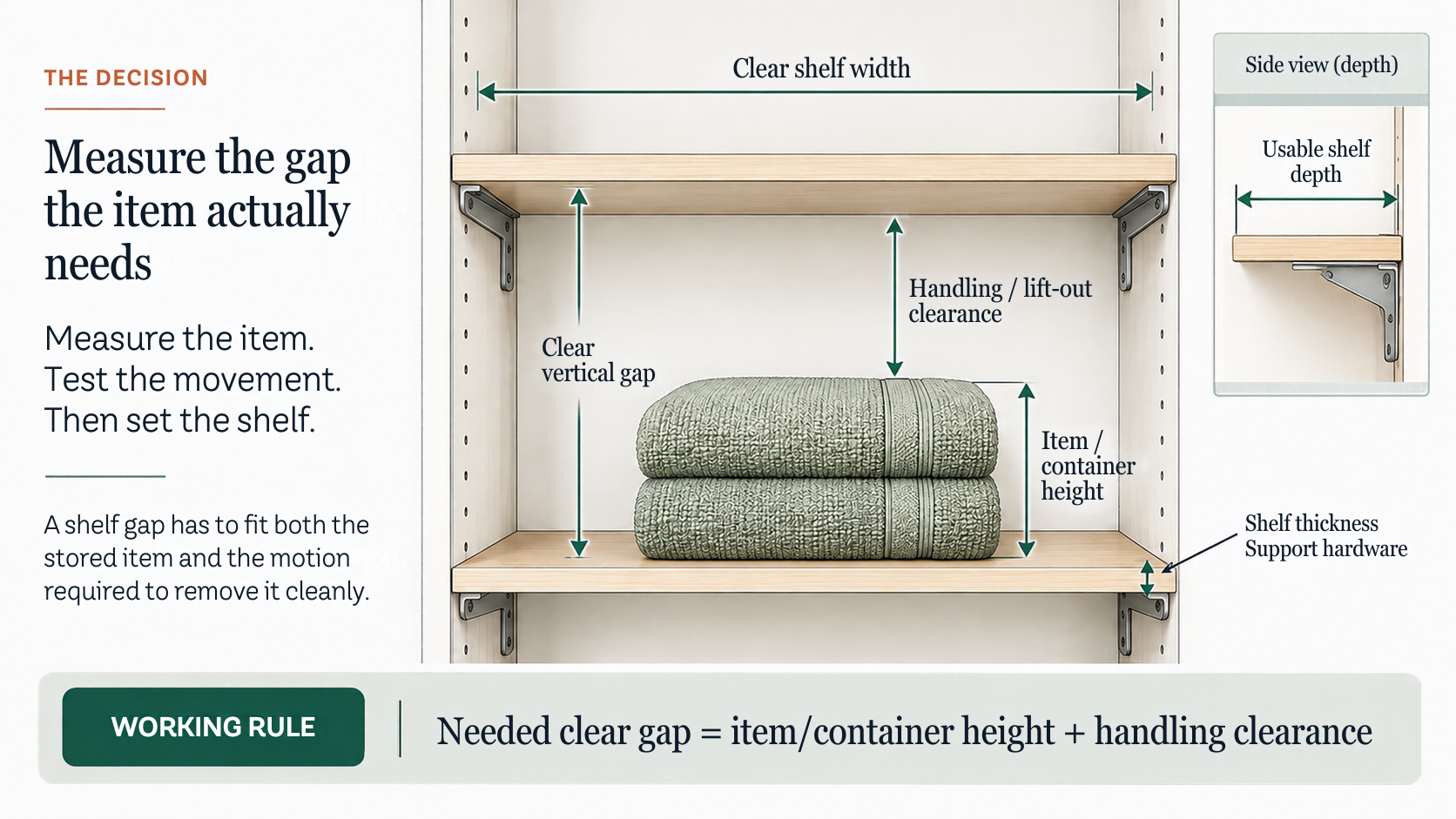
Start with the clear vertical gap between one shelf and the shelf above it. Then compare that gap with the actual height of the towel stack, sheet bundle, bin, paper-goods package or bulky linen that needs to live there.
Do not stop at the item height.
A container that technically fits in a gap may still be frustrating if you cannot lift it over the shelf lip, tilt it by the handle or pull it forward without hitting the shelf above. A folded stack needs enough room for your hand and for the top item to come out without dragging against the shelf above it.
A practical way to think about the problem is:
Needed clear gap = measured item or container height + the clearance needed to put it in and take it out
That extra clearance is not a universal number. Test it with the actual item.
This is also different from the structural spacing required by your shelving hardware. If your closet uses adjustable tracks, brackets or another manufactured system, follow the exact manufacturer instructions for the system itself.
Measure the closet before you move anything
You do not need to empty the entire closet to understand the layout. Clear enough of each shelf to measure safely and write down the numbers before you start changing positions.
For every shelf, record:
- the clear shelf width;
- the usable depth;
- the clear vertical gap to the shelf above;
- whether the shelf is fixed or designed to be adjustable;
- any bracket, track or support that limits where the shelf can move;
- whether the door or opening reduces usable access;
- and whether a container has to lift or tilt before it can come out.
Measure the usable space, not just the rough closet opening.
A deep closet can still have a shallow usable shelf. A wide shelf can lose useful width to brackets or trim. A basket can fit the shelf surface and still fail because its handle cannot clear the shelf above.
Measure the storage job, not a generic towel
The next step is to measure the way your household actually stores each category.
If bath towels are folded into one stack, measure that stack. If sheet sets are bundled together, measure the bundle. If toiletries live in a bin, measure the outside of the bin rather than estimating the bottles inside it.
Useful categories might include:
- bath towels;
- hand towels and washcloths;
- sheet sets;
- spare pillowcases;
- toiletries;
- toilet paper or tissues;
- cleaning cloths;
- first-aid or household-care supplies;
- spare blankets;
- guest linens;
- baskets or bins already in use.
The point is not to force all of these into the linen closet. The point is to see which jobs genuinely fit.
If a bulky item needs a very tall opening but is used only occasionally, it may be more efficient to move that item elsewhere than to make every shelf match its height.
Add the clearance the item needs to come out
A common measuring mistake is to compare the height of the object with the height of the gap and call it finished.
Try removing the item instead.
For a folded stack, place your hand where you normally grab the top towel or sheet bundle. Lift it the way you would during ordinary use. Notice how much space the movement needs.
For a bin, pull it forward. If the bin has a lip or handle, check whether it has to rise before it clears the shelf edge. If it must tilt, make sure the top corner still clears the shelf above.
If you have to scrape, crush, twist or partially unload the container every time you use it, the gap is not really usable even if the container technically fits.
This physical test is more useful than copying a shelf-spacing number from somebody else’s closet.
Decide what each shelf should do
Once you have the measurements, give each shelf one main job.
That does not mean one product or one label per shelf. It means the shelf should have a clear reason to exist.
For example, one shelf might hold everyday bath towels. Another might hold sheet sets. A lower section might handle a larger basket or bulky household supply. The exact arrangement depends on what your household owns and reaches for.
Try to avoid making one unusually tall category determine the spacing of the entire closet.
If four shelves could work with shorter gaps and one bulky item needs much more room, compare two possibilities:
- give that item one intentionally taller shelf; or
- move the item to a better storage location.
The second option is often overlooked because the closet has historically been “where linens go.” The better question is whether the item earns the space it uses.
Five decisions after you measure
After you record the shelf gaps and the stored-item heights, each shelf should lead to one of five decisions.
1. Keep the gap
If the shelf already fits its job and the items are easy to retrieve, leave it alone.
Not every visible gap is wasted space. Sometimes the extra room is what lets a basket lift out cleanly or keeps a folded stack easy to use.
2. Move an adjustable shelf
If your shelving system is designed to be adjustable, a shelf may be able to move closer to the stored item.
Check the exact system instructions before changing anything. The positions available, bracket design and support requirements depend on the hardware.
3. Add a compatible shelf
An additional shelf can be useful when a large vertical gap is serving two short categories poorly.
But “there is room for another shelf” is not enough. The shelf, supports, wall and existing system must be compatible with the change. Follow the manufacturer instructions for the exact system rather than improvising from a generic layout.
4. Use a shelf riser
A freestanding riser can divide a tall opening without changing the closet hardware.
It still has to fit.
Measure the riser’s exterior width, depth and height. Then check the new openings above and below it. Make sure both levels remain easy to reach and that the stored item can still be removed.
A riser that creates two technically usable layers but makes both awkward is not an improvement.
5. Move the item elsewhere
Sometimes the best shelf-spacing decision is to stop storing the item in the linen closet.
A bulky comforter, oversized package or rarely used object may consume an entire vertical zone that could serve several daily-use categories better.
Moving it is not a failure of organization. It is a space-allocation decision.
Adjustable shelves and fixed shelves need different plans
If your closet has adjustable shelves, start by identifying the exact system.
Track-and-bracket systems, pin-supported shelves and modular closet systems do not all work the same way. Some can be repositioned easily. Others have specific support requirements or limited adjustment points.
If the shelves are fixed, do not assume they can simply be moved.
Removing and reinstalling a fixed shelf can involve wall structure, anchors, cleats, trim and load considerations. At that point, the article’s job is to help you decide whether changing the layout is worthwhile. The installation itself should follow the exact hardware instructions or qualified help when appropriate.
Manufacturer-specific hardware note: If you plan to move or add shelving, use the instructions for the exact system you own. Examples of adjustable-system guidance include ClosetMaid ShelfTrack installation support and Rubbermaid adjustable closet systems. These sources govern their own hardware and installation requirements; they are not universal linen-closet shelf-spacing standards.
Use this shelf-by-shelf worksheet
A simple worksheet prevents you from buying organizers before the layout problem is understood.
| Shelf | Width | Depth | Current clear gap | Stored job | Item/container height | Handling test | Decision |
|---|---|---|---|---|---|---|---|
| 1 | |||||||
| 2 | |||||||
| 3 | |||||||
| 4 | |||||||
| 5 |
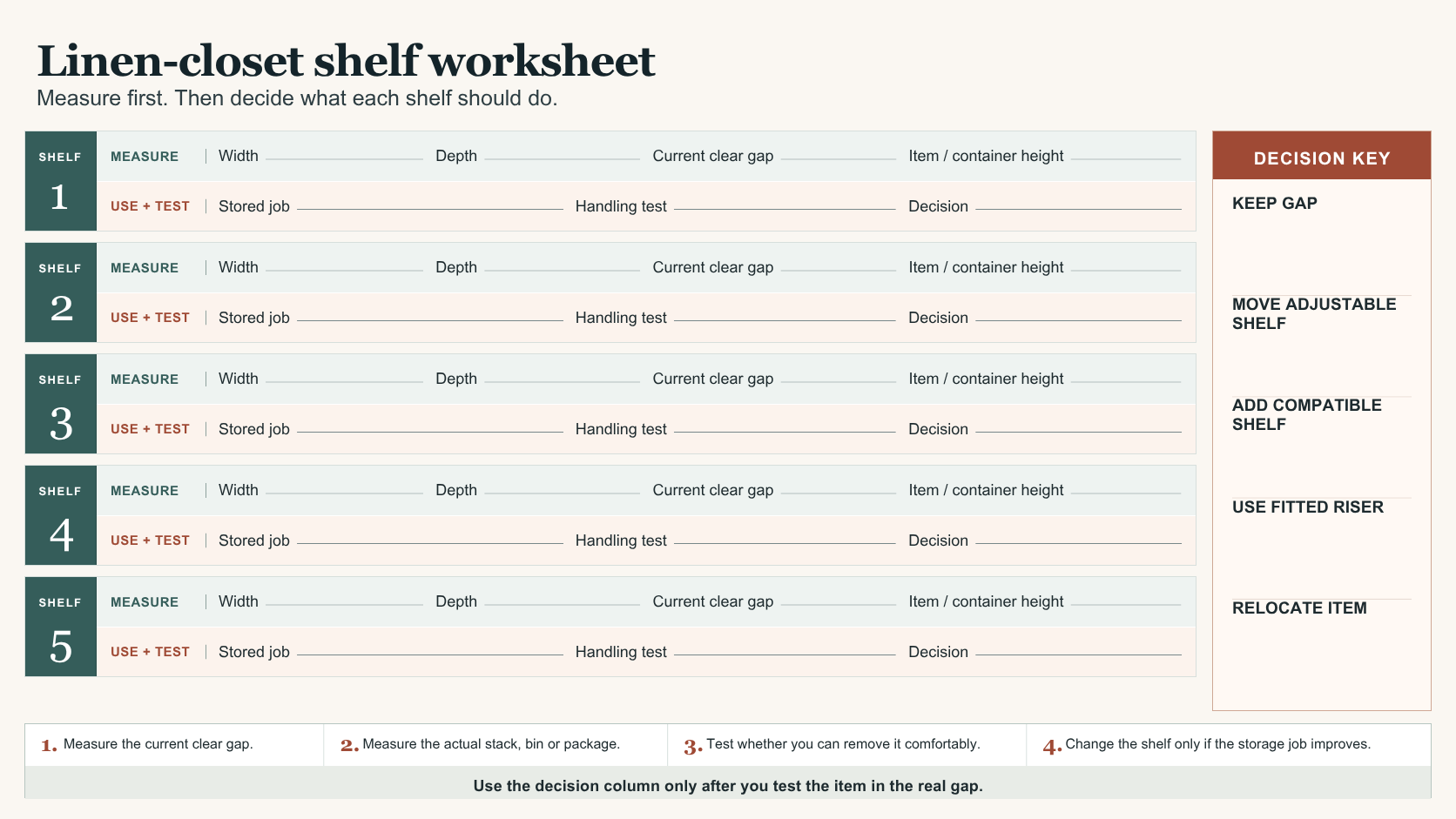
The handling-test column matters.
Write what actually happens: “slides out easily,” “must tilt,” “hand hits shelf,” “stack collapses,” or “extra room is useful.”
Those notes often make the decision more obvious than the dimensions alone.
Worked example: why equal spacing is not always useful
EXAMPLE CALCULATION — NOT A UNIVERSAL STANDARD AND NOT A TESTED HOUSEHOLD
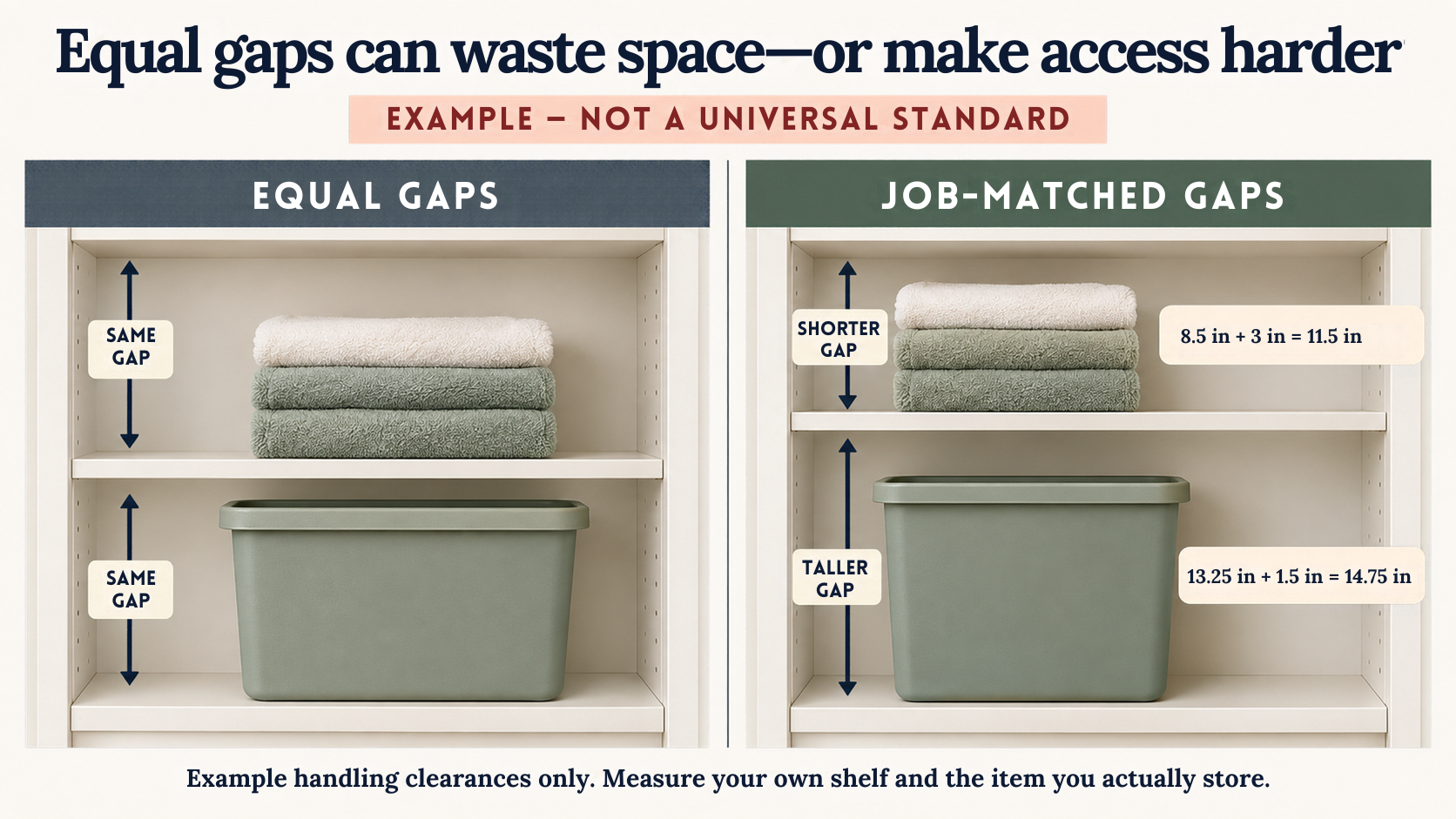
Imagine one shelf has a clear vertical gap of 15 inches.
The folded towel stack assigned to that shelf measures 8.5 inches high. For illustration, assign 3 inches of handling clearance to the towel stack in this example.
For that example:
8.5-inch stack + 3-inch example handling clearance = 11.5 inches of working height.
The existing 15-inch gap therefore has 3.5 inches that this specific towel job does not need.
For the shelf below, suppose the bin measures 13.25 inches high and the example assigns 1.5 inches of handling clearance for lifting and pulling it forward.
13.25-inch bin + 1.5-inch example handling clearance = 14.75 inches.
Those two shelves do not want the same gap.
The lesson is not that 11.5 inches or 14.75 inches is the “right” spacing. The lesson is that the correct gap changes with the actual storage job.
Mistakes that create a bad shelf layout
Copying one number across every shelf
Uniform spacing looks orderly on paper, but the items on the shelves are not uniform.
Measure the jobs before you decide the gaps.
Measuring the closet but not the container
A shelf may be wide and deep enough for a bin but too short for the handle to clear.
Measure the object that will actually be used.
Forgetting removal space
Fit is not complete until the item can come out.
A bin that must be emptied before it can be removed does not have enough usable clearance.
Buying risers before checking the new gaps
A riser consumes height of its own.
Measure what remains above and below it before buying.
Treating support spacing as storage spacing
Manufacturer instructions may specify where structural standards, supports or brackets belong. That is different from deciding the vertical clear gap between shelves for towels, sheets or bins.
Follow both: the manufacturer’s structural rules and your own storage-fit measurements.
Moving hardware without checking the system
An adjustable-looking shelf is not permission to improvise.
Identify the system and use its instructions.
Keeping a bulky category in the closet because it has always lived there
If one item forces the entire layout to work badly, reconsider the storage location.
Before you buy organizers
Do the shelf-spacing work first.
Then, if an organizer still solves a real problem, verify the exact product rather than shopping by category alone.
Check:
- exterior width;
- exterior depth;
- exterior height;
- how the item is removed;
- installation method;
- compatibility with the shelf or closet system;
- and any published load or capacity information that actually matters to the use.
Then compare those specifications with the measurements in your worksheet.
A product earns a place only if it improves the job without creating a new access problem.
If the real problem is that you have no linen closet
Shelf spacing cannot solve a storage location that does not exist.
If your bathroom has no linen closet at all, start with the available storage zones and what should stay in the bathroom versus move elsewhere. See Bathroom Storage Without a Linen Closet: What to Keep, Move and Add for that different problem.
The useful gap is the one that works
A linen closet does not need perfectly even shelves.
It needs shelves that fit the things you actually store, leave enough room to retrieve them, and work with the shelving system already in the house.
Measure the closet. Measure the storage job. Test the movement.
Then decide which gaps deserve to stay and which ones are worth changing.