Small Coat Closet Organization: Measure What Fits Before You Add Organizers
A small coat closet can be packed and still fail at the jobs you need it to do.
You open the door for one jacket and a bag falls forward. Shoes live on the floor, but the longest coats hang into them. A basket fits on the top shelf, yet returning anything to it takes enough effort that gloves and hats start collecting somewhere else.
That does not automatically mean you need more organizers.
The first question is simpler: What jobs does this closet need to repeat well?
For an entryway coat closet, that may be current-season outerwear, a few pairs of frequently used shoes, daily bags, umbrellas, hats and gloves, or dog-walking gear. Once those jobs are clear, you can measure the usable closet, see where the jobs collide, and decide whether a new organizer would actually help.
The goal is not to fill every inch.
The goal is to make the right items easy to take out and easy to put back.
On this page
- The quick answer: give the closet a job before you add storage
- Decide what actually belongs in the coat closet
- Measure the usable closet, not just the wall-to-wall space
- Measure the coats and hanging job you actually have
- Protect the easiest-access zone for the most repeated jobs
- Test the floor zone before you put shoe storage there
- Use the top shelf for a job, not random overflow
- Test retrieval and return before you call the layout finished
- Five decisions after you map the closet
- Adjustable systems, shelves and rods: follow the exact product instructions
- Use this small coat closet job-and-fit worksheet
- Worked example: why a closet can fit more and work worse
- Common mistakes that make a small coat closet harder to use
- Before you buy a coat-closet organizer
- If the problem is outside the closet
- A useful coat closet is easy to use twice
The quick answer: give the closet a job before you add storage
Start with the household jobs, not the products.
Write down what people actually need near the entryway. Then separate those items from things that happen to be stored in the closet only because there was nowhere else to put them.
After that, measure the usable opening, depth, door or track, shelf, rod and floor zone. Measure the real coats and other items that have to fit. Finally, test whether each item can be removed and returned without moving unrelated storage.
A useful decision sequence is:
ACTUAL JOBS → USABLE CLOSET → REAL HANGING ITEMS → PRIME ACCESS → FLOOR + TOP-SHELF CONSTRAINTS → ORGANIZER FIT → RETRIEVAL TEST → RETURN TEST → KEEP / MOVE / ADD / SKIP
That sequence matters because a product can fit the closet on paper and still make the closet harder to use.
A shoe rack may fit the width but collide with long coats. A drawer unit may fit the depth but fail to open through a narrow doorway. A basket may fit the top shelf but be awkward enough to return that the category never stays there.
The useful layout is the one that handles the repeated jobs without creating a new obstacle.
Decide what actually belongs in the coat closet
Before measuring organizers, define the closet’s job list.
For an ordinary entryway closet, possible jobs include:
- current-season coats and jackets;
- frequently used shoes or boots;
- daily bags or backpacks;
- hats, gloves and scarves;
- umbrellas;
- dog leashes or walking gear;
- one or two other items that are genuinely part of the household’s arrival or departure routine.
Your list may be shorter. That is fine.
Now look at everything else in the closet and ask:
Does this item need to live near the entryway, or is it simply using available space?
A bulky household item may still deserve a place there. But it should compete openly with the other jobs instead of becoming an invisible constraint.
Use three buckets:
DAILY / WEEKLY ENTRYWAY JOB
The item repeatedly enters or leaves with the household and benefits from prime access.
OCCASIONAL BUT REASONABLE
The item belongs near the entry but does not need the best position.
DOES NOT NEED TO LIVE HERE
The item may still need storage, but this closet is not the only sensible location.
This is not a decluttering test and it is not a command to throw anything away. It is a location decision.
If a vacuum, bulk paper goods, a seasonal tote and the family’s daily shoes all compete for the same floor zone, the closet cannot solve the problem until you decide which job matters most there.
Measure the usable closet, not just the wall-to-wall space
A closet’s raw dimensions do not tell you how much storage is actually usable.
Measure the parts that affect normal use.
Record:
- the clear opening width;
- the clear opening height;
- the usable interior width;
- the usable depth at the zone you plan to use;
- the door type and swing, or sliding-door track limits;
- trim, baseboards or other projections;
- the current rod position;
- the current shelf position and usable shelf depth;
- the open floor area;
- any fixed obstruction.
Then look at the route into the closet.
A wide organizer may fit the back wall but still be impossible to position if the doorway is narrower than the organizer body. A drawer unit may technically sit inside the closet but fail if the drawer cannot clear the door or trim.
Do not stop at, “The closet is 36 inches wide.”
Ask:
What is the clear opening? What can physically enter? What can operate once it is inside?
That is the difference between nominal space and usable space.
A simple measurement sketch
Draw the closet from the front and from the side.
On the front view, mark:
- clear opening;
- rod;
- shelf;
- floor zone;
- any side-wall obstruction.
On the side view, mark:
- usable depth;
- door or track limit;
- hanging-garment projection;
- shelf depth;
- any organizer you are considering.
You do not need a polished floor plan. The purpose of the sketch is to make interference visible before you buy anything.
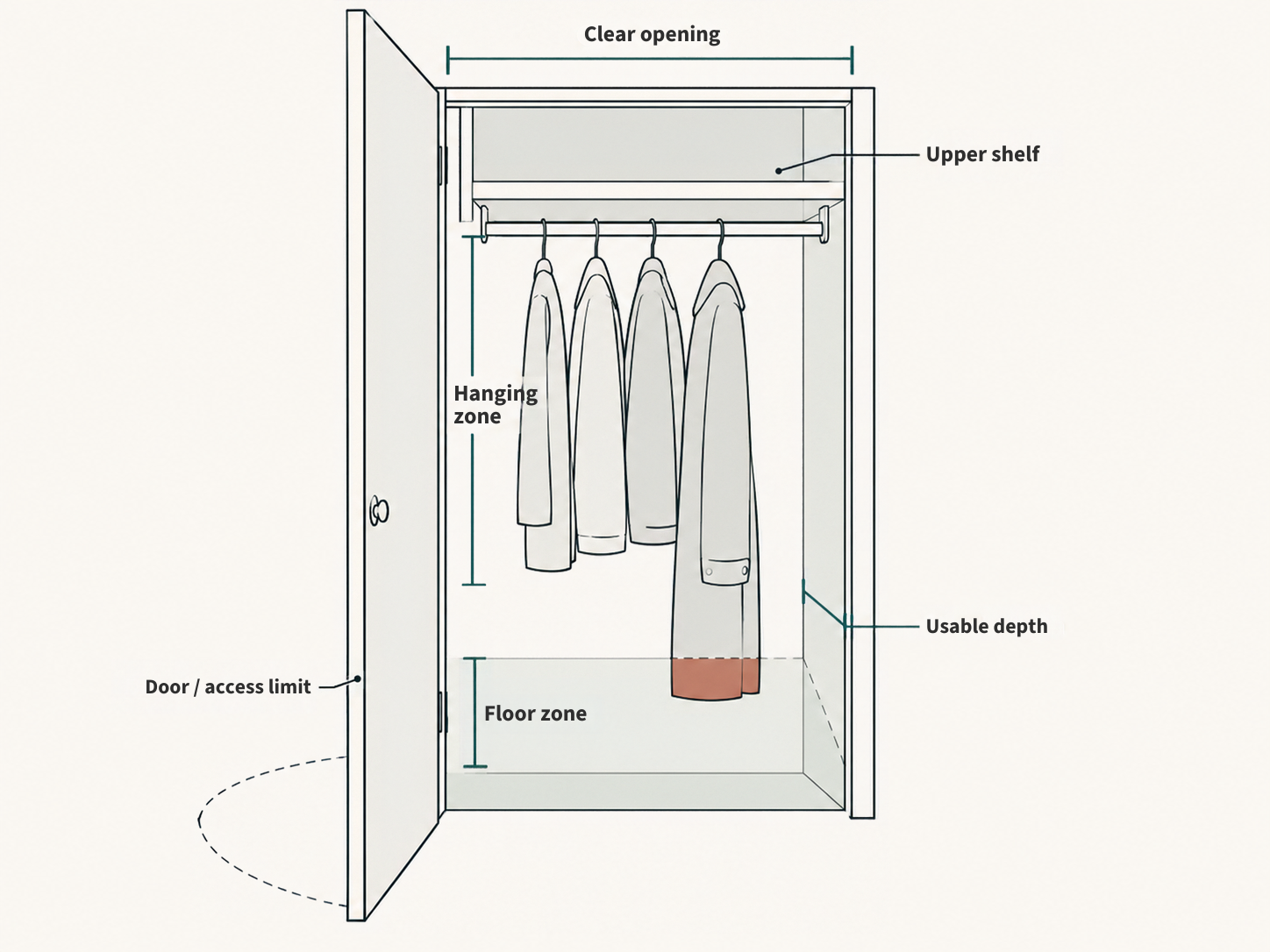
Measure the coats and hanging job you actually have
A generic coat measurement is not useful enough for this decision.
Measure the garments that really use the closet.
At minimum, check:
- the longest current-season hanging item;
- the bulkiest relevant item;
- how low the longest item hangs;
- how far the hanging load projects into the closet;
- whether garments already brush a shelf, floor item, basket or door.
If your household mainly stores short jackets, your floor zone may behave differently from a closet holding long winter coats.
That does not mean one arrangement is better.
It means the hanging job changes the space available to every other job.
This is why a floor organizer can pass a width-and-depth check and still fail the closet.
If the organizer occupies space that the actual coats need, it does not fit the complete system.
Do not copy a universal coat length or rod height from another home. Measure the real hanging items and work from the closet you have.
Protect the easiest-access zone for the most repeated jobs
The most frequently used items should be easy to retrieve and easy to return.
That sounds obvious, but small closets often do the opposite.
Daily coats may be packed behind occasional outerwear. Shoes used every morning may sit under a basket that has to be moved first. Hats and gloves may be placed high because the shelf had room, even though that position makes the category inconvenient enough that it migrates to a table.
For each repeated job, ask two questions:
Can I get this item without moving something unrelated?
Can I put it back without arranging the closet first?
If the answer is no, the item may be in the wrong zone even if it physically fits.
Prime access does not require a universal reach-height rule. Use the people, items and closet in the actual household.
The principle is functional:
The more often a job repeats, the less friction the system should add to that job.
Test the floor zone before you put shoe storage there
The bottom of a coat closet often looks like obvious shoe space.
Sometimes it is.
Sometimes the floor is also where long coats need clearance, where the door needs to move, where a bulky household item lives, or where boots need enough room to come out without unloading other storage.
Before buying a shoe rack, bench-style insert, basket or drawer unit, test the floor zone.
Check:
- Does the closet door still open and close normally?
- Can the proposed storage enter through the opening?
- Does it sit inside the usable depth?
- Does it interfere with the longest coats?
- Can shoes or boots come out without moving a basket first?
- Does a drawer, lid or pull-out have room to operate?
- Does the storage block access to another job?
The floor zone does not have to store shoes simply because the closet is near the entryway.
If shoes are already working well elsewhere, forcing them into a small closet can make the whole closet worse.
Use the top shelf for a job, not random overflow
The top shelf is valuable because it separates one storage job from the hanging zone.
It is also easy to turn into a place where unrelated items accumulate.
Measure the usable shelf depth and the clearance through the opening. Then decide what job the shelf should perform.
Possible candidates include:
- less-frequently used entryway accessories;
- seasonal rotation items;
- contained items that genuinely belong near the door.
The shelf should not become the answer to every category that does not fit below.
If a large bin fits the shelf but is awkward to remove, or if daily items are placed so high that they rarely get returned, the shelf is not doing the intended job well.
Less-frequent items may be reasonable candidates for an upper shelf if they can be stored and retrieved safely. This article does not assign one universal reach height or lifting limit.
Use the actual household and the exact item.
Test retrieval and return before you call the layout finished
A closet can look organized immediately after you arrange it and still fail within a week.
The missing test is often the return trip.
For each major job, run two tests.
Retrieval test
Can the item come out without:
- moving unrelated items;
- unloading a bin;
- scraping past another component;
- tilting it through an awkward gap;
- disturbing the whole hanging section?
Return test
Can the item go back without:
- rearranging neighboring items;
- opening several containers;
- carefully restacking a category;
- using an awkward sequence that people are unlikely to repeat?
The return test matters because entryway storage is a repeated handoff system.
A coat comes off. A bag comes home. Gloves return. Shoes are removed.
If the storage only works when someone stages everything perfectly, it is not solving the repeated job.
Five decisions after you map the closet
Once the jobs and constraints are visible, make one of five decisions for each problem zone.
1. KEEP CURRENT LAYOUT
Leave the zone alone when it already handles its job well.
Not every empty inch needs an organizer.
2. REASSIGN ZONES
Move jobs within the closet before buying anything.
For example, a top shelf that currently holds daily accessories may work better for occasional items while a more accessible zone takes over the daily category.
The exact swap depends on the household.
3. ADD VERIFIED ORGANIZER
Add storage only after you know:
- which job it solves;
- the exact zone available;
- the component dimensions;
- the operating clearance;
- the installation requirements;
- whether the stored item still comes out and goes back easily.
4. MOVE ITEM ELSEWHERE
Some items do not earn limited entryway space.
Relocating one bulky category may improve the closet more than adding another product.
5. SKIP PRODUCT
A product can be attractive, popular and still be wrong for the closet.
Skip it if it:
- blocks a more important job;
- interferes with the door;
- collides with coats;
- is difficult to operate;
- requires an installation method that does not fit the wall or system;
- solves a problem the household does not actually have.
Adjustable systems, shelves and rods: follow the exact product instructions
Storage-fit measurements and installation requirements are two different things.
Your measurements tell you whether a shelf, rod or organizer would solve the household job.
The product instructions tell you whether and how that exact component can be installed.
ClosetMaid’s current ShelfTrack installation guidance, for example, uses wall-type-specific hardware and system-specific rules for tracks, standards and brackets. The company also instructs installers to match bracket size to shelving depth except where the specific shelving type says otherwise.
Rubbermaid’s current closet-system specifications likewise publish exact fit ranges, included components, dimensions and, for some products, capacities by model. Its adjustable systems are designed to be configured within the limits of the specific kit.
Those are product rules, not universal coat-closet standards.
If your exact system is designed to be adjustable, follow its current instructions. If you are adding or changing wall-mounted hardware, use the hardware and installation method required for that system and wall type.
Do not copy an installation number, load rating or anchoring method from one system and apply it to another.
If the article later includes a specific product, its current instructions and specifications need to be rechecked before publication.
Use this small coat closet job-and-fit worksheet
Measure first. Then assign the job.
| Job / category | Frequency | Item dimensions / hanging length | Current location | Proposed zone | Retrieval test | Return test | Conflict with another job? | Decision |
|---|---|---|---|---|---|---|---|---|
| Current-season coats | ||||||||
| Shoes / boots | ||||||||
| Daily bag | ||||||||
| Hats / gloves | ||||||||
| Umbrella / dog gear / other repeated job |
For the final column, choose one:
- KEEP CURRENT LAYOUT
- REASSIGN ZONES
- ADD VERIFIED ORGANIZER
- MOVE ITEM ELSEWHERE
- SKIP PRODUCT
If you are considering a product, add a second fit check:
| Product / component | Exact exterior dimensions | Target zone | Operating clearance | Installation requirement | Intended job | PASS / FAIL |
|---|---|---|---|---|---|---|
The worksheet separates two questions that are easy to mix together:
Does the item or product fit?
Does it make the repeated job easier?
A yes to the first question does not guarantee a yes to the second.
Worked example: why a closet can fit more and work worse
EXAMPLE — NOT A UNIVERSAL STANDARD AND NOT A TESTED HOUSEHOLD
Imagine a small hall closet with:
- a 32-inch clear opening;
- 22 inches of usable depth in the floor zone;
- a rod that spans the closet;
- a top shelf;
- long coats that hang to about 10 inches above the floor.
Now imagine the household considers a 14-inch-high shoe organizer.
The organizer may pass a simple width-and-depth check.
But if it sits directly below the long coats, the organizer body extends into the space those coats already occupy.
That means the product does not pass the complete fit test even though its footprint fits the floor.
The household now has several possible decisions:
- keep the floor clear beneath the long coats;
- group long coats in one part of the rod and use floor storage only where shorter garments leave enough room, if the actual closet geometry permits;
- move a less important floor-zone job elsewhere;
- choose a different organizer only after checking its exact dimensions;
- skip the product entirely.
The lesson is not that a 14-inch organizer is too tall.
The lesson is that product height has to be compared with the real hanging job in the exact zone where the product would go.
Now add the return test.
If shoes fit on a rack but the rack is hidden behind hanging coats and people stop returning shoes to it, the layout still fails the household job.
Useful storage is not only about what can be placed inside the closet. It is about what can be used repeatedly.
Common mistakes that make a small coat closet harder to use
Treating the closet as whole-house overflow
A small entryway closet cannot perform every storage job equally well.
Define which jobs benefit from being near the door.
Buying a shoe rack before checking the hanging zone
The floor may already be part of the coat job.
Measure the longest garments before assigning that space.
Measuring the back wall but ignoring the opening
An organizer has to enter the closet and operate through the actual doorway.
Copying a “standard coat closet depth”
The reader does not need a generic number to know whether her own organizer and coats fit.
Measure the usable depth.
Double-hanging without checking real garment length
A second rod can create more hanging line while removing the space needed by long garments.
Do not assume the tradeoff works for the household.
Adding hooks where the door or coats cannot clear them
A hook is useful only if the stored item does not interfere with door operation or another storage job.
Putting daily items on the top shelf because it has space
Available space and useful access are not the same thing.
Filling every zone
An empty patch of floor or wall can be part of the operating space that makes the closet usable.
Buying an organizer before defining its job
“More storage” is not a job.
The product should solve a named problem.
Borrowing installation rules from a different system
Product dimensions, mounting, load and hardware requirements can differ.
Use the exact current instructions for the exact component.
Before you buy a coat-closet organizer
Finish the job map and measurement worksheet first.
Then verify the exact product.
Check:
- model or variant;
- exterior width;
- exterior height;
- exterior depth;
- intended closet fit range, if the manufacturer publishes one;
- drawer, basket, lid or pull-out movement;
- mounting method;
- required hardware;
- wall-type requirements;
- published capacity only if the number matters to your use;
- compatibility with hanging garments;
- door and opening interaction;
- whether the stored item can still be removed and returned easily.
Do not buy a product simply because it is labeled “closet organizer.”
It earns a place only when it solves a real job inside the usable envelope.
The initial version of this guide does not require an affiliate product block. A product can be added later only after its exact fit and current specifications are verified.
If the problem is outside the closet
Sometimes the coat closet is not the main constraint.
If the closet works but the hallway itself is so narrow that ordinary floor furniture would obstruct the route, use the separate guide to narrow hallway storage. That problem starts with protecting the walking path, not trying to make the closet solve the whole entryway.
If your home has no built-in coat closet at all, that is a different storage job. This article assumes an existing closet and does not try to solve the no-closet problem.
A future broad entryway guide can connect those different constraints. For now, keep the owner boundary clear.
A useful coat closet is easy to use twice
The first half of coat-closet organization is getting the item out.
The second half is putting it back.
Start by deciding which entryway jobs actually belong in the closet. Measure the usable opening and depth. Measure the coats and other items that have to coexist. Protect the easiest access for the jobs that repeat most. Test the floor and top shelf instead of assuming they need more products.
Then test every important category in both directions:
Can you get it out?
Can you put it back?
Only after those answers are clear should an organizer enter the plan.
The best small coat closet is not the one that holds the largest number of things. It is the one that handles the right household jobs inside the space you actually have.