Narrow Hallway Storage When Furniture Won’t Fit: A Renter-Friendly System
A narrow hallway can look like wasted storage space. That does not mean it is waiting for a bench, console or shoe cabinet.
If a piece of furniture makes the route harder to use, catches a door, crowds an opening or turns the hallway into a place everyone has to squeeze past, the storage has solved the wrong problem. In a genuinely narrow corridor, the better system may use almost no floor space at all.
That starts with a different question. Instead of asking, “What can I fit here?” ask, “What actually needs to happen here every day?”
The answer may be smaller than you expect. Keys, a daily bag, the leash, current outerwear and perhaps a limited shoe solution may deserve near-door access. Off-season footwear, backup bags, bulky coats, sports gear and rarely used items usually do not need to occupy the hallway simply because that is where they get dropped.
The goal is not to make the hallway store more. It is to make the hallway work without becoming an obstacle.
Start by deciding what the hallway actually needs to hold
Treat the hallway as a working route first and a storage zone second.
List the things that routinely land there. Then separate them into two groups:
- items that need quick access at the door or on the way out;
- items that are only there because no one has given them a better home.
The first group might include keys, a dog leash, one current bag, frequently used outerwear or another small daily-use category. The second group can be much larger: extra shoes, seasonal coats, reusable bags, sports equipment, umbrellas that are rarely used, packages waiting to be returned, and whatever else has drifted into the corridor.
Do not build storage around that second group. Move it first.
A corridor with almost no spare depth cannot behave like a mudroom just because the household wishes it could. If the hallway needs to hold fewer categories, that is a storage decision too.
A useful test is simple: if an item disappeared from the hallway tonight, would someone genuinely need it there tomorrow? If not, give it a home somewhere else before you buy anything.
Protect the route before you add storage
Walk the hallway the way you actually use it. Come through the entry with a bag. Carry a laundry basket. Open every nearby door. Check any closet door, room door, exterior door or window that must stay usable.
The U.S. Fire Administration advises keeping relevant doors and windows clear as part of home escape planning. That does not give every private home one universal hallway-width number, but it does support the basic rule that storage should not block an exit or interfere with normal escape routes.
For this article, that means the route and openings win every conflict.
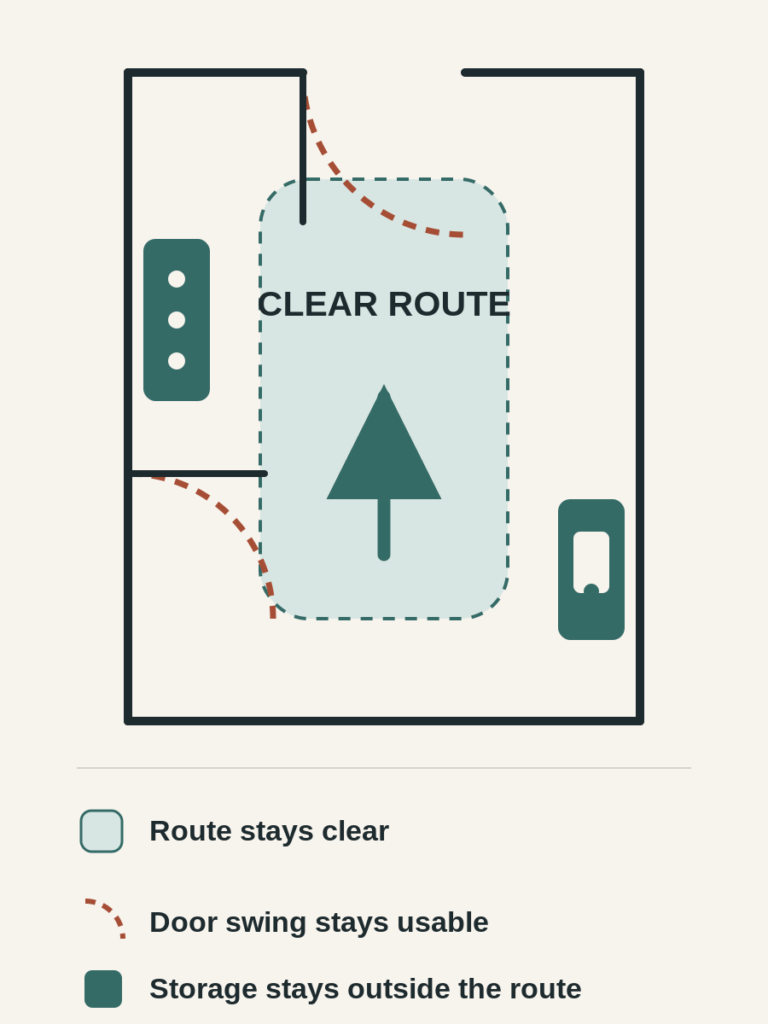
Before choosing storage, note:
- where doors swing;
- where people naturally walk;
- where a bag, coat or organizer would project into that path;
- whether a nearby switch, thermostat or other control needs access;
- whether the hallway is also the route to bedrooms, stairs or an exterior door.
If a storage idea only works when the household walks around it, turns sideways around it or stops opening something normally, reject it.
Do not rescue the idea by borrowing a generic “minimum hallway width” from the internet. Measure the real space, preserve the route and follow any property-specific requirements that actually apply to the home.
If furniture will not fit, stop shopping for furniture
“Slim” is a marketing word, not a promise that something belongs in your hallway.
A narrow console, tilt-out shoe cabinet or bench can still be too deep once you count handles, doors, baskets, feet and the space people need to use it. Product photos also tend to show the furniture alone, not the person carrying groceries past it while another door is open.
If the real hallway cannot spare floor depth, stop trying to find a slightly thinner version of the same idea.
You can check that before ordering. Use the product’s actual depth and operating dimensions to project how far it would occupy the real hallway, then walk the route and operate nearby doors. You are not testing the product itself. You are checking whether that amount of occupied floor space makes sense in the corridor.
If the answer is no, believe the hallway.
That pushes the system toward storage that uses the door, an appropriate wall surface, or another nearby zone instead of forcing furniture into the path.
Use the door only if the door still works normally
The back of a door can be useful because it can add storage without claiming floor space. But “over the door” does not automatically mean compatible with every door.
Before using a door-mounted organizer or hook, check the actual door and the actual product together. The door should still open, close and latch normally. The hardware should not catch on the frame, trim, wall or another door. The stored items should not swing into a nearby path or prevent the door from doing its main job.
That matters especially in tight halls where two doors sit close together.
Use the door for a clear repeated job, not as a second junk drawer. A few lightweight daily items may make sense. A stuffed organizer holding every small category in the house can simply move the clutter from the floor to a door.
Do not assume a universal door gap, hook thickness or weight limit. Those are product-specific checks.
Use removable wall storage only where the exact surface and product allow it
If a small wall section is the best available storage zone, the method needs to fit both the wall and the load.
Our renter-friendly wall storage guide explains the broader choices around removable and wall-free storage. For this hallway, the important point is narrower: the method is not “renter-friendly” just because the package says no drill.
Manufacturers of removable adhesive systems publish product-specific rules for surface preparation, compatible surfaces, application, load and removal. For example, Command’s official instructions vary by product and include surface/use restrictions as well as a warning that failing to follow the instructions can cause damage.
So treat every removable method as a compatibility check:
- Is this exact surface supported by the product?
- Is the wall finish in suitable condition?
- Does the exact item load fit the product instructions?
- Can the product be applied and removed exactly as directed?
- Do the lease or property rules allow the method?
If any of those answers is unclear, do not convert “no drill” into a guarantee.
The hallway does not need a full wall-storage system to work. One small assigned spot for a daily bag, leash or keys can be more useful than a row of hooks that gradually becomes permanent overflow.
Shoes may need to live somewhere else
Shoes can be the category that breaks a narrow hallway system because footwear still needs physical depth.
That is why the answer should not automatically be a narrower shoe cabinet.
If footwear on the floor interrupts the route, a cabinet will not fix the underlying problem just because it hides the shoes. The hallway may simply be the wrong storage location for most footwear.
Possible alternatives include:
- a nearby closet that is outside the tightest part of the corridor;
- a bedroom closet;
- a utility or mudroom zone if the home has one;
- off-season storage elsewhere, leaving only currently used pairs near the entry;
- a compatible door-based method if the door and exact product still operate normally.
Do not assign a universal number of pairs. A household with one person, a family with children and someone who needs multiple work shoes will not have the same realistic limit.
Use the available route to set the boundary. If shoes cannot stay there without becoming a trip or movement problem, move them.
Keep the hallway from becoming overflow storage again
A hallway system fails quietly when every hook, pocket or small surface becomes permission to store more.
Give each retained category one assigned place. When that place is full, the extra item does not get a second hallway location. It goes back to its real storage home.
For example:
- one place for the keys;
- one place for the current bag or leash;
- one defined outerwear zone;
- one shoe solution only if the hallway genuinely supports it.
Then use a short reset when the corridor begins to collect extras. Put seasonal, backup and rarely used items away. Remove return packages, empty bags and objects that were only passing through.
The system works best when capacity is intentional. More hooks are not always more organization.
Quick decision table: does this storage method belong in this hallway?
| Check | What to verify | Pass if | Reject / move elsewhere if |
|---|---|---|---|
| Job | What repeated hallway job the method serves | The storage solves a real near-door need | The reason is only “we have empty wall/door space” |
| Route / openings | Walking route, exit path and nearby doors/windows | Normal movement and openings remain usable | The method narrows, blocks or interferes with the route |
| Door operation | Swing, latch, trim and nearby conflicts | The door still opens, closes and latches normally | Hardware or stored items catch or prevent normal operation |
| Surface / product instructions | Exact surface, application and removal rules | The product instructions match the actual surface and use | Surface compatibility or removal method is unclear |
| Load | Actual items compared with the exact product instructions | The intended load is within the product’s stated conditions | Load is unknown, unsupported or exceeds instructions |
| Property rule | Lease/building/property restrictions | The method is permitted under the rules that apply | Permission is unclear or the method is restricted |
| Reset / overflow | Where extras will go when the assigned spot is full | Backup and seasonal items have another home | The hallway becomes the default overflow zone |
What to buy only after the hallway passes the test
Shopping comes last.
Once you know the hallway’s jobs, the route is protected and the usable surfaces or door zones are clear, you can decide whether anything needs to be purchased at all.
The useful product classes are simple:
- a removable hook or small holder for a lightweight repeated-use category, where the exact surface and product instructions support it;
- an over-door or back-of-door organizer where the door still functions normally;
- a tension-based vertical system only where the exact product, surfaces and route are compatible;
- nothing, if the better answer is to move the category to a nearby closet or room.
Do not buy a “slim” hallway product first and then negotiate the walking route around it. Do not buy extra capacity for categories you already decided do not need to live there.
The best purchase may be the smallest one that gives one repeated job a reliable place.
A narrow hallway does not have to become a storage room
A difficult hallway gets easier when you stop asking it to behave like a bigger space.
Keep the route and openings clear. Decide what genuinely needs near-door access. Move the rest. Use a door or removable wall method only when the exact product, surface and property rules fit the real home.
And if the hallway cannot hold shoes, a bench or a cabinet without getting in the way, let that be the answer.
The goal is not to fill the corridor. It is to make the home easier to move through and easier to use.