Shallow Closet Storage: What Fits When Standard Organizers Are Too Deep
A shallow reach-in closet does not need a smaller version of every normal closet product. It needs storage that matches the depth the room can actually use.
The key test is simple: measure the clear envelope, then compare it with the loaded hanger or stored item, the exact product body and the movement needed to use both the closet and the organizer. If the door, clothing or retrieval path has to fight the storage, the method does not functionally fit.
This guide starts after the basic depth question. If you still need to establish cavity depth versus usable depth, use The Reasoned Home’s closet-depth measurement guide, then come back and decide what the shallow closet should actually do.
On this page
- Decide which storage job the shallow closet can do well
- Use the measured depth as an input, not the answer
- Measure the loaded item, not just the organizer
- Protect the door and retrieval path
- Compare exact product depths before you shop
- Choose a storage direction that matches the envelope
- Use the shallow-closet fit worksheet
- Avoid the mistakes that make a shallow closet harder to use
- Verify the exact product before buying
- Make the final decision
Decide which storage job the shallow closet can do well
A shallow closet may not be able to perform every job that a conventional reach-in closet can.
Start with what truly needs to live there. Is the priority hanging clothes, folded clothing, shoes, bags, linens or another category?
Then ask which of those jobs can work without forcing the closet into a geometry it does not have.
If loaded hanging clothes project into the door, the answer is not automatically a different hanger. If a drawer tower fits between the side walls but extends into the opening, the answer is not automatically a narrower tower. The storage job itself may need to change.
Separate the contents into three groups:
- needs frequent access here;
- can use slower or less convenient space;
- can reasonably live somewhere else.
Relocating one category can be a better solution than stacking another product into a depth conflict.
Use the measured depth as an input, not the answer
Once you know the closet’s usable depth, treat that number as one input to the decision.
Check where the storage will actually sit. A baseboard can affect a floor unit without affecting a higher shelf. A sliding-door track can reduce usable floor depth. Trim or door movement can limit the front of the storage zone.
You do not need another universal “minimum shallow closet depth.” You need the clear depth at the height and location of the storage job.
If the measurement is close, mark the proposed body depth on the floor or wall with removable tape or paper. The point is not to simulate the finished installation perfectly. It is to expose an obvious collision before you buy.
Measure the loaded item, not just the organizer
The product body is only part of the footprint.
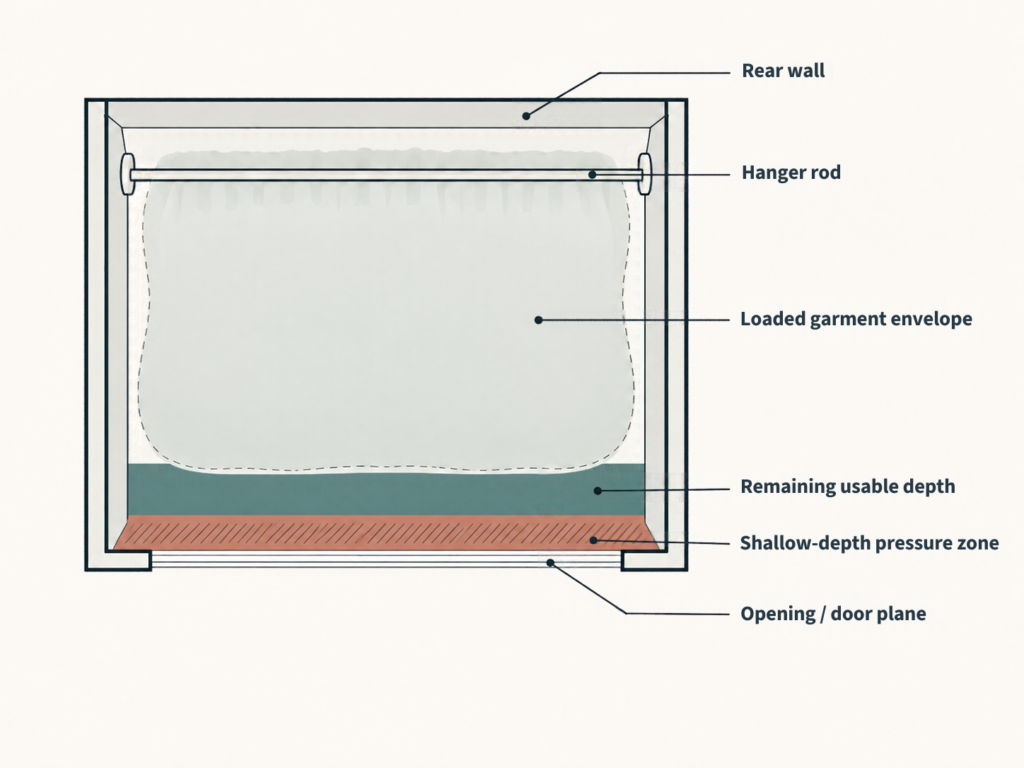
For hanging clothes, put one of the actual garments that needs to live there on the hanger you use. Measure how far that loaded combination projects in its normal position.
Do not substitute an average hanger number for this check. Coats, structured jackets, shirts and bags can occupy different envelopes. The useful measurement is the one created by your real storage job.
Use the same logic for shelves, bins and towers:
- a basket can project beyond the shelf that supports it;
- shoes can extend past a rack;
- folded items can overhang a shelf;
- a drawer unit can require more room when it opens than when it is closed.
Record the loaded projection separately from the organizer body.
That distinction is the heart of the shallow-closet problem: a component can fit while the completed storage job does not.
Protect the door and retrieval path
A shallow closet has very little room for a second operating envelope.
Move the closet door through its normal range. For a sliding door, test the panels on the track. For a bifold or hinged door, check the space the door itself uses.
Then remove and return the item you expect to use most often.
Can a basket come out without tilting around the door? Can a drawer open far enough to reach what is inside? Can a coat hang naturally without being pushed inward whenever the door closes? Can the item go back without moving something unrelated first?
There is no universal clearance number that answers those questions. The required room depends on the exact door, storage method and item.
If the product only works while every moving part is closed, it has passed a resting-fit test, not a functional-fit test.
Compare exact product depths before you shop
Words such as “narrow,” “small-space” and “closet organizer” do not tell you how much front-to-back space a product uses.
Current manufacturer specifications make the difference visible.
Elfa’s Classic wire-shelf line includes a 12-inch / 305 mm depth. Elfa describes that depth for narrower spaces such as hallways and shallow pantry storage. The same shelf family also includes deeper options. Elfa Classic wire shelf
IKEA’s BOAXEL shelf, product 704.487.37, uses a 15-inch shelf depth and a 15 3/4-inch system depth. IKEA BOAXEL shelf 704.487.37
IKEA’s JONAXEL frame, product 604.199.57, is listed at 19 5/8 inches wide and 20 1/8 inches deep. That is a useful example of why a product that looks relatively narrow from the front can still consume substantial depth. IKEA JONAXEL frame 604.199.57
These are geometry examples, not recommendations. None of those dimensions proves that the product will fit your closet or installation.
A hypothetical example shows why the sequence matters. If your clear envelope at the proposed location is 14 inches deep, a 15-inch product body already extends beyond it before you account for the stored item or door movement. That does not make the product defective. It makes it the wrong geometry for that location.
Choose a storage direction that matches the envelope
Once you have the usable depth, loaded projection and operating path, choose the method that creates the least conflict.
Keep the conflict zone open
An open strip near the door can be operating space rather than wasted space.
If filling that strip makes the door, clothes or retrieval path worse, leaving it open is a functional choice.
Use a genuinely shallower body
A shallow shelf or organizer can work when its exact body, loaded contents and installation all remain inside the usable envelope.
Verify the exact depth. Do not treat the word “shallow” as a measurement.
Change the storage job
If conventional hanging is the part that fails, decide whether the affected category actually needs to hang here.
Items that do not require hanging may work as folded or contained storage when the specific shelf or container passes the fit test. Another category may be better moved elsewhere.
This is not a rule that folded storage is always better. It is a way to stop asking a shallow envelope to perform a job it cannot serve normally.
Use wall, side or door storage only after the exact method passes
Moving storage off the floor can change the geometry, but it does not remove it.
Check product projection, door movement and the manufacturer’s installation instructions. An over-door or wall-mounted organizer can still collide with the frame, clothing or another storage zone.
Relocate the category that keeps creating conflict
If one category can only fit by blocking the door, crushing clothes or forcing another item to move first, the closet may be the wrong home for that category.
A useful small closet often does fewer jobs more reliably.
Use the shallow-closet fit worksheet
Fill this out before ordering a shelf, frame, bin, drawer unit or hanging system.
| Candidate method / product | Storage job | Usable closet depth | Door / track / trim notes | Actual loaded hanger / item projection | Product body depth | Loaded-item projection | Operating / retrieval movement | Mounting / installation notes | Decision |
|---|---|---|---|---|---|---|---|---|---|
| Your candidate | — | — | — | — | — | — | — | — | — |
Use one clear decision:
- KEEP OPEN
- USE
- RELOCATE ITEM
- CHOOSE SHALLOWER METHOD
- REJECT PRODUCT
- VERIFY INSTALLATION
Unknown is not the same as pass.
If the manufacturer does not publish the dimension or installation detail you need, leave that point unresolved until you can verify it. If the room measurement is unclear, remeasure at the exact height and location where the product will sit.
The worksheet has no universal pass/fail inches because the closet, door, loaded items and products are not universal.
Avoid the mistakes that make a shallow closet harder to use
Buying by width and forgetting depth
A tower can fit neatly between two side walls and still project too far into the opening.
Width matters when the room demands it. It does not replace the depth check.
Measuring the empty closet
An empty rod or shelf can look workable. The conflict may appear only after coats, baskets, shoes or folded items are loaded.
Measure the normal loaded state.
Treating “small closet” as a fit specification
A product marketed for small closets can still be too deep for your reach-in.
Start with the published dimensions, not the marketing category.
Ignoring the opening
The door, track and trim are part of the storage system.
If a product sits inside the cavity but stops the closet from operating normally, its body fit is not enough.
Choosing a deep product because it looks narrow from the front
Front width and body depth answer different questions.
The current JONAXEL frame above is under 20 inches wide but just over 20 inches deep. Those dimensions are not a judgment about the product; they show why you have to compare the correct axis with the room.
Forcing conventional hanging
If loaded garments have to be compressed, pushed aside or trapped by the door, reconsider the storage job for that part of the closet rather than assuming the hanging setup must stay.
Filling every open-looking inch
A clear zone can be serving the door or retrieval path.
Do not turn every empty-looking area into another product location.
Verify the exact product before buying
When a method survives your room measurements, verify the current product information.
Check, as relevant:
- finished exterior width, depth and height;
- shelf, frame or component depth;
- drawer, basket or door movement;
- installation and wall-mounting requirements;
- hardware or wall-fastener requirements;
- the dimensions of the actual items that will sit on or inside the product.
Keep manufacturer rules attached to the exact product.
For example, IKEA currently states that JONAXEL frame 604.199.57 must be secured to the wall when two frames are stacked or when the frame is used without casters, and that the wall fasteners must suit the wall material. That is a JONAXEL instruction, not a general rule for every closet system. IKEA JONAXEL frame 604.199.57
If a required dimension or installation condition is still unclear, use VERIFY INSTALLATION. Do not convert missing information into a purchase assumption.
Make the final decision
A shallow closet does not have to imitate a full-depth closet.
Use the measurements to make one decision.
KEEP OPEN when the clear area is more valuable as operating space than storage.
USE when the loaded storage method fits, operates and can be retrieved normally.
RELOCATE ITEM when the category creates more conflict here than value.
CHOOSE SHALLOWER METHOD when the storage job belongs in the closet but the current product body is too deep.
REJECT PRODUCT when its geometry or operation does not work in the actual envelope.
VERIFY INSTALLATION when a product-specific requirement is still unknown.
The goal is not maximum item count. It is storage that the shallow closet can actually serve.