Deep Pantry Shelves: Organize Around Reach, Not Just Storage Space
A deep pantry shelf can look generous and still be frustrating to use. The front fills first. Small packages disappear behind larger ones. Backstock becomes hard to see. And an organizer can fit the shelf on paper while making normal retrieval more complicated.
The useful question is not, “How do I fill all this depth?”
It is, “Which part of this shelf can I use repeatedly without digging, unloading or forgetting what is behind the front row?”
Start by measuring the shelf you actually have. Then separate frequently used items from reserve stock, measure the items and containers that need to live there, and test any organizer by its full job: body fit, loaded fit, operation, retrieval and refill.
On this page
- The quick answer: split deep shelves by access before you buy organizers
- Measure the actual shelf, opening and obstructions
- Mark the depth you can repeatedly reach and return items to
- Assign active, reserve and rare jobs before choosing containers
- Measure the actual item or container, not just the shelf
- Test open bins by body plus removal
- Test turntables by footprint plus loaded rotation
- Test two-tier turntables by vertical configuration
- Test shelf risers by depth plus vertical visibility
- Test pull-outs by slide travel and opening conflict
- Decide what belongs in the deep reserve zone
- Give reserve stock one refill and rotation rule
- Use this deep pantry shelf fit worksheet
- Worked example: the organizer fits the shelf but the daily-use job fails
- Common mistakes with deep pantry shelves
- Before you buy an organizer for deep pantry shelves
- A good deep pantry uses the back on purpose
The quick answer: split deep shelves by access before you buy organizers
Treat a deep pantry shelf as at least two possible jobs, not one equal storage zone.
The front should handle the items you need to see, remove and return regularly. The deeper area can work as reserve space only when the household can still identify what is there and retrieve it without dismantling the shelf.
Use this sequence:
MEASURE ACTUAL SHELF → MARK REPEATEDLY REACHABLE DEPTH → CLASSIFY ACTIVE / RESERVE / RARE → MEASURE ITEM OR CONTAINER → CHOOSE ORGANIZER ROLE → TEST BODY FIT → TEST LOADED ENVELOPE → TEST OPERATING ENVELOPE → TEST RETRIEVAL / REFILL → CHECK VISIBILITY → KEEP AS-IS / MOVE FORWARD / DEEP RESERVE / BUY VERIFIED-FIT / MOVE CATEGORY / SKIP
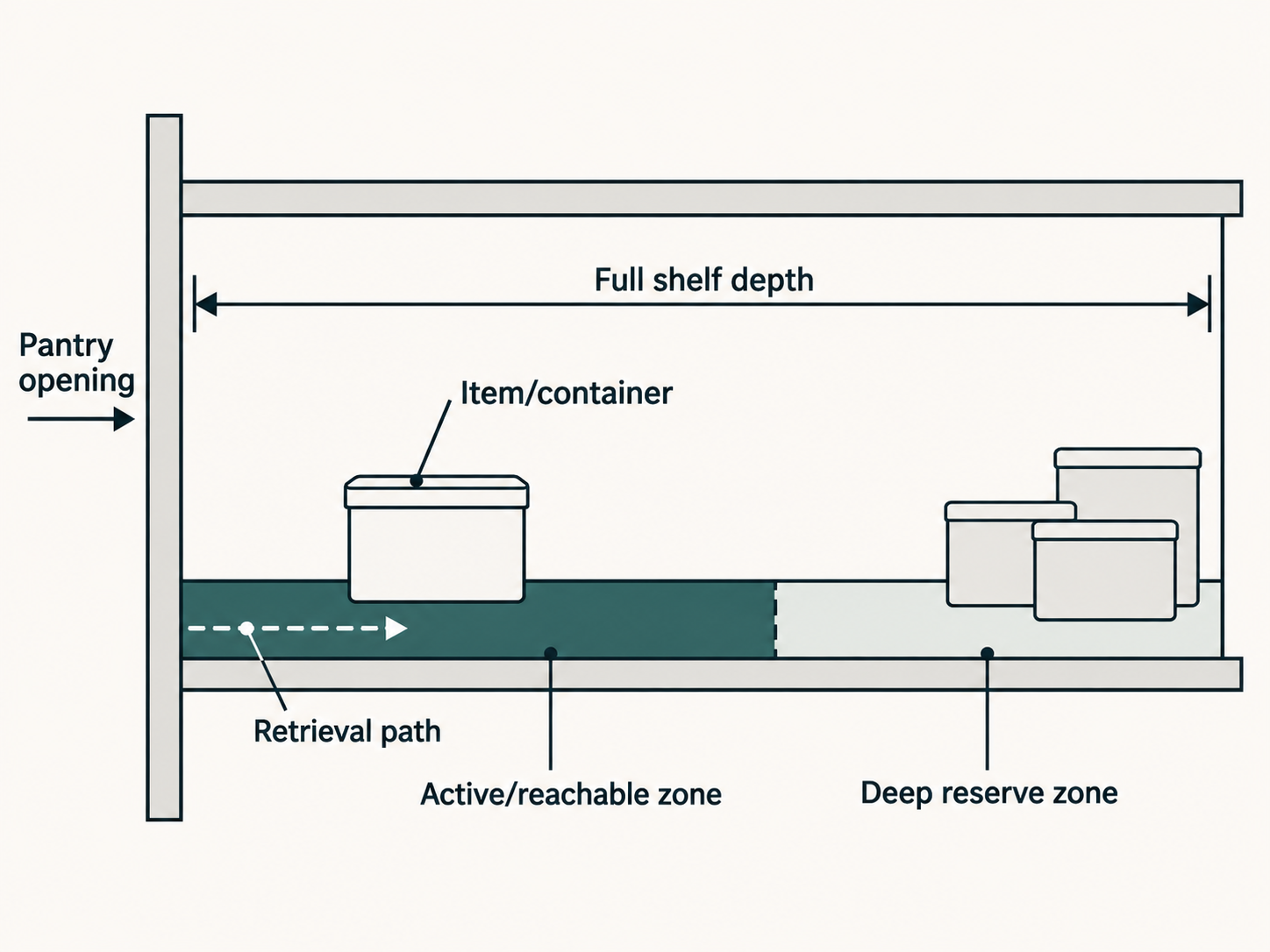
The important distinction is between full shelf depth and usable depth for the job. A shelf can extend far back without every inch being equally useful for daily storage.
Measure the actual shelf, opening and obstructions
Measure before choosing bins, turntables, risers or pull-outs.
For each shelf, record:
- the clear width;
- the full front-to-back shelf depth;
- the clear height to the shelf above;
- the width of the actual opening in front of the shelf;
- door, hinge or trim intrusion;
- shelf lips, rails, supports or other fixed features that affect removal;
- any other obstruction that changes how an organizer can enter, move or come back out.
This is the same basic fit logic used by current manufacturer fit tools for cabinet organizers. Rev-A-Shelf’s 5700 Series pantry organizer fit guidance, for example, tells shoppers to measure the opening side-to-side, front-to-back and top-to-bottom and to account for obstructions before determining whether a product fits.
That does not create a universal pantry dimension. It establishes a simpler point: the product must be checked against the real opening and real obstructions, not against a generic label such as “pantry organizer.”
A shelf may be 23 inches deep while the opening is narrowed by a hinge. A tall container may fit under the shelf above but fail to lift out cleanly. A pull-out may fit the interior width and still conflict with the door position.
Measure the whole use area, not just the empty rectangle.
Mark the depth you can repeatedly reach and return items to
Now separate full shelf depth from repeatedly reachable depth.
Stand where you normally use the pantry. Choose one representative item. Try to see it, remove it and put it back without moving unrelated items first.
Mark the portion of the shelf where that process feels normal and repeatable for you.
That is your working reachable zone for this shelf.
It is not a universal number. It can vary by shelf height, the person using the pantry, the size of the stored item and the way the pantry opens. A lower shelf may be easy to reach deep into while an eye-level shelf makes small items at the back difficult to see. A large package may be easy to grab even when a small packet in the same location is not.
The goal is not to measure human reach as a standard. The goal is to identify the part of this exact shelf that can perform a repeated-use job in this household.
Assign active, reserve and rare jobs before choosing containers
Once you know the reachable zone, assign each pantry category a job.
Active items are used often enough that easy visibility, removal and return matter. They belong in the part of the shelf the household can repeatedly use without unloading something else.
Reserve items are duplicates or backstock with a clear refill job. They can use deeper space if the household can still identify them and retrieve them when needed.
Rare items are lower-frequency pantry categories. They may tolerate a less convenient position, but only if placing them there does not bury active items or turn the shelf into forgotten inventory.
This is not a rule about how much food a household should own. It is a way to match access with frequency.
If a category is used every morning, putting it behind a reserve category creates unnecessary handling. If a duplicate package is only needed when the front package runs out, it may be a better candidate for the deeper zone.
Depth should serve a storage job.
Measure the actual item or container, not just the shelf
The shelf is only one side of the fit test.
For each category, measure or check the item that will actually occupy the space:
- depth;
- width;
- loaded height;
- handle or lid projection if relevant;
- whether the package overhangs the organizer;
- whether items must be stacked;
- whether one item has to be removed before another can come out.
Small packages can create a different problem from large ones. A large cereal box may remain visible at the back while a short pouch disappears behind the front row. A deep bin may make several small packages easier to gather, but it may also turn those packages into one long container that must be removed as a unit.
Do not assume the organizer improves access merely because it contains the category neatly.
Test open bins by body plus removal
An open bin can give a loose category one defined home, but a deep shelf does not automatically call for the deepest bin that will fit.
For a bin candidate, test:
- exact body width, depth and height;
- how far the loaded items project above or beyond the body;
- whether the handle or front edge remains easy to grasp;
- whether the bin can come out without unloading the shelf in front of it;
- whether you can still tell what is inside;
- whether the category needs the whole bin removed every time it is used.
A long bin can work well for reserve stock because the whole reserve category moves together. The same long bin may be a poor daily-use solution if every snack, packet or baking ingredient requires pulling the entire container forward.
The decision is about the job, not whether bins are generally good or bad.
Test turntables by footprint plus loaded rotation
A turntable has two different fit questions.
First, does its body fit on the shelf?
Second, does it still rotate when loaded with the actual items?
Check the full footprint, then load the category you intend to store. Rotate it through a complete cycle. Watch for packages that lean or project beyond the organizer body and hit the wall, a neighboring container or the shelf opening.
Also test the use position. A turntable placed deep enough that you cannot comfortably reach and rotate it has not solved the access problem.
If the design includes removable bins or sections, test whether those pieces can lift out under the shelf above without hitting the shelf, trim or nearby packages.
Do not invent a generic perimeter clearance. Test the actual loaded rotation on the actual shelf.
Test two-tier turntables by vertical configuration
A second tier can increase visible storage, but it introduces another fit variable: height.
Measure the clear height between shelves before choosing a multi-level organizer. Then compare that height with:
- the organizer’s configured height;
- the clearance between tiers;
- the tallest item assigned to each level;
- the room needed to remove an item without tipping or unloading the tier above.
An adjustable organizer may have more than one valid configuration. That is useful only if one of those configurations fits the shelf and the actual stored items.
The same two-tier body can work on one shelf and fail on another simply because the shelf spacing or package height changes.
Test shelf risers by depth plus vertical visibility
A shelf riser can turn one flat surface into two visible levels. That can help when short packages are being hidden behind taller ones.
But a riser does not automatically solve the deep-back problem.
Test:
- the riser’s body depth;
- its height;
- the depth of the items placed on top and below;
- whether the back row remains visible;
- whether the back row can still be removed;
- whether the lower row becomes trapped behind the riser legs or front items.
Current shelf-insert products are sold in materially different depths, which is another reason not to treat “shelf riser” as one fixed geometry. The article does not need a universal riser size. It needs the reader to compare the exact body with the exact shelf and category.
A riser earns the shelf when it improves visibility and retrieval. Adding another level without improving access is not enough.
Test pull-outs by slide travel and opening conflict
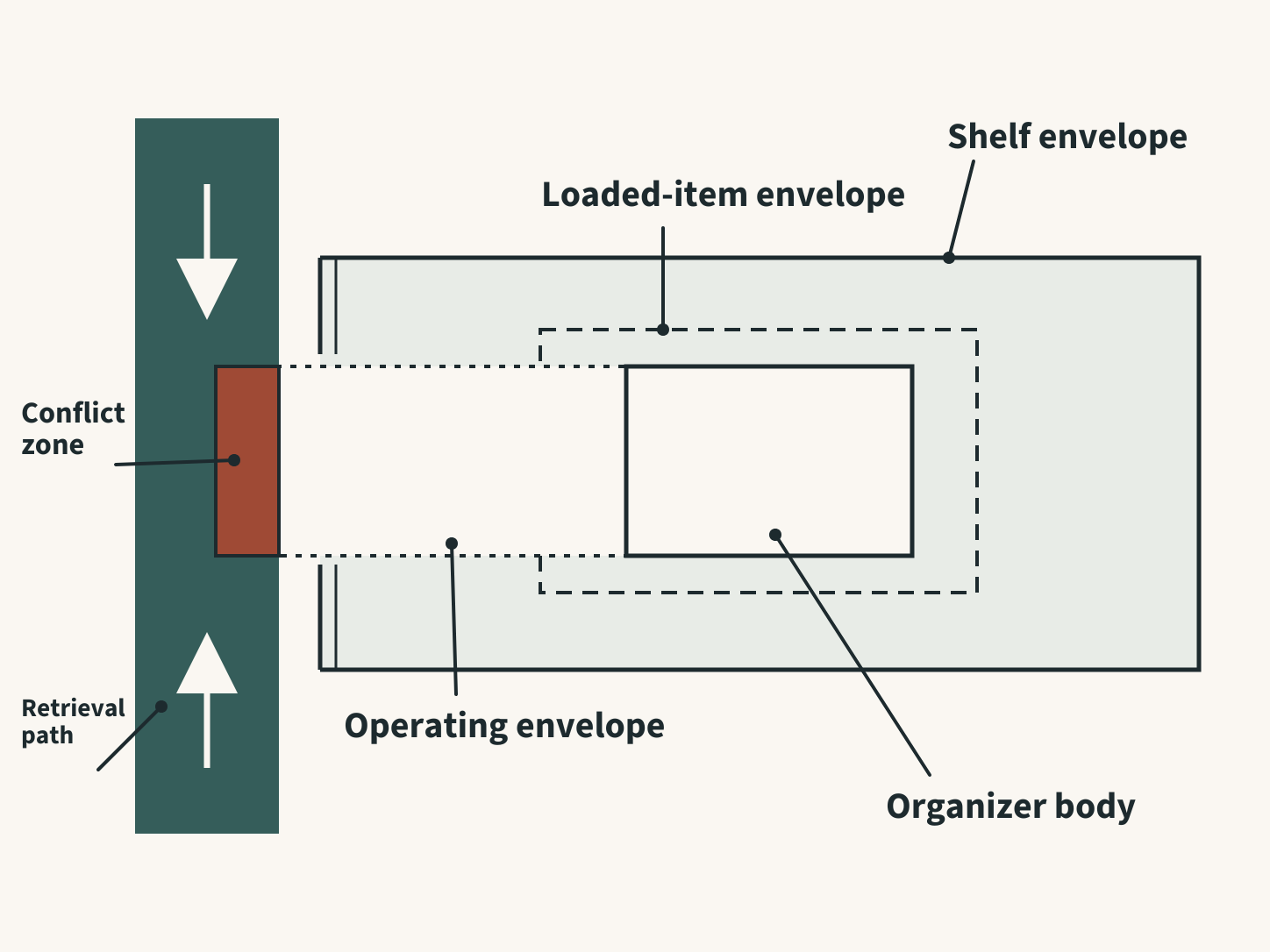
A pull-out changes the access problem by bringing storage forward, but its resting body is only part of the fit.
For any pull-out system, verify:
- exact body width, depth and height;
- the actual pantry opening;
- door, hinge and trim conflicts;
- the product’s extension or slide travel;
- whether the moving body clears the opening;
- whether stored items stay inside the working envelope;
- whether the user can reach and return the pull-out from the normal standing position.
Manufacturers publish different slide behaviors for different systems. Rev-A-Shelf’s Tall and Pantry Accessories guidance, for example, distinguishes full-extension, over-travel and three-quarter-extension slide types in its current tall/pantry guidance.
That is exactly why a generic “allow X inches for a pull-out” rule would be weak. The required movement belongs to the specific product and installation.
Use the manufacturer’s current dimensions and operation for the exact model if a pull-out survives into the shopping stage.
Decide what belongs in the deep reserve zone
The deepest part of the shelf works best when it has an intentional job.
Good reserve candidates may include:
- duplicate packages of staples already represented in the active zone;
- lower-frequency items that are easy to identify as a unit;
- bulky backstock that can be retrieved without moving unrelated daily-use categories.
The deeper zone is a poor fit when:
- the item is used every day;
- the package is so small that it disappears;
- retrieving one unit requires unloading several unrelated items;
- the household routinely forgets what is stored there;
- no one knows when reserve stock should move forward.
Do not use the back simply because it exists.
A deep reserve zone should reduce front-zone clutter without creating invisible inventory.
Give reserve stock one refill and rotation rule
A reserve zone needs one simple handoff.
Choose a household-specific refill point. When the active quantity reaches that point, bring the next reserve unit forward.
The exact threshold is up to the household. The useful part is that the back has a defined relationship to the front.
For example:
ACTIVE FRONT → USE → REACH REFILL POINT → MOVE ONE RESERVE UNIT FORWARD → CHECK REMAINING RESERVE
This article does not need shelf-life rules or food-safety claims to make that system work. It is simply a location and replenishment rule.
If the household cannot tell what is in reserve without unloading the shelf, the reserve system still needs a better visibility or category solution.
Use this deep pantry shelf fit worksheet
Use one row for each shelf/category combination you are trying to solve.
| Shelf / location | Shelf width | Full shelf depth | Clear height | Door / hinge / trim obstruction | Repeatedly reachable depth | Item / category | Frequency: ACTIVE / RESERVE / RARE | Item / container depth | Candidate organizer role | Exact model if considered | Product width | Product depth | Product height | Loaded projection | Operating motion | Operating-envelope test | Retrieval / refill test | Visibility test | Decision |
|---|---|---|---|---|---|---|---|---|---|---|---|---|---|---|---|---|---|---|---|
| Example row | NONE / ROTATE / LIFT / PULL / SWING / SLIDE | KEEP AS-IS / MOVE FORWARD / DEEP RESERVE / BUY VERIFIED-FIT / MOVE CATEGORY / SKIP | |||||||||||||||||
| Shelf 1 | |||||||||||||||||||
| Shelf 2 |
Do not start by filling the product columns.
Start with the shelf, reachable depth and category job. A product only enters the decision after the household knows what the shelf needs to do.
The worksheet separates questions that are easy to blur together:
- Does the empty organizer body fit?
- Do the actual stored items fit the body?
- Can the organizer rotate, lift, pull or slide as designed?
- Can the household retrieve, refill and return the category without moving unrelated items?
- Can the category still be seen well enough to manage?
A “yes” to the first question is not a pass on the other four.
Worked example: the organizer fits the shelf but the daily-use job fails
EXAMPLE — HYPOTHETICAL / NOT A TESTED HOUSEHOLD / NOT A UNIVERSAL STANDARD.
Imagine one pantry shelf is 23 inches deep. The household tests normal use and marks the first 14 inches as the depth where small packages can be seen, removed and returned repeatedly without unloading the shelf.
They have a frequent-use category of snack packets and a lower-frequency reserve supply of the same snacks.
They consider an 18-inch-deep open bin.
The body fits. Eighteen inches is less than the shelf’s 23-inch depth.
But when the household fills the bin from front to back with the daily-use packets, the items at the rear sit beyond the 14-inch zone they can repeatedly use. Getting the back packets means pulling the whole bin forward each time.
The bin passed the body-fit test.
It failed the daily-use job.
That does not automatically mean the bin is useless. The household can change the assignment:
- keep the daily-use packets in a shallower front container or directly in the active zone;
- use the deeper bin only for reserve packets;
- move the category to another shelf;
- choose a different verified-fit organizer;
- skip the organizer.
The lesson is not that 18 inches is too deep for a pantry bin.
The lesson is that product depth has to match the storage job and the reachable depth in the exact pantry.
Common mistakes with deep pantry shelves
Treating the whole shelf as equally usable
Full physical depth and repeated-use depth are not the same thing. Mark the active zone before assigning categories.
Putting daily-use items behind reserve stock
Frequency should influence position. Reserve stock should support the active zone, not sit in front of it.
Buying the longest bin that will fit
A long body can create one large container that must be removed for every use. Test the job, not just the capacity.
Measuring empty organizers only
Stored items can project beyond the body, block rotation or change removal height.
Assuming a turntable will rotate after loading
Test a complete loaded rotation on the actual shelf.
Adding a riser without checking the back row
Another level can improve vertical visibility while leaving the deepest items just as hard to retrieve.
Using a pull-out without checking the opening
The interior can be wide enough while the door, hinge or trim interferes with travel.
Storing small packages where labels disappear
Containment can make a category look tidy while reducing visibility. Check what you can actually see.
Creating deep reserve without a refill rule
Backstock without a handoff to the active zone can become forgotten inventory.
Buying matching organizers for visual uniformity
Different shelves and categories can need different geometries. Fit and retrieval come before a matching set.
Copying an inspiration pantry without checking local geometry
A photographed layout is not evidence that the same shelf depth, opening, item mix or organizer motion works in another home.
Before you buy an organizer for deep pantry shelves
Finish the shelf and category worksheet before shopping.
Then verify the exact candidate:
- shelf width, full depth and clear height;
- pantry opening and door/hinge/trim interference;
- repeatedly reachable depth for the intended user;
- category job: active, reserve or rare;
- actual item/container dimensions;
- exact organizer model;
- exact product width, depth and height;
- loaded item projection;
- rotation, lift, pull, swing or slide motion;
- exact extension or travel where relevant;
- retrieval and refill path;
- visibility after loading;
- current manufacturer specifications;
- any load or material claim only when it is actually needed;
- current availability only if you plan to rely on it.
Do not buy an organizer simply because it is marketed for deep shelves or pantries.
No product earns the shelf on body dimensions alone.
A good deep pantry uses the back on purpose
The goal is not to fill every inch.
The goal is to make the front easy enough to use repeatedly, give the deeper area a deliberate reserve job when it can support one, and reject organizer setups that create more pulling, unloading, digging or forgetting than they solve.
Measure the shelf. Mark what is truly reachable. Assign active and reserve jobs. Then let an organizer earn its place by proving that its body, loaded items, movement and retrieval all work together.
Sources used for this guide