21 Storage Ideas for Kitchens With No Pantry
Create pantry function from the space you actually have. Each idea includes what to measure first, what it can store or free up, and when to skip it.
A kitchen without a pantry does not need more storage everywhere. It needs the right things in the right places.
That distinction matters because the obvious fixes can create a second problem. A rolling cart may fit the gap but block a door. A tall cabinet may add shelves but narrow the walkway. The side of the refrigerator may look empty even though your appliance needs that space for ventilation, door swing, connections, or service access. And not every unused cabinet or high shelf is a good place for food.
Before you buy another bin or cabinet, use this order:
- Rule out locations that are bad for food or make the kitchen harder to use.
- Measure the clear space you actually have — not just the outside dimensions of a cabinet or gap.
- Decide which food needs prime access and which can live in backup storage.
- Move non-food items out of prime cabinet space when they have a better home elsewhere.
- Choose only the storage ideas that solve the shortage that remains.
The 21 ideas below are organized that way. For each one, the useful question is not simply “Can I put this here?” It is “What will this store or free up, what do I need to measure first, and when should I skip it?”
If you want the fastest route into the list, start with the shortage you actually have:
- Food is scattered but you have cabinet/drawer capacity → start with ideas 1–7.
- You have usable door, wall, or narrow-gap space → review ideas 8–13.
- You have a real floor footprint for added furniture → review ideas 14–18.
- The kitchen itself is saturated → use ideas 19–21 to create an annex or move non-food elsewhere.
First, rule out storage spots that will create a new problem
For shelf-stable food, start with the location itself. USDA food-safety guidance says dry and shelf-stable foods should be kept in a cool, clean, dry place, and warns against storage above or beside the stove, under the sink, in damp areas, or where food is exposed to temperature extremes. USDA FSIS
That gives you a useful first veto: an empty space is not automatically pantry space.
Also check whether the proposed storage interferes with something mechanical or structural. Refrigerator clearances, for example, vary by model. Manufacturer guidance tells owners to preserve the clearances and access required by the specific appliance rather than treating the side, top, or rear gap as universally available storage. Whirlpool · Samsung
Finally, look at circulation and stability. A cabinet that technically fits but pinches a doorway, blocks a pull-out path, or forces you to squeeze past it every day is not a good storage solution. If you add tall or top-heavy freestanding furniture, follow the manufacturer’s assembly and anti-tip instructions; the U.S. Consumer Product Safety Commission also advises securing top-heavy furniture to reduce tip-over risk. CPSC
Use the same practical test for every potential zone:
- Is it cool, clean, and dry enough for food?
- Is it away from the stove, sink, dampness, and temperature extremes?
- Does it preserve refrigerator or other appliance clearances?
- Can doors, drawers, and walkways still work normally?
- Can you reach the items safely?
- If it is freestanding furniture, can it be used and secured as directed?
Map the space you actually have
“No pantry” can describe very different kitchens. One person may have deep lower cabinets but no tall storage. Another may have wall space but almost no floor space. A renter may have a useful blank wall but no permission to drill into it. A third kitchen may be short on food storage only because appliances and serving pieces occupy the most convenient cabinets.
So measure before you shop.
For each possible storage zone, record:
- clear width;
- clear depth;
- clear height;
- hinges, handles, trim, or door parts that intrude into the opening;
- the path a drawer, door, or rolling cart needs to open or pull out;
- nearby doors and walkways;
- whether the zone is easy to reach or better for occasional access;
- whether it is a suitable food-storage location;
- renter or mounting limits;
- what is stored there now; and
- what could move somewhere else.
The word clear is important. A nominally wide cabinet can have less usable width once hinges or face frames are counted. A narrow cart can be the right width and still fail if it cannot pull straight out. A shelf can be tall enough for a bin but too shallow for the bin to sit fully inside.
| Zone | Clear size | What interferes? | Food / renter / access check | Role / decision |
|---|---|---|---|---|
| Example: upper cabinet | ___ W × ___ D × ___ H | Hinges / face frame | Cool, clean, dry; no renter issue; easy reach | Daily / backup / overflow / space-release |
| Zone 2 | ___ W × ___ D × ___ H | ________________ | ________________ | ________________ |
| Zone 3 | ___ W × ___ D × ___ H | ________________ | ________________ | ________________ |
| Zone 4 | ___ W × ___ D × ___ H | ________________ | ________________ | ________________ |
| Zone 5 | ___ W × ___ D × ___ H | ________________ | ________________ | ________________ |
| Zone 6 | ___ W × ___ D × ___ H | ________________ | ________________ | ________________ |
No-pantry space map: measure clear usable space and record interference, suitability and the job each zone should do.
Decide what deserves your best storage
A pantry does more than hold food. It separates different levels of access.
A useful no-pantry system can do the same thing even when the storage is distributed across several places:
Daily-use food belongs in the easiest safe zone. Think breakfast staples, snacks, frequently used cans, oils or dry ingredients that your household reaches for constantly.
If snacks are one of the categories your household reaches for most, see our family snack storage system for a more focused approach to daily access, backup stock and restocking.
Backup or bulk food can live in a secondary cool, clean, dry zone if it is still easy enough to inventory.
Occasional or overflow items can use less convenient safe storage, especially when they are lightweight and not needed every day.
Non-food space-release is the fourth role. Sometimes the best pantry solution is not storing food somewhere new. It is moving a roasting pan, stand mixer, serving platter, or utensil collection out of prime cabinet real estate so food can take that space instead.
This is the central idea behind the list below: create a pantry function, not necessarily a pantry-shaped piece of furniture.
If an existing cabinet has deep shelves where groceries disappear behind one another, solve that access problem before buying another organizer. Our deep pantry shelf guide shows how to separate daily-use items from reserve stock and test whether bins or pull-outs can actually be reached and removed.
Get more from the cabinets and drawers you already have
1. Designate one cabinet as the primary pantry zone
If you have enough cabinet space overall but food is scattered across several locations, consolidation may solve more than adding storage.
Choose one cabinet that is easy to reach and suitable for food, then treat it as the daily-use pantry. Before moving anything, measure its clear width, depth, and height and note any hinge or door interference.
Best for: households with enough total cabinet volume but no clear food zone.
Skip it if: dedicating the cabinet would simply push cookware into an equally inconvenient location with nowhere sensible to go.
What this idea changes is not capacity; it changes allocation. If the food zone is too small after you consolidate, use the next ideas to improve retrieval or free nearby space.
2. Use deep pull-out bins in deep cabinets
A deep cabinet can hold plenty while still being frustrating to use. Instead of stacking loose packages front to back, a pull-out bin can turn the depth into something you retrieve as one unit.
Measure the cabinet’s clear interior width, depth, and height, including hinges and the amount of space needed to pull the bin out fully. Choose a bin that can be handled comfortably when loaded; do not assume a large container is better simply because it fills the shelf.
Best for: packets, snacks, baking supplies, or groups of similar dry goods that tend to disappear behind one another.
Skip it if: the cabinet is already shallow, the bin cannot clear the door or hinges, or the loaded bin would be awkward to lift and pull.
3. Add shelf risers where vertical clearance is being wasted
If short jars or cans occupy only the bottom half of a tall shelf opening, a riser can create a second usable level without changing the cabinet.
Measure the height above the items you actually store, not just the empty shelf. Check that the upper level will remain visible and reachable once loaded.
Best for: short items that can be separated into two shallow levels.
Skip it if: the riser makes the back row harder to see or turns one usable shelf into two cramped shelves.
The goal is not to create the maximum number of layers. It is to make each layer easier to use.
4. Add an under-shelf basket when door and hinge clearance allows
An under-shelf basket can use the thin zone directly below a shelf for lightweight, relatively flat items.
Before buying one, measure shelf thickness, the space below the shelf, and the clearance required for the cabinet door to close. Check whether the basket would block access to the items beneath it.
Best for: light packets, wraps, or small items that otherwise sit in a loose pile.
Skip it if: the basket conflicts with hinges, door closure, tall items below, or makes the shelf harder to reach.
5. Turn a deep drawer into a pantry drawer
A drawer can be a strong food zone because it brings the contents toward you rather than making you reach behind the front row.
Measure the inside of the drawer and the clearance under the counter or cabinet above it. If you plan to store heavier items such as cans, do not guess at load capacity; use the drawer and any organizers within their actual manufacturer limits.
Best for: cans, packets, snack bins, or dry goods that benefit from top-down visibility.
Skip it if: the drawer hardware is not intended for the load, the contents would block closing, or you need that drawer for something with no better home.
6. Use a turntable for small bottles and jars
A turntable can make a corner or deep shelf easier to scan when the items are small enough to stay contained and visible.
Measure the clear shelf depth and width, then check the diameter against the actual opening. Make sure the items you plan to store will not hit the shelf above when the turntable rotates.
Best for: small jars, bottles, condiments, or baking ingredients that are otherwise hidden in a cluster.
Skip it if: the shelf is rectangular but shallow enough that a round organizer would waste useful space, or if you mainly store boxes and bags that fit better in straight-sided bins.
7. Rehome rarely used appliances or serving pieces
This can be a strong no-pantry move because it creates food storage without adding another object to the kitchen.
Look for bulky non-food items occupying prime cabinets: special-occasion platters, a roasting pan, a rarely used appliance, oversized bowls, or seasonal entertaining pieces. If there is a genuinely better safe home elsewhere, move them and give the convenient cabinet to food.
Best for: kitchens where storage is being consumed by low-frequency non-food items.
Skip it if: the alternative location is damp, unsafe, impossible to reach, or so inconvenient that the item will simply migrate back.
The point is not to exile useful tools. It is to match storage quality to how often something is used.
Use doors, walls, and narrow gaps without blocking something else
8. Add a light-duty rack inside a cabinet door
The inside of a cabinet door can hold small, light items while preserving the shelf itself.
Measure the door panel, hinge area, and the clearance between the closed door and anything stored on the shelves. A rack that fits the door can still fail if it crashes into shelf contents when the door closes.
Best for: light packets, small boxes, wraps, or another low-profile category that fits the actual rack and door.
Skip it if: mounting is not allowed, the door is not appropriate for the hardware, the rack interferes with hinges or closure, or the load exceeds the product’s instructions.
9. Use an over-door organizer on a suitable interior door
If a pantry-less kitchen opens near a closet, laundry area, or another appropriate interior door, an over-door organizer can create vertical storage without taking floor space.
Check the door thickness, top clearance, swing path, nearby wall, and whether the hardware will allow the door to close normally. Also consider what happens when the organizer is loaded: a door that becomes cumbersome is not a successful storage upgrade.
Best for: lightweight packaged goods or non-food items that benefit from many shallow pockets or shelves.
Skip it if: the door must remain easy to open, the organizer interferes with trim or closure, or the location is unsuitable for the food you want to store.
10. Use the refrigerator side for light non-food storage — only if the appliance allows it
The side of a refrigerator is tempting because it looks like free vertical space. Treat it as a possible space-release zone rather than default food storage.
A magnetic organizer for light items can move notes, small tools, towels, or other appropriate non-food items out of a cabinet or drawer. But refrigerator ventilation and door clearances are model-specific, so check the exact manual before covering or occupying side, top, rear, or base areas. Whirlpool · Samsung
Best for: light non-food items when the manufacturer’s clearances and the door swing remain fully respected.
Skip it if: the organizer occupies required clearance, blocks ventilation/service access, interferes with the door, or is not secure on your appliance’s surface.
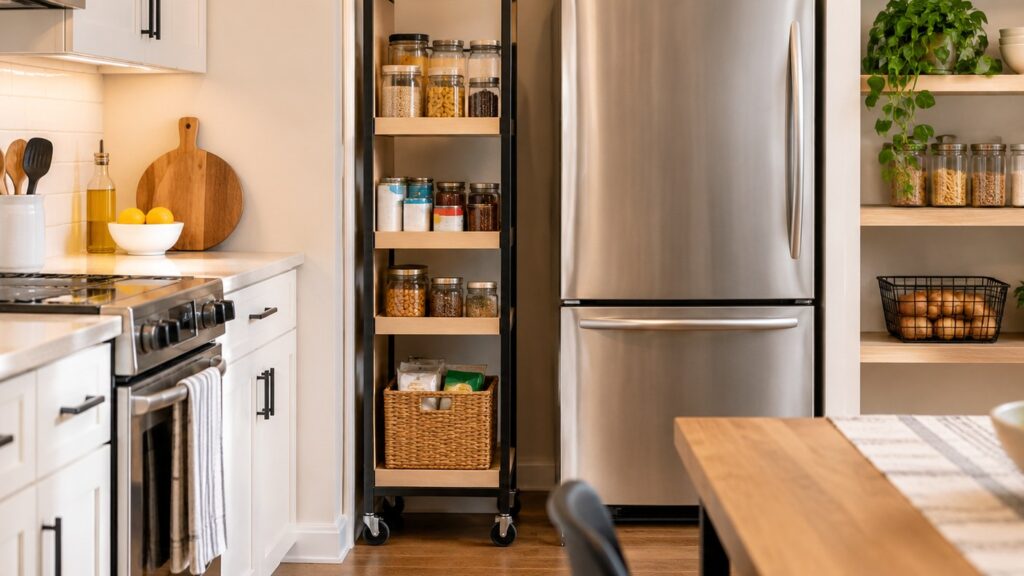
11. Use a narrow rolling cart only in a verified gap
A slim cart can turn a narrow unused strip into accessible storage, but the word “fits” needs more than one measurement.
Measure the gap width, usable depth, height, handle or trim interference, and the straight-line path needed to pull the cart out. If the gap is beside a refrigerator or other appliance, confirm the appliance’s required clearances first. Whirlpool · Samsung
Best for: a true unused gap with an unobstructed pull-out path.
Skip it if: the cart would occupy appliance clearance, rub a door or wall, block a walkway, or require awkward maneuvering every time you use it.
12. Add open wall shelves in a suitable location
Open shelves can move selected items off counters or out of cabinets, but they work best when the wall is genuinely useful rather than simply empty.
Measure the wall, the projection of the shelf, nearby door swings, head/shoulder clearance, and the items you intend to store. If food will be stored there, the location still needs to meet the same cool, clean, dry standard used elsewhere. USDA FSIS
Best for: frequently used lightweight items that benefit from visibility, or non-food items that can leave cabinets and free food space.
Skip it if: mounting is not permitted, the shelf would intrude into circulation, the location is near heat or moisture, or the visual openness would make the kitchen harder for your household to maintain.
13. Move pots, pans, utensils, or tools to an appropriate wall system
If cookware consumes the cabinets you need for food, a safe wall-mounted rail or rack can be a space-release move.
If you use a wall system, follow the actual installation and load instructions for the rail, rack, hooks, anchors, and wall type.
Best for: frequently used tools that are suitable for visible wall storage and have no reason to occupy prime enclosed cabinet space.
Skip it if: you cannot install the system correctly, your lease does not allow the mounting, the wall location creates a bump hazard, or you prefer the items enclosed.
Add a freestanding pantry substitute when you truly have floor space
14. Add a slim freestanding pantry cabinet
A tall pantry cabinet can create the most pantry-like experience without remodeling, but it is also one of the easiest fixes to overbuy.
Measure the full footprint, not only the cabinet width: depth, door-opening space, baseboards, nearby switches or vents, ceiling height, and the walkway that remains after installation. Follow the manufacturer’s assembly and anti-tip instructions; top-heavy furniture should be secured as directed. CPSC
Best for: a room with a real vertical footprint available and a need for enclosed food storage.
Skip it if: the cabinet would narrow circulation, block a door or vent, crowd a dining route, or cannot be assembled and secured properly.
15. Use a sideboard or buffet as closed pantry storage
A sideboard can work well when the kitchen itself has no floor space but the adjacent dining area has a long, low wall.
Measure the furniture depth, door/drawer swing, and the circulation around dining chairs and walkways. If you use it for food, the location should still be cool, clean, and dry. USDA FSIS
Best for: backup food, baking supplies, snacks, or serving-related pantry items in a nearby room.
Skip it if: it makes the dining area cramped or turns frequently used food into a long, inconvenient trip.
16. Use a hutch or bookcase-with-bins in a suitable adjacent area
An adjacent dining nook, hallway recess, or family-room edge can sometimes hold pantry backstock better than the kitchen can.
Treat the furniture as real furniture, not a temporary pile of shelves. Measure footprint, depth, access, door paths, and the safe reach to upper shelves. If the unit is tall or top-heavy, follow its anti-tip instructions. CPSC
Best for: sealed backup goods, lightweight overflow, or categories you do not need during every meal.
Skip it if: the location is damp, hot, hard to inventory, or the furniture would be unstable or obstruct circulation.
17. Use a rolling kitchen cart with storage
A rolling cart can add both storage and a work surface, but only if it has somewhere to live when you are not using it.
Measure the parked footprint and the route the cart needs to move. Check cabinet, appliance, and door clearances in both positions.
Best for: kitchens that have flexible floor space rather than a permanent narrow gap.
Skip it if: the cart will live in the walkway, block a cabinet every day, or force you to move it just to perform basic kitchen tasks.
18. Use a closed console or low cabinet in an adjacent area
If you want pantry backstock nearby without adding another tall piece, a low console can be a calmer option.
Measure depth first; a piece that looks modest from the front can project farther into the room than expected. Also check door or drawer swing and how the furniture affects the route through the space.
Best for: sealed backup foods, paper goods, or pantry-support items that do not need prime kitchen access.
Skip it if: the storage is so low or deep that items will disappear, or if the furniture creates a new circulation problem.
Create an annex or release valve instead of forcing everything into the kitchen
19. Use part of a nearby cool, clean, dry closet as a pantry annex
A coat closet, utility closet, or other nearby storage area can sometimes handle sealed backstock better than the kitchen — but only if the location is actually suitable for food.
USDA’s same storage rule still applies: keep shelf-stable food in a cool, clean, dry place and away from dampness and temperature extremes. USDA FSIS
Use the annex for a defined role rather than letting it become a second miscellaneous closet. Backup cans, unopened dry goods, or bulky sealed packages are easier to manage when the daily-use supply stays in the kitchen.
Best for: backup or bulk food that does not need constant access.
Skip it if: the closet is damp, hot, hard to keep clean, or too far away to inventory reliably.
20. Move lightweight, infrequently used non-food items to the tops of cabinets
The top of a cabinet is better treated as a space-release zone than a food-storage zone.
If the area is stable and safely reachable, lightweight, infrequently used non-food items may be able to move up there and free enclosed cabinet space for food. Do not use the area above or beside a stove as general shelf-stable food storage; USDA specifically warns against heat exposure around the stove. USDA FSIS
Best for: lightweight non-food items you rarely need.
Skip it if: you would need unsafe climbing for routine access, the items are heavy, the area is exposed to cooking heat/grease, or the arrangement is unstable.
21. Keep a very small countertop zone for genuinely daily staples
Not every pantry item has to be inside a cabinet. A small countertop zone can release cabinet space when the items are used constantly and the containers belong on a food-prep surface.
The restraint matters. Choose only truly daily staples, keep the group small, and preserve enough counter space for the kitchen to function.
Best for: a few high-frequency staples whose cabinet space would be more valuable for other food.
Skip it if: the counter is already your scarce resource, the containers would sit near heat or moisture, or the “small zone” keeps expanding into visual and functional clutter.
Quick comparison: what to measure and when to skip each idea
| Idea | Best role | Measure / verify | Skip if |
|---|---|---|---|
| 1. Primary pantry cabinet | Daily-use | Clear shelf W/D/H; hinges/door | No usable cabinet volume or unsuitable food location |
| 2. Deep pull-out bins | Daily / backup | Shelf depth; bin size; door and pull-out path | Cannot clear door/hinges or becomes too heavy |
| 3. Shelf risers | Daily-use | Shelf opening and riser height; door closure | Unstable, blocks visibility, or crowds the shelf |
| 4. Under-shelf baskets | Daily / light | Shelf thickness; basket fit; lower clearance | Interferes with hinges/door or intended load is too heavy |
| 5. Pantry drawer | Daily-use | Inside dimensions; extension path; load guidance | Drawer is not suited to load or will not close freely |
| 6. Turntable | Daily-use | Shelf W/D; turntable diameter/height | Round organizer wastes space or items are unstable |
| 7. Rehome low-frequency appliances | Space-release | New destination size, access and safety | No genuinely better destination exists |
| 8. Cabinet-door rack | Daily / space-release | Door area; hinge/handle clearance; rack depth | Door will not close or product/load is unsuitable |
| 9. Over-door organizer | Backup / daily | Door thickness; trim; swing; organizer depth/load | Blocks door operation or location is unsuitable for food |
| 10. Refrigerator-side non-food storage | Space-release | Surface; door swing; model clearance/service needs | Blocks ventilation, service or door movement |
| 11. Narrow rolling cart | Daily / backup | Gap W/D/H; pull-out path; appliance clearance | Blocks appliance clearance, walkway or pull-out path |
| 12. Open wall shelves | Daily / space-release | Wall; mounting; depth; head clearance; load | Mounting not allowed/secure or location is hot/damp |
| 13. Wall rail for cookware/tools | Space-release | Wall/rail; mounting; item weight; work-zone clearance | Mounting unsafe/not allowed or creates a bump/burn hazard |
| 14. Slim freestanding pantry cabinet | Daily / backup | Full footprint; doors; walkway; anti-tip instructions | Crowds circulation or cannot be installed/secured correctly |
| 15. Sideboard or buffet | Backup / daily | Footprint; interior; doors/drawers; circulation | Cramped circulation or unsuitable food-storage conditions |
| 16. Hutch/bookcase with bins | Backup / overflow | Footprint; shelf size/load; circulation; stability | Unstable, overloaded or unsuitable food location |
| 17. Rolling kitchen cart | Daily / backup | Parked footprint; movement route; clearances; load | Lives in the walkway or has no stable parking position |
| 18. Low console/cabinet nearby | Backup / overflow | Depth; interior; doors/drawers; circulation | Blocks circulation or makes items disappear |
| 19. Nearby closet annex | Backup / overflow | Shelves; access; cleanliness; temperature/moisture | Damp/hot, hard to inventory or mixed-use contamination risk |
| 20. Top-of-cabinet non-food storage | Space-release | Top clearance; safe reach; stability; heat/grease exposure | Heavy items, unsafe climbing, unstable or near stove heat/grease |
| 21. Small daily-staple counter zone | Daily-use | Counter footprint; container size; work/appliance clearance | Crowds prep space, sits near heat/moisture or keeps expanding |
Quick comparison for the 21 no-pantry storage ideas. Use the full article text for safety and renter nuance.
Pantry spots that look useful but can be bad choices
A no-pantry kitchen encourages creative thinking, but a few “unused” zones deserve extra skepticism.
Above or beside the stove for shelf-stable food
Avoid treating this as general pantry space. USDA warns against storing canned and other shelf-stable food above or beside the stove, so do not treat that zone as general pantry space. USDA FSIS
Under the sink for shelf-stable food
This is another poor default pantry zone. USDA guidance warns against storing dry goods in damp locations and specifically cautions against under-sink storage for shelf-stable foods. USDA FSIS
Refrigerator clearances
Do not fill a gap beside, behind, or above the refrigerator just because a cart or rack fits there. Check the exact appliance manual for required ventilation, door, installation, and service clearances. Those requirements are model-specific. Whirlpool · Samsung
Tall furniture that is not assembled or secured correctly
A tall pantry cabinet is only useful when it can be installed safely. Follow its actual assembly and anti-tip instructions. CPSC’s Anchor It guidance recommends securing top-heavy furniture to reduce tip-over risk. CPSC
Storage that blocks a walkway, door, or pull-out path
If the new storage makes you work around it every day, it has not reduced household friction. Check the movement paths the kitchen uses in real life: refrigerator and appliance doors, drawers, nearby doors, and the proposed storage should operate without colliding or forcing a blocked route.
Anything that “almost fits”
Almost is not enough for drawers, doors, hinges, rolling carts, or appliances. Measure the clear opening and the movement path, not only the advertised width of the item you hope to add.
A simple order of operations
If you want to turn this article into a plan instead of a wish list, do the work in this order:
1. Veto unsuitable locations. Remove hot, damp, mechanically restricted, unsafe, or circulation-blocking zones from consideration.
2. Measure what remains. Record the clear width, depth, height, interference, access, and movement path.
3. Assign roles. Put daily-use food in the easiest safe location, backup food in a suitable secondary zone, and light low-frequency items in less convenient storage.
4. Move non-food first when it makes sense. Freeing one good cabinet may solve more than buying several small organizers.
5. Choose the smallest intervention that solves the remaining shortage. A riser may be enough. A full-height pantry cabinet may be justified. The room decides.
6. Re-check the kitchen after the storage is loaded. Doors should still open, the walkway should still work, and frequently used items should still be easy to reach.
Build a pantry function, not a pantry look
A pantry-less kitchen does not need to imitate a walk-in pantry to work well.
Start with the spaces that are safe and usable. Give the best one to the food you reach for most. Move low-frequency non-food items when they are consuming prime storage. Then add only the organizer, shelf, cart, or cabinet that solves the shortage you can actually measure.
Before buying anything, complete the no-pantry space map. One careful measurement round can eliminate ideas that do not fit your kitchen — and make the viable options much easier to choose.