How to Organize Family Snacks: A Simple Pantry, Fridge and Backstock System
A snack drawer can be tidy right after groceries are put away and crowded again a few days later. The drawer may not be the real problem. It is that one small space is being asked to do too many jobs at once: hold what people want today, store unopened extras, supply lunchboxes and somehow represent what is waiting in the refrigerator too.
Instead of starting with more bins, give each part of the snack system one clear job. Keep a small amount of everyday shelf-stable food in a ready-now area, keep foods that require refrigeration in the refrigerator, move unopened reserve stock out of the daily-use zone, and choose one visible cue that tells you when it is time to refill.
The aim is not a showroom pantry. It is a household system whose zones are visible at a glance—and can be adjusted when the household, the space or the routine changes.
Start with the jobs, not the organizers
Before you empty a drawer or order a set of matching containers, write down what your snack storage actually needs to do.
A practical way to map the jobs is to use a few groups:
- Ready now: shelf-stable snacks used routinely.
- Cold: foods that need refrigeration.
- Backstock: unopened reserve food that does not need to occupy the daily-use area.
- Purpose-specific, if useful: food you intentionally group for a lunchbox, work bag or another repeated routine.
- Refill: the signal that tells you when working stock needs to be replenished from reserve stock.
You may not need all five. In a small kitchen, three zones can be enough: ready now, cold and backstock. The point is not to create more categories. It is to stop one drawer, cabinet or bin from carrying every role.
If the real problem is that you simply do not have enough pantry capacity, solve that first. Our guide to 21 Storage Ideas for Kitchens With No Pantry focuses on where additional usable storage can come from. This article assumes you have at least some place for daily stock and some place for reserve stock; the task here is deciding what belongs where.
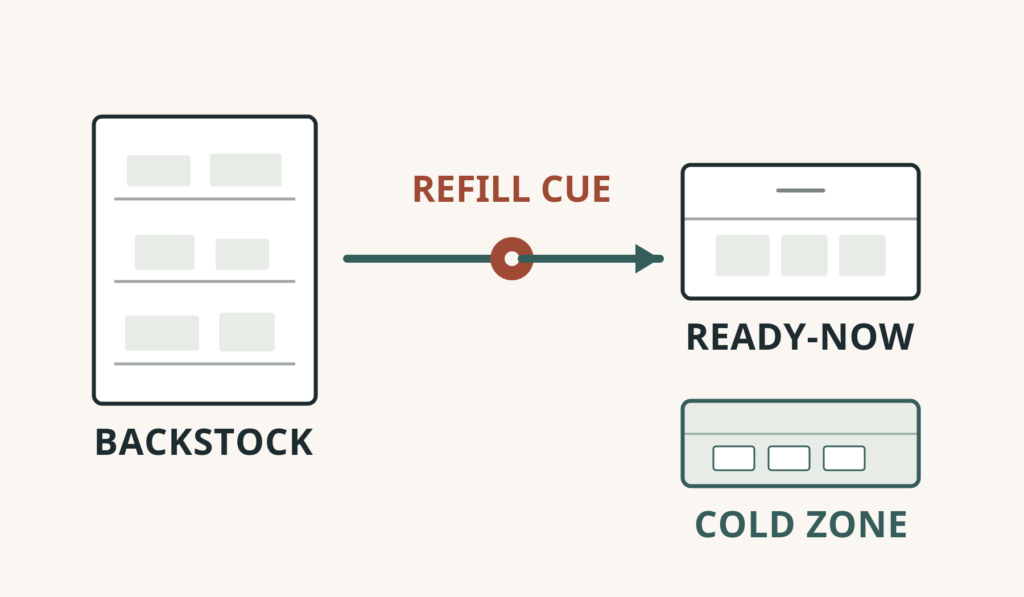
Build a small Ready-Now Zone
Choose one drawer, cabinet shelf or shallow bin for the shelf-stable snacks people use most often. This is working stock, not the household warehouse.
Start with a small amount. There is no universal number of bars, crackers, pouches or other snacks that belongs in a daily zone because households use food at different rates. The useful question is simpler: How much can this space hold without hiding what is already there?
Broad categories can help if they match how your household looks for food. For example, you might separate grab-and-go items from snacks that need a plate, or keep lunchbox items together if that is a frequent routine. But do not create six labeled sections just because a container set has six compartments.
A category should earn its maintenance. If everyone ignores it, merge it.
Containers are optional here. A drawer divider, shallow bin or reused open container can keep packages from sliding around, but the system should still make sense before you buy anything. Decide the job first; choose the tool second.
Give refrigerated snacks a separate Cold Zone
The refrigerator is part of the snack system even if it is across the kitchen from the pantry or cabinet.
Foods that require refrigeration should stay refrigerated. The U.S. Food and Drug Administration says refrigerators should be kept at 40°F or below, and it also advises against overpacking because cold air needs to circulate around refrigerated food.
That means a useful cold snack zone is not the biggest bin you can wedge into a shelf. It is a visible, bounded area that still allows the refrigerator to do its job.
You might use part of a shelf, a shallow refrigerator bin or an existing drawer for refrigerated grab-and-go items. Follow the product’s storage directions, and do not move a food into the pantry simply because that location would be more convenient.
Keep reserve quantities in check here too. If the cold zone is so full that older items disappear behind unopened extras, the reserve stock is taking over the working area. Reduce what is kept in the ready-to-grab section instead of adding another layer of bins.
Move unopened reserve food into Backstock
Backstock is the unopened reserve that refills the daily-use zones. It does not need to compete for the easiest-to-reach space.
For shelf-stable foods, USDA food-storage guidance recommends a cool, dry storage location. USDA’s Shelf-Stable Food Safety guidance also makes clear that some packaged products still require refrigeration, so package-specific storage directions matter.
That can make a higher cabinet shelf, a deeper pantry section or another suitable dry-storage location useful for reserve food—provided the location fits the product’s storage directions and your home.
The important distinction is available now versus reserve. If every unopened package is poured into the daily drawer the day groceries come home, you lose that distinction. The visual difference between working stock and reserve stock disappears, and there is no obvious moment when the ready-now zone needs a refill.
Keep the reserve separate enough that you can answer two questions quickly:
- What can someone grab now?
- What is still waiting to refill it?
You do not need a formal inventory system to get that clarity.
Add a Purpose Zone only if it solves a real handoff
A separate lunchbox or work-snack area can be useful when one repeated routine keeps interrupting the general snack storage. But it is optional.
If you routinely pack several items from the same group, a small purpose zone can keep those repeatedly packed items together. If the same food is already easy to reach in the ready-now zone, creating another category may only create another place to maintain.
Use a simple test: Does this zone remove a repeated decision, or does it duplicate another zone?
If it duplicates, skip it.
Keep the Purpose Zone focused on the packing routine. It does not need to become a separate set of nutrition, portion or age-based rules. Its job here is storage workflow.
Preserve the information you still need
Decanting snacks into clear containers can make a shelf look tidy, but packaging also carries useful information.
For households managing food allergies, that information can be especially important. FDA guidance says labels on most packaged foods marketed in the U.S. disclose major food allergens, and advises consumers with food allergies to read the full ingredient information because not every product uses a separate “Contains” statement. Ingredients can also change, so labels should be checked each time a product is purchased.
If anyone in your household relies on ingredient or allergen information, keep the original package accessible or preserve the relevant label information when you reorganize food. The same practical rule applies when storage directions, dates or product identification matter.
This does not mean every snack must stay in its retail box. It means the visual neatness of a container should not erase information the household may need later.
Choose one refill cue
To make refill state explicit, choose one visible sign that the ready-now zone needs more stock.
The cue does not have to be clever. It can be:
- an empty section at the back of a bin;
- a household-defined minimum line;
- a small restock note;
- a designated row that is refilled only from reserve stock.
Choose one method and use it consistently.
When the cue appears, refill the ready-now area from backstock. When backstock itself reaches the level your household has chosen, add the item to the shopping list.
The useful part is the sequence:
use → cue → refill from reserve → restock reserve when needed
The sequence keeps the roles separate: daily use, refill from reserve, then reserve restocking.
What to buy only after the system works on paper
You may already own everything you need.
Before buying organizers, sketch the zones or place temporary notes where they might go. If the system still makes sense after you assign the jobs, then decide whether a physical organizer solves a specific problem.
A few tool types can be useful:
- Shallow bins when packages disappear behind one another.
- Drawer dividers when loose packages slide into one pile.
- Simple labels when two zones look similar but have different jobs.
- Refrigerator bins when they create a visible cold zone without crowding the shelf.
Measure the space before buying, and check that the organizer itself does not make access or refrigerator airflow worse.
Do not buy a six-bin system because six bins fit in a photo. Buy—or reuse—only what has a job.
If the snack system keeps breaking down
| What you see | Likely system problem | Try this instead |
| The daily drawer is always overflowing | Reserve stock is living in working space | Move unopened reserve to Backstock and keep a smaller working quantity |
| The refrigerator snack bin is packed tightly | The cold working zone is holding too much reserve | Reduce the working quantity and preserve normal cold-air circulation |
| Nobody knows what needs refilling | There is no visible refill cue | Pick one cue: an empty section, minimum line or restock note |
| Ingredient or allergen information gets lost | Packaging is discarded before information is preserved | Keep the original package accessible or save the relevant label information |
| The system has too many labels and categories | It is organized by container capacity instead of household use | Collapse categories into broader groups people actually use |
| A lunchbox/work bin never stays sorted | The Purpose Zone duplicates Ready-Now | Merge it into the general daily zone |
Before adding another bin, check whether the failing zone is carrying too many jobs. If it is, remove a job before changing the container.
A simple setup sequence
You can build the system in this order:
- Name the jobs. Decide whether you need ready-now, cold, backstock and an optional purpose zone.
- Choose the locations. Use the space you already have before buying organizers.
- Separate working stock from reserve stock. Do not fill the daily zone with every unopened package.
- Check food-storage and label constraints. Keep refrigeration-required foods cold and preserve package information that matters.
- Choose one refill cue. Make the next action visible.
- Add organizers only where they solve a specific problem. Measure first.
Then live with the arrangement long enough to notice which zone keeps failing. If a zone is always overflowing, empty, ignored or duplicated, change the role before changing the container.
The goal is fewer jobs per zone, not more bins
A practical family snack system does not need to make every package look identical. Its design goal is to make the household’s next action visible.
Keep a small amount ready now. Keep refrigerated food where it belongs. Put reserve stock somewhere appropriate instead of letting it crowd the daily area. Preserve the information you still need. Use one cue to tell you when to refill.
Once those jobs are clear, the bins and labels become the easy part.