Renter-Friendly Wall Storage: What to Use When You Can’t Drill
A blank wall in a rental can look like storage space waiting to happen. Then the practical questions start: Can you drill here? Will an adhesive shelf hold on this paint? What if the wall is textured? Is the item too heavy? What happens if the mount lets go?
That is why “no drill” is not enough information by itself.
A renter-friendly storage choice has to fit the actual wall, the actual item and the actual rules for the home. Sometimes that means a removable wall product. Sometimes it means using the door, furniture or floor instead. And sometimes the better answer is to ask for permission to install a conventional fixing rather than make a temporary product do a job it was not designed to do.
Use this five-part check before buying anything: permission, surface, load, consequence of failure and whether the storage job can be solved without the wall.
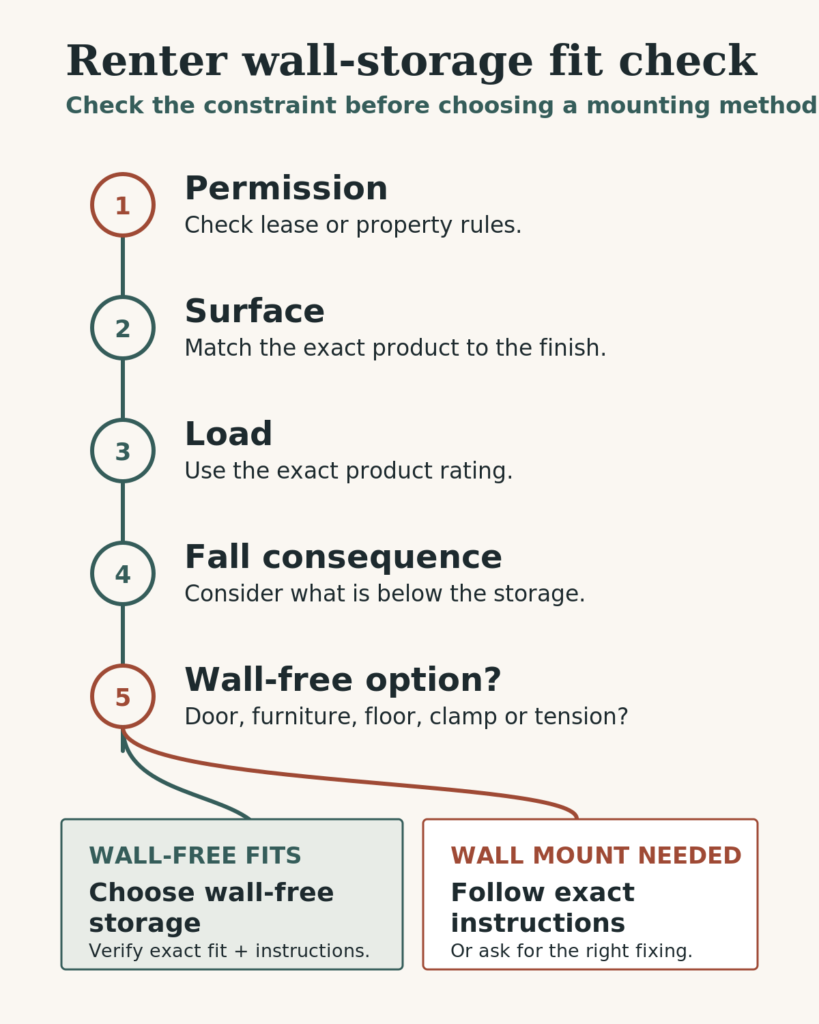
Start with the storage job, not the wall
Before choosing hooks or shelves, name the problem you are trying to solve.
Do you need a place for a daily bag by the door? A few light bathroom items? Cleaning tools that keep falling over? Office supplies above a desk? Or enough capacity for books, pantry goods or several baskets?
Those are not the same storage job.
A light item that is easy to replace creates a very different decision from a shelf carrying heavy or valuable things. The more capacity you need, the less useful it is to start with the question, “Which adhesive shelf should I buy?”
Instead, ask:
- What needs to be stored?
- How often do you use it?
- How much does it weigh?
- Would a fall merely be annoying, or could it hurt someone or damage something important?
- Does it actually need to be on the wall?
If the real problem is that your kitchen simply does not have enough usable storage, solve that capacity problem first. Our guide to 21 Storage Ideas for Kitchens With No Pantry looks at where additional storage can come from before you add another organizer.
Check what your rental actually allows
Do not assume that every rental has the same rules.
Read the relevant part of your lease or property guidance. If it is unclear, ask the property manager or landlord before making a permanent change. The useful distinction is not “renters never drill.” It is whether your particular home allows a fixing, allows it with permission, or requires a removable approach.
That matters because a no-drill workaround is not automatically the best solution for every load.
If the storage job needs more capacity than a removable product is designed to carry and a conventional fixing is the right method, asking for written permission can be more sensible than trying to make a temporary product do a job outside its intended use.
If drilling is not allowed—or you simply prefer not to do it—move to the next checks instead of treating adhesive as the only alternative.
Inspect the surface before choosing adhesive or suction
The phrase “painted wall” hides a lot of differences. Paint can be fresh, old, weak, glossy, matte or sitting over a surface the mounting product does not support. Wallpaper, texture, brick, tile and glass behave differently too.
The exact product instructions matter more than a general article about “renter-friendly” storage.
For example, 3M’s instructions for Command Picture Hanging Strips tell users to wait seven days after painting, clean with rubbing alcohol, follow a specific waiting period before loading and use a specific stretch-removal method. The same instructions say not to use the strips on wallpaper and not to hang them over beds. A separate Command product page excludes surfaces such as textured walls, brick and rough surfaces for that product.
That does not mean every removable adhesive product follows the same rules. It means the surface check cannot be skipped.
Suction products have their own limits. IKEA’s TISKEN suction basket, for example, is specified for flat surfaces such as glass, mirrors and tile. IKEA also warns against attaching that product to wallpaper because it can damage the material.
If the manufacturer excludes your surface, choose another method rather than trying to compensate with more adhesive or more strips.
Match the method to the load—and to what happens if it falls
A product rating only applies to the product and configuration that earned that rating.
Do not take a weight number from one hook, strip or shelf and assume it applies to another. Even within one brand, different products can have very different limits and installation requirements.
Before mounting anything, check the exact weight of what you plan to store and the exact manufacturer limit for the product you are considering. Leave room for the reality that storage changes: a basket that begins with two light items can quietly become the place where everything gets dropped.
Then look beyond the number.
What is underneath the storage? A clear patch of wall? A desk with a laptop? A place where someone sits or sleeps? A countertop with breakable items?
Some manufacturers already build this consequence check into their warnings. 3M, for example, tells users of its picture-hanging strips not to hang them over beds and not to use them for valuable or irreplaceable items.
You do not need a universal rule. You do need to recognize when a fall would be more than an inconvenience. In those locations, use a method designed for the job—or move the storage somewhere else.
Try wall-free vertical storage before forcing the wall
If the wall is questionable, the next question is not “Which stronger adhesive should I use?” It is “Can I get the same function without attaching storage to this wall?”
Several categories are worth checking.
Over-door storage
An over-door hook or rack uses the top edge of the door instead of the wall. IKEA’s SEKINER hook is one simple example of that mechanism: it hangs over the door edge and can be attached or removed without wall mounting.
Before buying, measure the door and the product. Make sure the door can still close and move normally and that the organizer will not interfere with trim or nearby hardware.
This method is useful for things such as bags, robes, towels or other daily items when the door is in the right place for the routine.
Storage that attaches to furniture instead of the wall
Some organizers are designed to clamp, hook or attach to an existing shelf, desk, cabinet frame or other furniture edge. When the product is designed for that surface, it can create vertical storage without asking the wall to carry the load.
The same rule still applies: verify fit and capacity for the exact product. A clamp that fits one desk edge may not fit another.
Small freestanding storage
A slim cart, low shelving unit or other freestanding piece can create vertical capacity without relying on the wall.
The tradeoff is floor space. If the room can spare a narrow footprint, that may be a cleaner solution than covering a questionable wall with temporary mounts. Follow the furniture manufacturer’s assembly and safety instructions; “freestanding” is not a reason to ignore them.
Purpose-built tension systems
Some storage products use tension or pressure between surfaces rather than screws in the wall. They can be useful in the right niche, but the exact fit, surfaces and load still depend on the product.
A Yamazaki tension-rack product, for example, explicitly ties its usable load to the capacity of the supporting tension rods and tells users to make sure those rods are securely installed. That is a useful reminder: “tension” is a method, not a universal capacity rating.
Use adhesive only when the product, surface and load all fit
Adhesive storage can be useful. The mistake is treating it as the default renter solution before checking anything else.
Use it only when all of these are true:
- the exact product is intended for the surface you have;
- the wall finish meets the manufacturer’s conditions;
- the item and loaded organizer stay within the exact product limit;
- the location is appropriate for the product’s warnings;
- you can follow the required prep, waiting and removal steps;
- a failure would not create an unacceptable risk.
Keep the packaging or save the instructions until you remove the product. Removal is part of the installation decision. If the manufacturer tells you to stretch a tab slowly in a particular direction, that is not an optional detail to remember months later.
Do not assume that a product marketed as removable will have the same removal result on every rental surface. The honest standard is narrower: use the exact product only where its instructions say it belongs, and remove it the way the manufacturer specifies.
Use suction only on the surfaces the product specifies
Purpose-built suction storage can be useful where the exact product specifies a smooth surface such as glass or tile, but suction is not a generic substitute for wall mounting on every surface.
Again, the exact product controls. IKEA’s TISKEN basket is specified for flat surfaces such as glass, mirrors and tile, with its own load limit and cleaning instructions. It also carries a wallpaper warning.
If your surface is not one the product specifies, skip it. A suction cup that works well on tile does not become a painted-wall product because the room needs storage.
When the better answer is to move the storage job—or ask permission
Sometimes the fit check ends with a useful answer: the wall is not the right place for this item.
That is not a failure. It is better information.
If a removable method does not fit the exact product instructions or the consequence-of-failure screen, try one of three moves:
- Change the location. Put the item on a door, inside a cabinet, on an existing furniture frame or in a narrow freestanding unit.
- Change the storage job. Keep only the daily-use items in the convenient spot and move reserve items elsewhere.
- Ask whether a conventional fixing is permitted. If the wall-mounted solution genuinely needs hardware, permission may be a better route than overloading a temporary product.
The goal is not to prove that every rental wall can hold storage without holes. The goal is to create useful storage without making the home harder to use or turning a temporary mount into a permanent worry.
Quick fit check: which direction should you try first?
Use this as a starting point, then verify the exact product before installation.
| What you know | Better first direction | Skip / caution | Verify before use |
| No wall modification allowed + lightweight daily items | Over-door, furniture-attached, clamp-on or small freestanding storage | Do not assume adhesive is required | Dimensions, fit, exact product instructions |
| Smooth glass, mirror or tile + small bathroom items | Suction product designed for that surface | Skip wallpaper or surfaces the product excludes | Surface, load, cleaning and removal instructions |
| Smooth, fully cured painted wall + light item | Removable adhesive may be a candidate | Skip excluded surfaces and high-consequence locations | Exact product surface rules, rating, prep and removal |
| Textured, wallpapered, fresh or questionable paint | Wall-free method first | Do not force a product onto a surface it excludes | Lease/property rule, surface condition, product instructions |
| Heavy, valuable or high-consequence storage | Wall-free capacity or permission-based conventional solution | Do not improvise with light-duty removable mounting | Exact product/installation requirements and property permission |
A simple install-and-removal checklist
Before installing a removable storage product:
- Read the full instructions for the exact product.
- Confirm the surface is approved.
- Confirm the loaded item stays within the exact rating.
- Prepare the surface only as directed.
- Respect any waiting time before loading.
- Keep the removal tab or release mechanism accessible if the product needs it.
- Save the instructions or packaging until move-out or removal.
- Remove the product using the manufacturer’s method rather than improvising a different removal method.
None of those steps can guarantee that every rental surface will finish perfectly. They do give you a more defensible process than choosing a mount because an online list called it renter-friendly.
The most useful question is not “What can I stick to this wall?” It is “What is the least complicated method that fits this storage job, this surface and this home?”
Start there, and the wall becomes one option instead of the only option.