Toilet Paper Storage for a Small Bathroom: Decide What Stays in the Room Before You Buy a Holder
A small bathroom can have plenty of places where toilet paper could go and still have no good place for it.
A freestanding holder fits beside the toilet but becomes one more thing to move when you clean. A basket looks tidy until it starts holding the whole bulk package. A narrow cabinet seems made for small spaces until its door cannot open properly. A wall holder saves floor space, but only if the wall, projection and mounting method work in the room you actually have.
The first decision is not which organizer looks best.
It is which toilet-paper job needs to happen in this bathroom.
On this page
- The quick answer: separate the three toilet-paper jobs
- Decide what actually needs to stay in this bathroom
- Map the usable locations before you shop
- Keep spare toilet paper clean and dry
- Put the in-use roll where normal use works
- Test floor storage against the cleaning path
- Measure wall-mounted holders before you drill
- Test narrow cabinets by the whole operating envelope
- Seven layouts to test—not seven universal recommendations
- Use this toilet-paper placement-and-fit worksheet
- Worked example: why the narrowest product is not always the best fit
- Common toilet-paper storage mistakes in a small bathroom
- Before you buy a toilet-paper holder or storage cabinet
- When bulk toilet paper belongs outside the bathroom
- A useful toilet-paper setup solves the job without stealing the room
The quick answer: separate the three toilet-paper jobs
Treat toilet paper as three different storage jobs:
- In-use roll: the roll being used now. It needs to work in normal bathroom use.
- Immediate spare: the backup roll or small reserve the household genuinely needs in the room.
- Bulk stock: the larger package waiting to replenish the bathroom.
Those jobs do not need the same location.
In a very small bathroom, the in-use roll may belong beside the toilet, one immediate spare may fit in a cabinet or contained dry spot, and the rest of the package may work better in a nearby closet or another clean, dry reserve location.
That split matters because a bathroom can fail when it is asked to store the whole package simply because that is where the rolls are used.
Use this sequence before you shop:
ROLL JOB → LOCATION → CLEAN + DRY → ACCESS → CLEANING PATH → PRODUCT FIT → INSTALLATION → KEEP / MOVE / BUY / SKIP
The goal is not to maximize the number of rolls in the room. It is to make the right roll available without creating another bathroom problem.
Decide what actually needs to stay in this bathroom
Start with the household rather than the holder.
Ask three questions:
- Where does the in-use roll need to be for normal use?
- How much immediate backup does this bathroom genuinely need?
- Can the bulk package live somewhere else without making replenishment annoying?
There is no useful universal answer to the second question. One household may want a spare roll in every bathroom. Another may have a linen closet directly outside the door and need very little reserve inside the room.
That is why “how many rolls should a bathroom store?” is the wrong starting point.
Instead, look at what competes for the same limited storage:
- towels;
- daily toiletries;
- cleaning supplies;
- medicine or personal-care items that have their own storage requirements;
- spare hand towels;
- trash supplies;
- toilet paper.
If four bulky rolls take the only easy-to-reach cabinet shelf, the question is not whether they technically fit. The question is whether toilet-paper reserve deserves that shelf more than the other repeated bathroom jobs.
Bulk toilet paper is also not the same problem as broader bathroom backstock. A multi-category refill system for toiletries, tissues and reserve supplies is a separate household inventory job. Here, bulk toilet paper only matters long enough to decide whether it belongs in this bathroom at all.
Map the usable locations before you shop
Now look at the bathroom as a set of possible locations.
Do not begin with products. Begin with the spaces that actually exist.
Possible candidates might include:
- a usable side wall beside the toilet;
- a small floor strip beside or near the toilet;
- an existing vanity or cabinet;
- a narrow vertical space between fixtures;
- an over-toilet zone;
- a dry shelf or cabinet already in the room;
- a nearby clean, dry location outside the bathroom for bulk stock.
For each candidate, record what matters.
Width: How much horizontal room is genuinely available?
Depth or projection: How far can a holder, basket or cabinet project before it interferes with a fixture, door, legroom or passage?
Height: Is there vertical room for the item and any door, lid or shelf operation?
Fixture conflict: Will the storage compete with the sink, toilet, shower door, bathroom door, vanity door or another required function?
Cleaning path: Can you still reach the floor, toilet base and surrounding surfaces without turning storage into a repeated obstacle?
Installation: If the solution mounts to a wall, is that wall actually usable for the exact installation method?
The important measurement is the usable location, not the empty-looking gap.
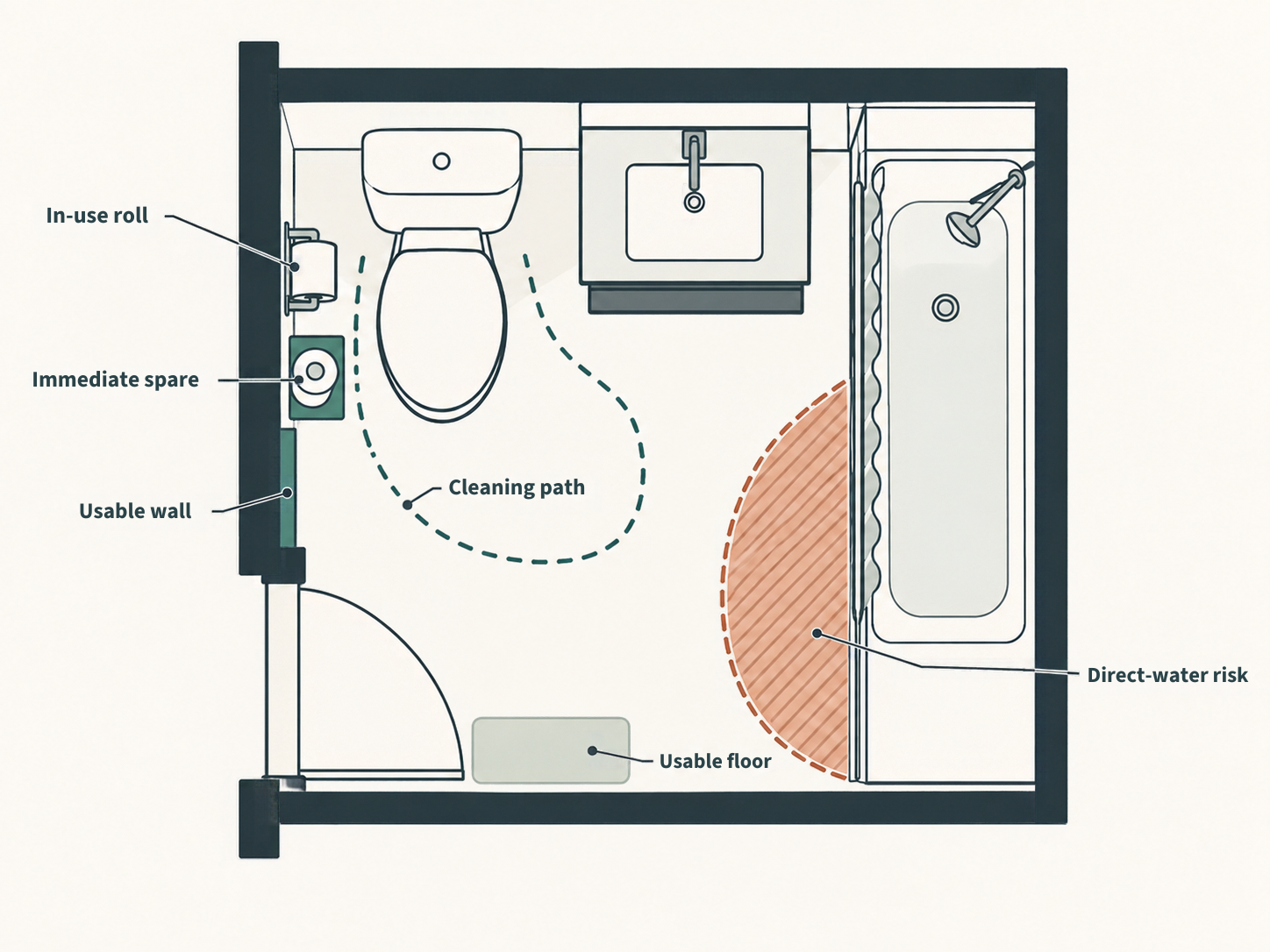
A narrow strip can look perfect in a photo and still fail once the product has depth, a door that swings outward, a roll that projects from the wall or an anchoring requirement.
Keep spare toilet paper clean and dry
Toilet paper is a paper product. Reserve rolls need a clean, dry storage location.
Kimberly-Clark Professional states that its toilet paper has an unlimited shelf life when stored in a clean, dry area: https://www.kcprofessional.com/en-us/faqs
For a household bathroom, that supports a simple rule: do not choose a reserve location where the paper is likely to get directly wet.
Check for obvious exposure such as:
- direct sink splash;
- shower splash;
- a location regularly hit by wet-floor cleaning;
- a known leak-prone area;
- a floor spot where rolls can contact water.
That does not mean every roll stored in a bathroom needs to be sealed in a waterproof container.
It also does not justify claims that normal bathroom humidity automatically ruins toilet paper. The useful boundary is much simpler: keep spare paper clean and dry, and move reserve stock elsewhere if the bathroom cannot do that reliably.
Be careful with product language too.
A cabinet may use bathroom-suitable materials or humidity-resistant edge treatment without making the contents waterproof. For example, IKEA says the NYSJÖN bathroom cabinets use protective edge bands fixed with humidity-resistant glue. That is a material/construction detail, not a promise that stored paper can tolerate direct water.
Put the in-use roll where normal use works
The in-use roll has the most repeated job, so test it separately from reserve storage.
A good-looking location can still fail if the roll is awkward to use.
Ask:
- Can the intended household user reach the roll during normal use?
- Can the roll be changed without removing unrelated items?
- Does the holder project into a tight space?
- Does a vanity, wall, bin or cabinet make access awkward?
- Does the holder interfere with another fixture or a narrow passage?
Do the test in the real room rather than copying a number from a diagram.
Some manufacturer installation guides provide recommended tissue-holder locations for their own product families. Those instructions can be useful for that exact product and installation context, but they are not a universal answer for every bathroom, user or holder.
If accessibility requirements are important in the household, treat that as a specific design requirement and use the appropriate current accessibility guidance for that situation rather than a generic article measurement.
For the ordinary storage decision here, the practical test is simple:
Can the in-use roll be reached and replaced normally without making another bathroom function worse?
Test floor storage against the cleaning path
Freestanding toilet-paper storage can be useful because it avoids wall mounting.
It can also turn a tiny floor area into a maintenance problem.
Before choosing a floor holder, basket or narrow cabinet, test the space as if you were cleaning the room.
Ask:
- Can you clean around the toilet base?
- Can you reach the wall and floor behind the unit?
- Must the storage be moved every time you clean?
- Does it block a vanity door, bathroom door or shower door?
- Does it sit in a spot that routinely gets wet?
- Does it make the room feel physically tighter because people have to step around it?
None of those questions automatically disqualifies floor storage.
A small stand that moves easily may be perfectly workable for one household. A heavier cabinet wedged beside the toilet may be annoying enough that the same square inches are better left open.
That is the tradeoff to make visible.
The floor footprint is not “free” just because an organizer fits there.
Measure wall-mounted holders before you drill
Wall-mounted holders can protect scarce floor space, but the product still has an operating envelope.
Do not measure only the width of the mounting plate.
Check:
- total assembled width;
- how far the holder projects from the wall;
- the roll-change or pivot movement;
- usable wall area;
- nearby vanity or toilet clearance;
- the wall material;
- the manufacturer’s required mounting method.
For example, Delta lists its Trinsic tissue holder model 75950 at 7 inches wide, 3 5/16 inches deep and 1 1/8 inches high. Delta also publishes mounting guidance tied to the wall condition and provides mounting hardware and a template: https://www.deltafaucet.com/bathroom/product/75950.html
Those dimensions are not a recommendation for your bathroom.
They demonstrate why the phrase “it goes on the wall” is not enough. A holder still occupies real width and projection, and the wall still has to accept the exact installation.
The same rule applies to another brand or model: use its current instructions, not a measurement copied from a different holder.
If drilling is not acceptable in your home or rental, that changes the option set. It does not make every adhesive or no-drill product automatically damage-free or suitable. Those claims need to be verified for the exact product and surface.
Test narrow cabinets by the whole operating envelope
A cabinet can look like the obvious answer because it hides extra rolls and uses vertical space.
But “narrow” is a marketing description, not a fit test.
A cabinet has at least four physical questions:
- Does the body fit?
- Can the door open?
- Can you reach what is inside?
- Can it be installed or anchored as required?
The IKEA NYSJÖN high cabinet is a useful example of why exact dimensions matter. IKEA currently lists model 204.708.15 at 11 3/4 inches wide, 10 5/8 inches deep and 74 3/4 inches high. The door can be mounted to open left or right, and IKEA says the cabinet must be secured to the wall: https://www.ikea.com/us/en/p/nysjoen-high-cabinet-white-20470815/
That is not a recommendation to buy it.
It is evidence that even a cabinet designed for limited space has a real footprint, a door-direction decision, full-height implications and an anchoring requirement.
Under-sink storage needs the same discipline.
IKEA’s NYSJÖN sink cabinet, model 604.704.08, is currently listed at 19 5/8 inches wide, 12 5/8 inches deep and 32 5/8 inches high. IKEA specifically notes room for piping at the back and includes toilet paper among the items the shelf space can hold: https://www.ikea.com/us/en/p/nysjoen-sink-cabinet-white-60470408/
That does not mean every sink area is usable toilet-paper storage.
A pedestal sink may have no cabinet at all. Another vanity may already be full. Plumbing, leaks, cleaning supplies or the cabinet’s other jobs may make under-sink storage a poor choice.
The exact room still decides.
Seven layouts to test—not seven universal recommendations
These are not ranked designs. They are seven common patterns to test against the same questions: job, access, clean/dry storage, cleaning, fit and installation.
1. Side-wall holder with spare stock elsewhere
This can work when:
- the side wall is usable;
- the holder fits without excessive projection;
- the wall can accept the exact installation;
- the bathroom does not need an in-room reserve.
Its strength is simplicity.
Its failure mode is equally simple: the wall, reach or mounting method does not work in the real room.
2. Side-wall holder with one contained immediate spare
This keeps the in-use roll separate from a small backup.
It can work when:
- the bathroom genuinely needs an immediate spare;
- the spare location stays clean and dry;
- the contained reserve does not interfere with cleaning.
Watch for reserve creep.
A one-roll backup can quietly become a basket holding half a bulk package, using space that was supposed to stay open.
3. Freestanding holder with reserve
A stand can avoid wall installation and combine the active roll with backup storage.
Test:
- the floor footprint;
- the unit’s stability;
- how easily it can be moved for cleaning;
- whether the reserve stays dry;
- whether people have to step around it.
It is a poor fit when the bathroom is so tight that every floor object becomes an obstacle.
4. Existing vanity or cabinet reserve with a separate in-use holder
This can be efficient when the bathroom already has genuinely usable cabinet space.
Check:
- plumbing;
- other daily-use items;
- leak exposure;
- shelf access;
- whether toilet paper is displacing a more important bathroom job.
The cabinet is not automatically the best reserve location merely because it closes.
5. Narrow cabinet beside the toilet
This layout can combine reserve storage with a small footprint.
It passes only if:
- the exact width and depth fit;
- the door or drawer can operate;
- the unit can be anchored if required;
- the contents are reachable;
- the cleaning tradeoff is acceptable.
A cabinet can be slim and still be too deep for the only usable strip of floor.
6. Over-toilet storage for immediate reserve
This uses vertical space instead of floor space.
Test:
- the exact product footprint;
- toilet/tank access;
- wall mounting or freestanding support;
- normal cleaning;
- retrieval;
- whether the storage crowds the room.
Toilet-paper placement is only one use of the above-toilet zone. A broader above-toilet storage decision is a separate problem because that area may also be expected to store towels, toiletries or other items.
7. Split storage: in-use roll in the bathroom, bulk stock outside
This is often the most useful pattern to test in a genuinely small room.
The bathroom keeps only the job it must perform.
The bulk package moves to a nearby clean, dry location.
The test is convenience: if reserve stock is so far away or poorly assigned that the bathroom repeatedly runs out, the split needs adjustment.
The principle is not “store less at all costs.”
It is “do not make a tiny bathroom carry a bulk-storage job it does not need.”
Use this toilet-paper placement-and-fit worksheet
Use one row for each real location you are considering.
| Job | Candidate location | Available width | Usable depth / projection | Usable height | Reach / use test | Clean / dry test | Cleaning impact | Product model | Exact product dimensions | Operation / opening | Mounting requirement | Decision |
|---|---|---|---|---|---|---|---|---|---|---|---|---|
| In-use roll | KEEP / MOVE / BUY / SKIP | |||||||||||
| Immediate spare | KEEP / MOVE / BUY / SKIP | |||||||||||
| Bulk stock | KEEP / MOVE OUT / SKIP |
A product only earns the space after the location has a job.
That order prevents a common mistake: buying a clever-looking bathroom organizer and then trying to invent a reason for it to stay.
Worked example: why the narrowest product is not always the best fit
EXAMPLE — NOT A UNIVERSAL STANDARD AND NOT A TESTED HOUSEHOLD.
Imagine a small bathroom with an 8 1/2-inch-wide strip of floor between the toilet zone and the vanity.
A hypothetical narrow floor cabinet is 7 1/2 inches wide and 8 inches deep.
On width alone, it appears to fit.
But the bathroom check shows three problems:
- the cabinet projects into the easiest path for cleaning beside the toilet;
- its door needs additional room to open;
- the bulk toilet-paper package still does not fit comfortably inside, so the cabinet would mainly store a few immediate spares.
Now test a different allocation.
The in-use roll stays on an existing wall holder. One spare roll uses a small dry cabinet location already in the room. Bulk stock moves to a nearby hall closet.
The second layout does not “create more storage.”
It simply removes a bulk job from the bathroom and avoids adding a floor object that solves less than expected.
That is the point of the example.
A product can fit the measurement you first notice and still fail the room.
Common toilet-paper storage mistakes in a small bathroom
Treating the bulk package as an in-room requirement
The fact that toilet paper is used in the bathroom does not mean the whole package belongs there.
Buying from the phrase “small-space storage”
Measure the actual body, projection, door movement and anchoring requirement.
Using a floor organizer where cleaning becomes annoying
If a unit must be dragged out repeatedly, that is part of its real operating cost.
Measuring the wall but not the holder projection
A wall holder still extends into the room.
Drilling before checking the exact installation instructions
Wall material and hardware requirements differ by product.
Assuming bathroom furniture makes paper waterproof
Bathroom suitability and content protection are not the same claim.
Keeping spare rolls in a directly wet location
Reserve paper needs to stay clean and dry.
Copying one “ideal” holder height
A product guide, accessibility standard or design diagram may apply to a specific context. Do not turn one number into a universal household rule.
Using over-toilet storage without checking toilet and cleaning access
Vertical space is useful only when the storage does not interfere with the fixture below it.
Buying a narrow cabinet without checking its door
The body can fit while the operating space fails.
Letting reserve stock take over prime daily-use storage
A bathroom shelf can technically hold toilet paper while still being better used for a more repeated bathroom job.
Before you buy a toilet-paper holder or storage cabinet
Verify the exact product rather than the category name.
Check:
- model or variant;
- exterior width, depth and height;
- wall projection;
- how the roll changes or pivots;
- cabinet door, lid or drawer operation;
- mounting method;
- wall material requirements;
- anchors, studs or blocking requirements where applicable;
- anchoring requirements for tall storage;
- any exact water-, humidity- or material-resistance claim you plan to rely on;
- current availability;
- whether the product solves the assigned job.
If a seller says “perfect for small bathrooms,” treat that as marketing until the dimensions pass your room.
If a holder fits but the mounting method does not, it fails.
If a cabinet fits but the door cannot open, it fails.
If an organizer stores extra rolls but makes the room harder to clean every day, decide whether that tradeoff is worth it before you buy.
When bulk toilet paper belongs outside the bathroom
A small bathroom can be fully functional without storing the bulk package.
If the room can support:
- the in-use roll; and
- the immediate backup the household actually needs,
then reserve stock can live in a nearby clean, dry location.
The important part is to give the bulk package a real home rather than letting it migrate between the floor, vanity top and hallway.
If you later build a broader bathroom backstock system, toilet paper becomes one category inside that larger reserve-and-refill workflow.
That broader system should not dictate the layout of this small bathroom.
If toilet paper is only one symptom of a bathroom with no linen closet and nowhere sensible for towels, toiletries and backup supplies, use the broader bathroom-storage guide: https://reasonedhome.com/bathroom-storage-without-linen-closet/
A useful toilet-paper setup solves the job without stealing the room
A useful small-bathroom toilet-paper setup is not the one that stores the most rolls.
It is the one that gives the in-use roll a workable location, keeps the necessary backup clean and dry, fits the real bathroom, respects cleaning and fixture access, and moves unnecessary bulk out of the way.
Start with the job.
Then test the location.
Then measure the product.
If the organizer cannot pass all three, the right decision may be to skip it.