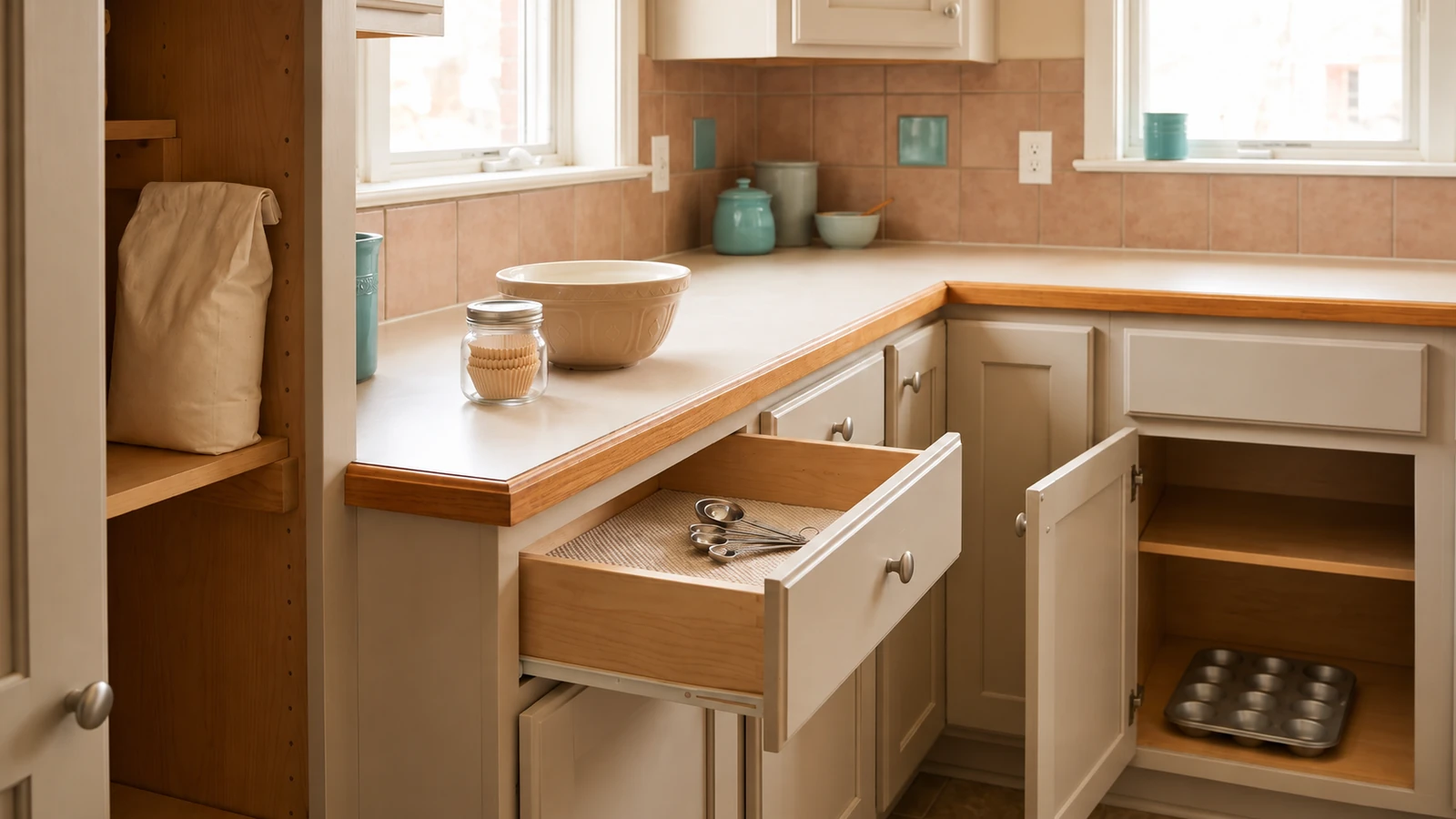
Baking Supplies in Different Cabinets? Use One Recipe to Decide What to Move
A bag of flour lives in the pantry, the mixing bowl is near the sink, and the baking sheets are in the lower cabinet. That arrangement might be perfectly practical. Baking supplies do not need to share one cabinet to make baking manageable.
The question is what happens when you use them. Do you pull out three things to reach a pan? Carry the same small tools back and forth between drawers? Or finish baking and leave a basket on the counter because putting everything away is harder than getting it out?
Before buying a baking organizer or moving every ingredient into a matching set, trace one recipe from the first item you gather to the last item you put away. The route—not the number of cabinets—will show you what is worth changing.
The quick answer: keep what works, change one awkward step
Keep supplies in their current locations if you can find, retrieve, use and return them without moving other items or blocking a household member’s regular routine. Having a few baking things in different cabinets is not automatically an organization failure.
If small baking-only items disappear into several drawers, try grouping those items in a container you already own. If a large pan is difficult to reach, a clear, stable home for that pan may help more than a portable basket. If flour, sugar or measuring tools serve everyday cooking as well as baking, think carefully before moving them to a baking-only station.
There is also a fourth choice: buy nothing. A storage product that adds a pull, lift or extra item to return is not an improvement merely because the shelf looks neater.
Start with one recipe you actually make
Choose a recipe you repeat—not an elaborate recipe you might try someday. You do not need to empty the pantry or redesign the kitchen. Look at the ingredient list and the equipment you normally use, then walk through the task in its usual order.
Ask yourself where each item begins. Do you take it straight from its cabinet, or move another item first? Does the package need to be carried to a small counter? Afterward, where does the washed pan, bowl or measuring cup return? Does the proposed storage place remain reachable when every item is back inside?
Look at the return trip as carefully as the first retrieval. The obstacle may not be finding a pan; it may be the stack you must lift to replace it after washing. Mark that obstacle on your route before choosing a container.
Here is a hypothetical muffin-baking route, not an observed or tested kitchen. The baker gathers flour from a shared pantry, measuring spoons from an everyday drawer, paper liners from another drawer and a muffin pan from underneath a stack. After baking, the same supplies must find their way home. A useful first decision is different for each item:
- Flour — KEEP in shared storage if it is already easy to reach and other meals use it.
- Measuring spoons — KEEP PENDING if other household members may use them for everyday cooking; check with them before moving the spoons.
- Paper liners — TEST GROUP with other genuinely baking-only small supplies in an existing shallow container, but only if it fits and returns easily.
- Muffin pan — TEST MOVE to a stable, accessible place only if the full pan can be retrieved and replaced without unsafe handling or an unsupported stack.
This is a proposed decision map, not a demonstrated improvement. The reader would still need to try the retrieval and return routes, then cross-check the shared-use items during another normal cooking task. If the change adds an obstacle, restore the old location.
Decide what to keep, group, move—or leave alone
Keep shared-use ingredients in a shared home
A convenient baking zone can become an inconvenient cooking zone when an ingredient serves more than one task. A family member may expect flour, oil, sugar or measuring cups in the same place they use them for other meals.
Before moving anything shared, check a second ordinary task and ask who else uses the item. If the new baking arrangement makes that task harder—or you cannot tell yet—leave the item where it is. A short gather list for your baking recipe may be enough. You can make one trip to collect what you need without permanently relocating the household’s supplies.
Group small baking-only pieces when they travel together
For small items used mainly for one kind of baking, a modest container can be useful when you can take out the whole group and return it in one easy action. Think of cookie cutters, specialty decorating tips or a few cupcake liners—not heavy pans, multiple large packages or everything that happens to be labeled “baking.”
Try an existing box or shallow container first. Check the loaded size, not just how neatly the empty container fits. Can you grasp it? Can you remove one item without scattering the rest? Will you actually return the pieces to it after washing or using them?
If the container needs to be moved every time you want one everyday item, or it blocks access behind it, keep those frequently used items separate. A group is useful only when the group behaves as one practical storage job.
Move an awkward pan to a stable, directly accessible home
Bulky bakeware has a different problem from small packets. A pan can be hard to reach because it is under a pile, behind an appliance or trapped by the way a cabinet opens. Putting it in a portable baking kit usually does not solve that.
First try a safe, stable location where the pan can be removed and returned without shifting a precarious stack. Keep cookware fully supported, allow for door and hinge clearance, and do not assume a new vertical rack or shelf can carry a load without checking its actual instructions and the supporting cabinet. Never force heavy items into an overhead position just to make the categories look consistent.
Skip the organizer when the handling is already easy
Perhaps your whisk is in a drawer, flour is in the pantry and cake pan is below the counter—but each has a clear home and comes out directly. In that case, the best system may be the one already there.
Before calling a shelf “disorganized,” name the specific repeated difficulty. If you cannot identify an awkward action that a change would improve, leave it alone. You can always revisit the decision after noticing an actual problem during normal use.
When a portable baking basket creates more work
A portable baking basket looks convenient, but it has two jobs: leave its shelf without colliding with other things, and return with the contents you actually used.
Imagine a container holding measuring tools, extracts and several packets. If the container must be pulled out to reach a single tool used for everyday cooking, that tool may be better left in its usual drawer. If the basket becomes too bulky to lift comfortably when loaded, or its handle strikes the shelf above, the container is not serving its intended job. If the basket stays on the counter for days because putting it away is awkward, the return route is the real problem.
A small baking-only kit is worth a trial only when its contents genuinely travel together, it fits with room for your hand, it can be handled safely when loaded, and it goes back as easily as it comes out. Test with an existing container before considering a new one.
Check the loaded fit, not just the empty space
An organizer may fit on a bare shelf but fail once it holds real supplies. Before changing a cabinet, look at the opening and everything that moves through it:
- Opening and door: Will a handle, hinge or door swing block the straight path?
- Grip and lift: Is there enough space to hold the item securely and move it without scraping or tipping?
- Support and weight: Is the proposed location stable and suitable for the actual load? Check any product or shelf maker’s instructions; do not infer capacity from appearance.
- Visibility and return: Can another person identify the contents and put them back without unloading the shelf?
- Food directions: Are packages identifiable, and are their specific storage conditions maintained? An organizational preference is not a reason to disregard food labels or move something requiring refrigeration into a cabinet.
For specific storage and freshness questions, follow the package’s directions and consult the USDA-developed FoodKeeper guide. For refrigeration and general handling, FoodSafety.gov’s four basic safety steps provide a useful reference. An organizational preference is not a reason to change a food’s required storage conditions; this article is not a substitute for food-safety, cabinet-load or installation instructions.
The one-recipe cabinet route: six prompts to use before you buy
You can copy these prompts into your phone’s notes app or write them on paper. Use a recipe you really make, with supplies in their current locations. If an ingredient or tool is shared, repeat the relevant part of this check with another regular meal or household member before moving it.
- Name the real recipe and task. Recipe/task: ______. Items I actually gather, use, clean and put back: ______. If I do not have a real repeated task in mind yet, I will observe one before reorganizing.
- Trace each item’s current route. Item: ______. Current home: ______. How I get it out: ______. How I put it back: ______. What gets lifted, shifted or blocked: ______. Repeat for items that actually cause trouble; the goal is to find the awkward action, not build an inventory of the whole kitchen.
- Check shared use. Who else needs this item, and for what other meal or task? ______. Where would they naturally look for it? ______. Would a baking-only location make their routine harder? ______. If I do not know, my decision is KEEP PENDING—not move it yet.
- Propose one reversible change. Choose KEEP the current home; TEST GROUP a small baking-only set using a container already available; TEST MOVE a bulky item to a stable accessible location; or SKIP an organizer. The old step I hope to eliminate: ______. A new pull, lift or return step this might add: ______.
- Apply the fit, handling and food-label stop check. Does the loaded item clear the opening, hinges and shelf above? ______. Can I grip and return it safely, with suitable support? ______. Are package identity and storage instructions still satisfied? ______. If any answer is uncertain or unsafe, STOP and check the relevant instructions before moving, buying or decanting anything.
- Try both directions, then decide. Without purchasing, try getting the item out and putting it back, including the second household task where relevant. What felt easier? ______. What got harder? ______. Decision: KEEP / TEST GROUP / TEST MOVE / SKIP OR DEFER. If the new arrangement adds work or cannot be checked safely, restore the original home.
These prompts are a reader-led decision exercise, not a measured experiment or proof that any particular organizer saves time. You are looking for an arrangement that works for your own normal task, with a return route you can maintain.
A small kitchen may need several storage homes
In a small kitchen, the same cabinet can serve cooking, baking and everyday dishes. Trying to reserve one full “baking cabinet” may displace supplies that everyone reaches for more often.
Instead of sorting the room into perfect categories, protect the most frequent shared jobs first. Keep ingredients where their required storage conditions are met, allow a clear path to everyday tools, and look for one smaller change that solves a repeated baking inconvenience. A removable container for genuinely occasional supplies may be more practical than a permanent cabinet makeover, but only if the loaded container is easy to retrieve and put away.
If the underlying problem is a shelf too deep to reach comfortably, use our guide to deep pantry shelves instead. If you lack a dedicated pantry or a workable place for groceries, see our guide to storage in kitchens without a pantry. Those are different layout jobs; neither is fixed by buying a matching set of baking bins.
What not to buy yet
Do not start with a matching set of containers, a rack that promises more capacity, or an extra cart just because baking supplies are spread out. First identify the movement or access problem and test a change with what you own.
Consider buying only after an existing-container trial shows a specific benefit, and you can check the new product’s actual loaded footprint, access clearance, support limits and storage directions. If the trial adds a lift or interferes with a shared household task, skip the purchase.
Frequently asked questions
Should all baking ingredients stay together?
Not necessarily. Ingredients used for several meals may make more sense in shared kitchen storage, and each food still needs its appropriate storage conditions. Put the repeated task ahead of the matching appearance.
Is a baking basket useful in a small kitchen?
Sometimes, especially for a small set of baking-only items that you routinely gather together. Test the loaded container with one real recipe and the full put-away step. If it blocks a cabinet or adds work for everyday tools, keep the items separate.
What should I do with pans that are difficult to reach?
First identify what blocks retrieval or return. Try a stable, directly accessible home that does not require an unsafe lift or unsupported stack. Do not assume vertical racks, extra shelves or pull-outs are suitable without checking the actual product and cabinet instructions.
Do I need to reorganize the whole kitchen?
No. Start with one ordinary baking task and one repeated frustrating action. A modest change that also works for the people who use the kitchen daily is a more useful first step than a full category makeover.
The goal is an easier round trip
An organized baking area is not defined by how many things share a cabinet. It is defined by whether you can find what you need, work comfortably, and put supplies back without creating another problem.
Choose one recipe. Watch the gathering and returning. Keep shared items where they still serve the household, group only what travels well together, and give awkward bakeware an accessible home when you can do so safely. If no change improves that route, buying nothing is a valid decision.