Bathroom Organization: Build a System Around What You Use Every Day
A bathroom can have plenty of baskets, shelves and organizers and still feel disorganized.
The problem is often not that you need one more container. It is that daily-use items, reserve stock, occasional supplies and cleaning tools are competing for the same easy-access space.
A better bathroom organization system starts by deciding what should stay in the room, what deserves the easiest access, what can move to reserve storage and which storage zones are actually usable.
Then, and only then, decide whether you need to buy anything.
On this page
- Decide what actually belongs in the bathroom
- Give the easiest space to daily-use items
- Move reserve and overflow out of prime space
- Map the bathroom into usable storage zones
- Protect cleaning, service and operating access
- Use existing storage before adding more
- Know when you have an exact-fit problem
- Buy organizers only after the job and zone are clear
- Build a simple refill and reset system
- Use the bathroom organization worksheet
- Common bathroom organization mistakes
- Make the final plan
Decide what actually belongs in the bathroom
Start with the contents, not the containers.
Take a quick inventory of what the bathroom is currently holding. Then sort those items by the job they perform in the room.
Use five groups:
- daily-use items;
- reserve or backup stock;
- occasional or guest items;
- cleaning and maintenance supplies;
- items that could reasonably live somewhere else.
This is the first important decision because not every bathroom-related item needs to occupy bathroom space.
If an item is used every morning and evening, it probably deserves easier access than an unopened backup that is needed once every few weeks.
If an item can live elsewhere without making the routine harder, moving it out may solve the storage problem without adding any organizer at all.
Do not force every category to stay in the room simply because it is associated with the bathroom.
The goal is not to maximize the number of things the bathroom can hold. The goal is to make the room easier to use.
Give the easiest space to daily-use items
Once you know what is staying, assign the easiest storage first.
Daily-use items deserve the least friction.
That may mean:
- the easiest vanity drawer;
- the most reachable shelf;
- one simple countertop tray;
- one shallow cabinet zone;
- one small bin that can be removed without moving anything else.
The exact location will vary by bathroom and household.
Do not use a universal reach-height rule. Use the real people who use the room.
Ask:
- Can the item be reached without moving another container first?
- Can it be put away quickly after use?
- Does the location keep the counter clearer without creating a harder retrieval problem?
- Does the storage still work when the drawer, shelf or bin is loaded?
A small daily-use zone is often more useful than trying to make every drawer equally convenient.
Reserve stock can tolerate a less convenient location.
Daily-use items usually cannot.
Move reserve and overflow out of prime space
Reserve stock often causes bathroom storage to feel smaller than it is.
Unopened toiletries, extra paper goods, duplicate products, guest supplies and extra towels can take over the easiest drawers and shelves even though they are not used every day.
Give reserve items a separate job.
That might be:
- a higher shelf;
- a secondary cabinet;
- a linen closet;
- a nearby hallway or bedroom storage zone;
- another appropriate overflow area.
The correct choice depends on the item and the home.
The important point is that reserve stock does not automatically deserve prime bathroom space.
If your bathroom does not have a linen closet and the reserve-storage problem affects the whole room, use the deeper guide to bathroom storage without a linen closet.
That article owns the no-linen-closet constraint. This page stays focused on the whole-room organization system.
Map the bathroom into usable storage zones
Now look at the room itself.
A bathroom may contain several possible storage zones, but not every zone is automatically useful.
Walk through the room and mark the places that could realistically hold something:
- vanity drawers;
- vanity cabinet;
- under-sink area;
- wall space;
- above-toilet area;
- linen closet if present;
- door or wall-mounted vertical storage;
- nearby overflow storage outside the room.
Then ask what each zone is actually good at.
For example:
A shallow vanity drawer may be excellent for small daily-use items but poor for tall bottles.
An under-sink cabinet may offer useful volume but lose space to plumbing, hinges or doors.
The wall above the toilet may look empty but still fail once the actual toilet, tank, storage opening and access needs are considered.
A linen closet can look large but waste vertical space if shelf gaps do not match the items being stored.
The useful question is not:
“How much empty space do I have?”
It is:
“What storage job can this exact zone do without making another part of the bathroom harder to use?”
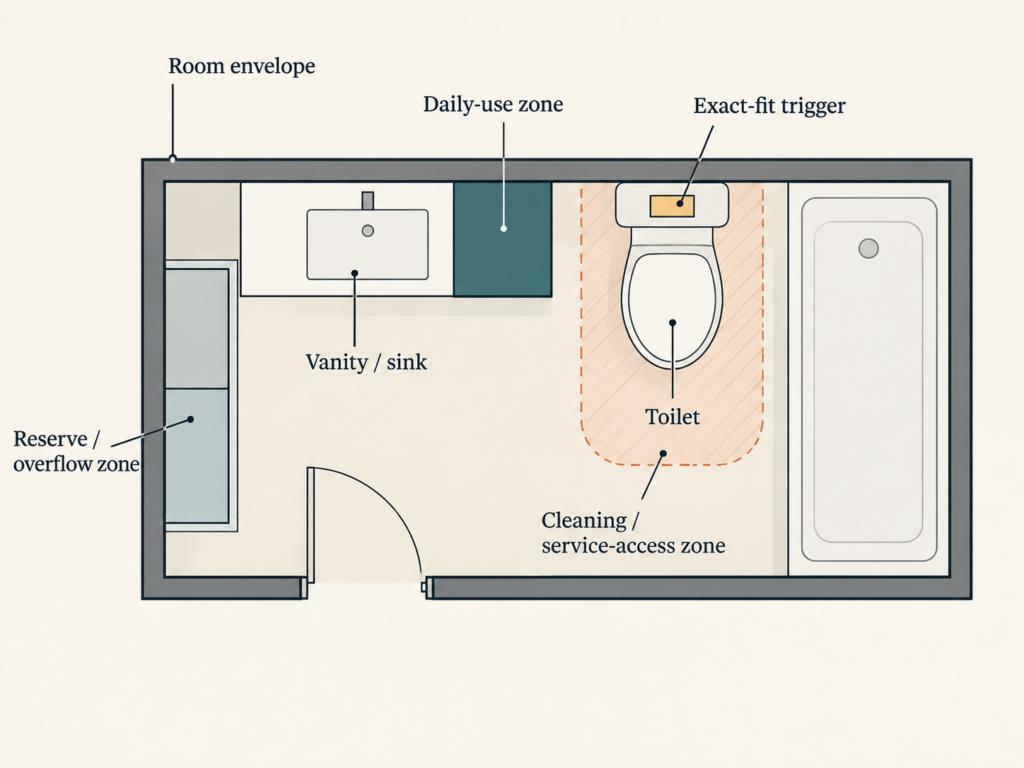
Protect cleaning, service and operating access
Storage should not solve one problem by creating three others.
Before you approve any zone or organizer, check how the bathroom operates.
Look at:
- drawer and cabinet-door movement;
- toilet and tank access;
- plumbing or service access;
- cleaning routes around fixtures;
- shower or tub entry;
- the path people use to turn, reach and move through the room.
Do not rely on a universal clearance number.
The test is whether the actual room still works normally.
A cabinet can technically fit beside or around a fixture and still make cleaning awkward.
A shelf can fit on a wall and still interfere with something that needs to open.
A floor-standing organizer can occupy an empty-looking corner and still create a narrow route that is annoying every day.
Treat access as part of the storage footprint.
If storage blocks ordinary use, it does not fully fit.
Use existing storage before adding more
Before you buy anything, try to improve the job assignment inside the storage you already have.
Ask:
- Is one drawer doing too many jobs?
- Are backups mixed with daily-use items?
- Are tall items using a space that would work better for short items?
- Are several half-empty baskets occupying more space than one consolidated zone?
- Is the counter holding things that already have usable storage elsewhere?
- Is an organizer taking up more space than the items inside it require?
Sometimes the fix is not another product.
It is:
- consolidation;
- relocation;
- removing duplicates;
- changing which category owns a drawer;
- moving reserve stock out of prime space;
- leaving a low-value storage zone open.
Do not “containerize” clutter automatically.
A container is useful only when it gives a defined category a better home.
Know when you have an exact-fit problem
Some bathroom organization problems are too specific to solve with broad advice.
That is when you should stop using generic organization logic and switch to exact-fit measurement.
Pedestal sink storage
A pedestal sink creates a specific geometry problem around the pedestal, plumbing, floor space and cleaning access.
Use the pedestal sink storage guide when that fixture is the real constraint.
Above-toilet storage
The wall above a toilet can look usable while the internal opening of a storage unit conflicts with the toilet, tank or service area.
Use the above-toilet storage fit check before buying a cabinet, etagere or shelf system for that zone.
Bathroom with no linen closet
If the entire room is carrying towels, paper goods, toiletries and backups because there is no linen closet, use bathroom storage without a linen closet to solve the whole reserve-storage constraint.
Toilet-paper placement
If the actual problem is where toilet paper should live so it is reachable without crowding the room, use the small-bathroom toilet-paper storage guide.
Linen closet shelf spacing
If a linen closet already exists but its shelf gaps waste height or do not fit what you store, use the linen closet shelf-spacing guide.
A broad bathroom organization article should not pretend that all of these are the same problem.
Route the narrow problem to the narrow solution.
Buy organizers only after the job and zone are clear
When you do need to buy something, start with the job.
Do not begin with:
“This basket is cute.”
Begin with:
“What exact storage problem is this solving?”
Before buying an organizer, answer:
- What items will live in it?
- How often are they used?
- Where will the organizer live?
- What width, depth or opening matters?
- Does a door, drawer, hinge, pipe or fixture affect the fit?
- What has to remain accessible?
- What happens when the organizer is full?
- Can the item still be retrieved normally?
- Does the organizer create another cleaning or maintenance problem?
If you cannot answer those questions, the product is not ready to buy.
A good organizer solves a defined storage job in a defined zone.
It does not simply create one more place to put things.
Build a simple refill and reset system
Bathroom organization fails when the system only works on the day you organize it.
Add one simple maintenance loop.
For each frequently used category, define:
- the daily-use location;
- the reserve location;
- the refill trigger;
- the reset action.
For example:
Daily-use toothpaste lives in the top drawer.
Unopened backup tubes live in reserve storage.
When the daily-use tube is nearly finished, bring one backup forward.
When the drawer starts holding extras again, move them back to reserve.
The same pattern can work for paper goods, toiletries and other repeat-use categories.
Keep the reset simple enough that the household can actually repeat it.
The goal is not a perfectly styled bathroom.
It is a room that returns to usable order without requiring a major reorganization every week.
Use the bathroom organization worksheet
Use this worksheet to make the room-level decisions visible.
| Storage job | Items | Use frequency | Current location | Best zone | Constraint / access issue | Existing storage usable? | Measurement needed? | Buy / move / keep / reject | Next action |
|---|---|---|---|---|---|---|---|---|---|
| Example: daily dental care | toothbrush, toothpaste, floss | daily | mixed with backups | easy vanity drawer | drawer depth / shared space | yes | no | KEEP + CONSOLIDATE | move backups out |
| Your storage job | — | — | — | — | — | — | — | — | — |
Use one row for each storage job, not one row for each individual product.
Useful decisions include:
- KEEP
- MOVE
- CONSOLIDATE
- MEASURE
- BUY
- REJECT
- ROUTE TO SPECIALIST GUIDE
If the storage job already has a good home, the correct answer may be KEEP.
If the current zone works but is badly assigned, the answer may be CONSOLIDATE.
If a product looks useful but the geometry is unresolved, the answer is MEASURE.
If the room does not need the storage job at all, the answer may be MOVE or REJECT.
Common bathroom organization mistakes
Buying bins before reducing inventory
An organizer cannot solve an inventory problem by itself.
If several half-used or duplicate items are competing for space, another bin may simply package the clutter more neatly.
Decide what is staying first.
Giving reserve stock prime space
Backups are useful.
They usually do not need the easiest drawer in the room.
Separate daily use from reserve stock.
Using every empty wall
An empty wall is not automatically a storage opportunity.
The zone still has to work with the room, fixtures, cleaning and access.
Ignoring cleaning and service access
A storage product that must be moved every time the area needs cleaning is creating recurring work.
Treat cleaning and service access as part of the decision.
Mixing daily-use and backup categories
When one drawer contains the item in use plus several unopened replacements, daily retrieval becomes harder.
Separate the two jobs.
Buying by outside dimensions only
Outside width and height do not prove functional fit.
Internal openings, doors, supports, plumbing, loading and operating space can matter just as much.
Use the narrow exact-fit guides when the room reaches that level of detail.
Skipping the refill rule
A well-organized drawer can fail again when reserve stock slowly migrates into it.
Define where the backup lives and when it moves forward.
Treating a narrow fit problem as a generic organization problem
If the real problem is a pedestal, toilet opening, shelf gap or missing linen closet, generic “bathroom organization ideas” are too broad.
Switch to the specialist guide.
Make the final plan
Finish with a short room-level decision.
For each storage job, choose one action.
KEEP when the current location already works.
MOVE when the item does not need prime bathroom space.
CONSOLIDATE when several containers or zones are doing one job badly.
MEASURE when the fit is still unresolved.
BUY when a real storage job and a real usable zone are both clear.
REJECT when the organizer creates more crowding, access or maintenance problems than it solves.
ROUTE TO SPECIALIST GUIDE when the problem is actually a pedestal-sink, above-toilet, no-linen-closet, toilet-paper or shelf-spacing problem.
Bathroom organization is not about fitting the maximum number of products into the room.
It is about giving each storage job the right amount of space, access and complexity.
Organize the jobs first.
Then organize the room.